Snow Day vs Two-Hour Delay vs E-Learning Day: What Each Means
A snow day cancels school, a two-hour delay starts it late, an early dismissal ends it early and an e-learning day moves it online. What each means, and why districts pick one.

A bad-weather morning ends one of four ways. The district closes for the day (a snow day), opens two hours late, sends students home early, or keeps school going online (an e-learning or remote day). Which one you get depends on when the storm hits, what the district’s buses can do, and whether your state lets a remote day count as a school day.
On a snow day there are no lessons, and the day often has to be made up later. On a delay the bus comes late, and in the rules we read the day still counts. An early dismissal brings children home at midday. An e-learning day means logging in from home, and most of the states we read that allow one set a cap.
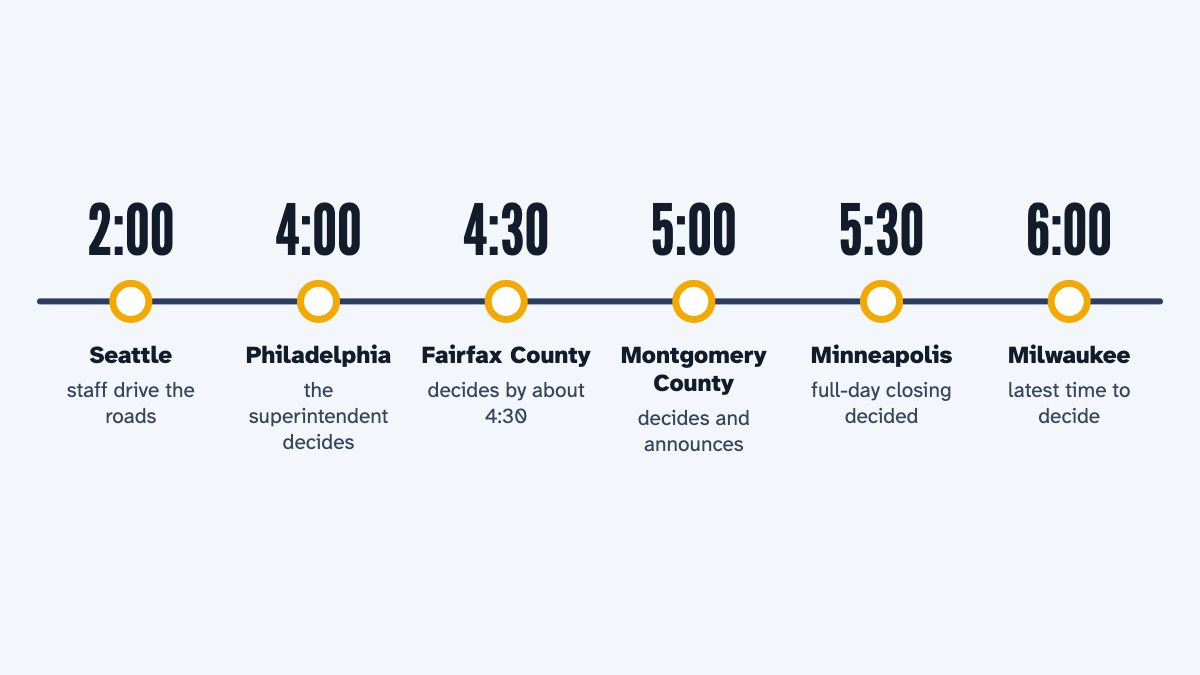
Only your district decides, and most of the deadlines districts publish fall between 4 and 6 AM (see how schools decide).
What is a snow day?
A snow day is a school day the district cancels because of snow, ice or cold, with no classes in the building or online. Jefferson County, Colorado, draws the line plainly: its weather page lists a snow day, with no instruction, as a separate choice from a remote learning day or a two-hour delay.
The lost day often comes back later, because every state sets a minimum school year (see below).
What happens on a two-hour delay?
On a two-hour delay, everything starts two hours later than usual, buses included. Fairfax County, Virginia, gives the example on its weather page: a bus that usually comes at 7:10 AM comes at 9:10 AM. In Seattle, late-start buses use stops on main roads that the city clears first (Seattle Public Schools).
Not every district offers one. Saint Paul, Minnesota, says delayed starts and early dismissals are “not logistically possible” (weather plan), so its choices are school, an e-learning day or a day off. Anoka-Hennepin, also in Minnesota, said in January 2026 that it has no late-start option (district notice), and Jefferson County uses its delay for extreme weather only.
A delay does not cost a day in the rules we read. Pennsylvania counts weather delays and early dismissals as instruction time (Department of Education), New York lets up to 2 lost hours a day count when the superintendent certifies them (8 NYCRR 175.5), and DC Public Schools says a delay is not a snow day and is not made up later (DCPS).
Why do schools send students home early?
Schools let out early when a storm is due during the school day and the buses need to beat it home. Montgomery County, Maryland, decides on an early release by 10:30 AM if weather is expected to affect the afternoon trip (closings page). Seattle decides by 11 AM (Seattle Public Schools), and Columbus, Ohio, can dismiss as early as noon, which also cancels after-school activities (Columbus City Schools).
Some districts avoid it: DC Public Schools dismisses early “only in extreme situations” (DCPS), and Saint Paul not at all. In Fulton County, Georgia, students go home on their regular bus when school closes mid-day unless other directions are on file (Fulton County Schools), so check what your school has for your child.
What is an e-learning day?
An e-learning day closes the school buildings but keeps school going online, so in states that allow it the day counts toward the school year. Districts also call it a remote, virtual or flexible instructional day. On January 25, 2026, New York City announced that its public school buildings would close the next day, with instruction continuing remotely, for about 500,000 students in more than 1,100 schools (NYC Public Schools).
School news
Districts use them differently. Pittsburgh keeps its first two weather closings as snow days, then switches to remote teaching days (Pittsburgh Public Schools). Minneapolis switches to e-learning only after 2 or 3 cancelled days, depending on grade (Minneapolis Public Schools), and Saint Paul keeps its first 2 weather cancellations as days off (weather plan). Chicago closed for cold on January 23, 2026, and said “There will be no remote learning” (Chicago Public Schools).
A remote day is still a school day, with rules. Minnesota requires each teacher to be reachable online and by phone during normal school hours (Minn. Stat. 120A.414). Michigan does not count paper packets as virtual instruction (Michigan Department of Education), while Illinois requires paper materials for students without a computer at home (105 ILCS 5/10-20.56).
Why does a district choose one over another?
Mostly timing. Snow that ends overnight can leave time to clear roads for a late start, and snow due by midday calls for an early dismissal. Ice before dawn is the hard case: Gwinnett County, Georgia, says it is more likely to cancel in the early morning than to let school out early, because of overnight road conditions (Gwinnett County Public Schools).
Staff have to travel too: Philadelphia chose a virtual day in February 2026, partly because its staff commute from counties across the region (district notice).
Then the cost of closing at all. Jefferson County weighs the schedules of 66,500 students’ families and 14,000 employees, and when it asks whether to close, “Most often, the answer is no” (Jeffco). And the calendar: New York City named the state’s 180-day rule as one reason it went remote. Nashville had used all its weather days by January 30, 2026, and said remote options were not workable then (Metro Nashville Public Schools).
Do snow days have to be made up?
Usually, once the spare days are gone. Every state sets a minimum school year in days, hours or both, and a lost day counts toward it only if the state forgives it. Many calendars carry a cushion: Illinois puts at least 5 emergency days in each calendar (ISBE), and from 2026–27 Texas requires 2 make-up days or the same minutes (TEA).
Some states forgive a set number. Michigan counts the first 6 weather days as if school were held, and up to 3 more with the State Superintendent’s approval (MCL 388.1701). Virginia makes up every lost day up to 5; past that, the first 5 plus 1 for every 2 more, by adding days or lengthening the school day (Va. Code 22.1-98). Your state’s rule is on its page, from the list of states.
Can an e-learning day replace a snow day in your state?
In many states, yes, up to a limit and with a plan approved ahead of time. Here is what the law or the state education department says in 14 states. Your district’s own plan decides how it uses what the state allows.
Remote days count, up to a limit
- Illinois: e-learning days may replace the calendar’s emergency days, up to 5 a year, under a program the regional office of education verifies each year (105 ILCS 5/10-20.56; ISBE).
- Kentucky: up to 10 Nontraditional Instruction days with a state-approved plan (KRS 158.070); a waiver for other lost days comes only after a district misses more than 20 (KDE attendance manual).
- Michigan, new for 2026–27: up to 3 virtual days under a board-approved plan, but only after the 6 forgiven days and 3 waiver days are used up (MCL 388.1621f).
- Minnesota: up to 5 e-learning days under a plan negotiated with the teachers’ union; families must hear at least 2 hours before the usual start (Minn. Stat. 120A.414).
- North Carolina: up to 5 remote days or 30 hours, with a plan filed by July 1, and 15 days or 90 hours in counties with a “good cause” waiver (G.S. 115C-84.3).
- Ohio: counts hours and has no calamity days (Ohio Department of Education and Workforce); a board plan with the teachers’ union’s written consent can make up as much as 3 days’ worth of lost hours online (ORC 3313.482).
- Oklahoma, from 2026–27: virtual days no longer count, except up to 2 days or 12 hours, and only with a state-approved plan, a board vote and a Governor’s emergency proclamation (70 O.S. 1-109).
- Pennsylvania: up to 5 Flexible Instructional Days, only for schools whose application the Department of Education accepted, and never put on the calendar in advance (PDE).
- Virginia: up to 10 unscheduled remote learning days, more only with a state extension (Va. Code 22.1-98).
Remote days count, and the rules we read set no cap
- Maryland: once a school system has used the snow days in its calendar, its board may vote in an open meeting to allow virtual education days instead of closing, each with at least 4 hours of live teaching (Education Article 7-103.2).
- New York: a district that would otherwise close may stay in session and teach remotely; it is optional, needs no prior approval and cannot be planned ahead (NYSED). Without it, the Commissioner may forgive up to 5 weather days that cannot be made up (Education Law 3604).
- Wisconsin: a closed day’s hours count only if virtual teaching is offered that day (PI 8.01), and the state leaves it to each district to judge how many such days it can run well (DPI).
A remote day does not replace a snow day
- Texas: remote instruction is generally not funded, so a snow day is made up, not replaced; a district may ask for a waiver for days missed beyond its 2 make-up days (TEA attendance handbook).
- Idaho: hours from a virtual day do not count toward attendance funding when buildings close for bad weather (Idaho State Department of Education); a board may instead take up to 11 hours of weather closures off its required hours (Idaho Code 33-512).
Which is likeliest at your school tomorrow?
The calculator gives three chances that add up to 100%: a snow day, a late start, or school as usual. It reads the National Weather Service forecast for your ZIP code and gives the most weight to snow that falls overnight and while buses run. It does not guess whether a closed day becomes an e-learning day, because that is district policy, not weather, and early dismissals get no chance of their own.
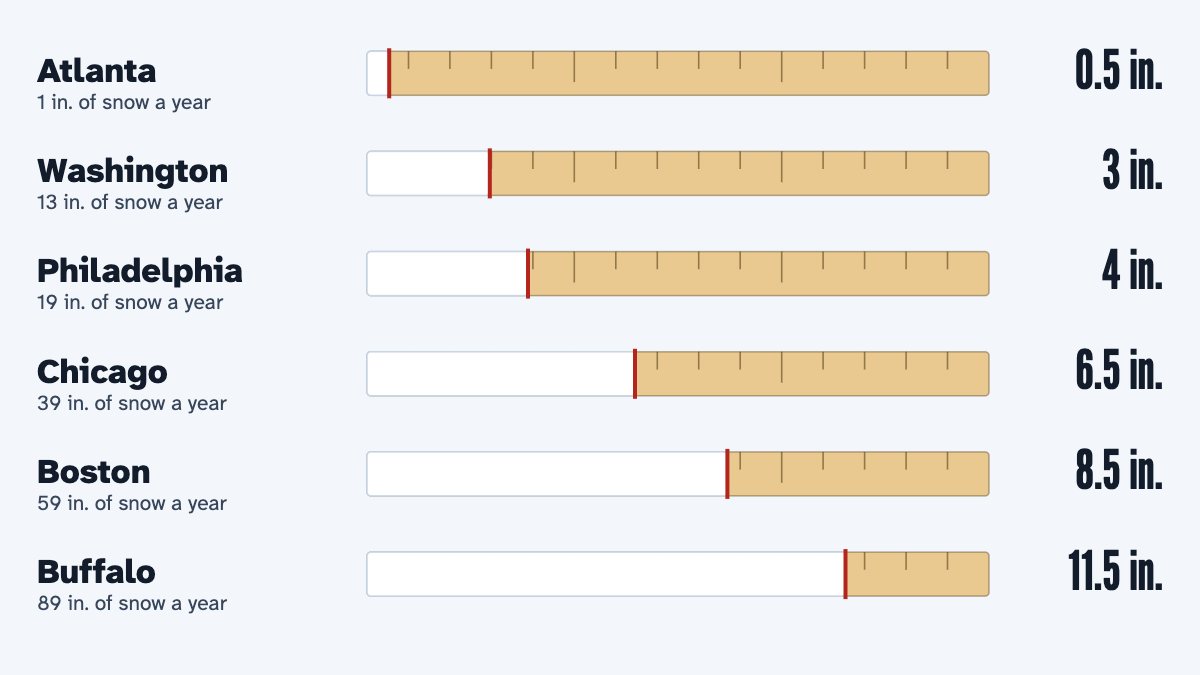
Try it: pick a city and move the slider. It opens on Philadelphia with 4 inches overnight, about the amount at which, by our rule of thumb, schools there close half the time.
How much snow would close school here?
Philadelphia, PA (about 19 in. of snow a year), with 4 in. overnight: snow day 52%, late start 43%, school as usual 5%. By our rule of thumb, schools there usually close at about 4 in.
Worked out with the calculator's own rules for a plain storm: the snow falls between 9 PM and 6 AM, it is 25°F with little wind, and no Weather Service warning is out. A real forecast also counts timing, ice, cold and alerts.
For your own forecast, type your ZIP code into the calculator; how it works lists every rule. Only your district decides, so check its website, app or local TV and radio before you set the alarm.
Four ways a snow morning goes
- Snow day
- buildings closed
- no lessons
- often made up later
- Two-hour delay
- buses 2 hours late
- the day still counts
- not offered everywhere
- Early dismissal
- storm due mid-day
- home on the usual bus
- after-school plans off
- E-learning day
- buildings closed
- lessons online
- capped in many states
- Who decides
- your district
- deadlines 4 to 6 AM
- check its site or app
Questions people ask
Are snow days going away because of e-learning?
Not in the state rules we read. Of the 14 states above, 9 cap remote days, from 2 a year in Oklahoma to 10 in Kentucky and Virginia (and 15 in North Carolina’s counties approved for good cause), and Texas generally does not fund remote instruction. Some districts keep real snow days on purpose: Saint Paul gives its first 2 weather cancellations as days off.
Do students have to log in on an e-learning day?
Usually, yes: a remote day is a school day, and the state rules we read require attendance. Pennsylvania requires attendance on Flexible Instructional Days and a backup plan for power or internet failures (PDE guidance). Kentucky expects every student to take part by video, phone, an online class system or paper work (KDE).
Is an e-learning day better for learning than a snow day?
The research we found is thin. A 2014 study of Massachusetts by economist Joshua Goodman found that snow closures did not lower test scores, while each absence caused by bad weather did; teachers seem to cope well when everyone misses the same day (NBER). A Maryland study by David Marcotte and Steven Hemelt points the other way: in years with about five unscheduled closings, nearly 3 percent fewer third graders passed state tests than in years with none (Education Finance and Policy). Idaho’s Department of Education doubts a virtual day matches a day in class (Idaho SDE).
Can I keep my child home when school stays open?
Yes, though your district sets the absence rules. Green Bay, Wisconsin, excuses the absence when a parent calls (Green Bay schools), and Fargo, North Dakota, says parents may keep children home (Fargo schools).
Sources: Jeffco Public Schools, weather and school closures; Saint Paul Public Schools, weather plan; DC Public Schools, inclement weather guidance.
Facts checked October 29, 2026.
More guides
-
-
-
-
-