Maryland Snow Day Calculator: Chances, Virtual Days and Make-Up Rules
By our rule of thumb, 3.5 to 5.5 inches of snow closes schools in Maryland's big cities half the time. Virtual days are allowed only after a calendar's snow days run out.

- Under 5%
- 5 to 24%
- 25 to 49%
- 50 to 74%
- 75% or more
The next school day in Maryland
Worked out from the National Weather Service forecast, 3:07 PM EDT, Thursday.
- Baltimore<1% snow dayFriday: no snow
- Frederick<1% snow dayFriday: no snow
- Gaithersburg<1% snow dayFriday: no snow
- Rockville<1% snow dayFriday: no snow
- Bowie<1% snow dayFriday: no snow
- Hagerstown<1% snow dayFriday: no snow
In Maryland’s big cities, 3.5 to 5.5 inches of snow is where schools close about half the time, by our rule of thumb. Bowie and Rockville sit at 3.5 inches, Baltimore at 4, Gaithersburg at 5, and Frederick and Hagerstown at 5.5.
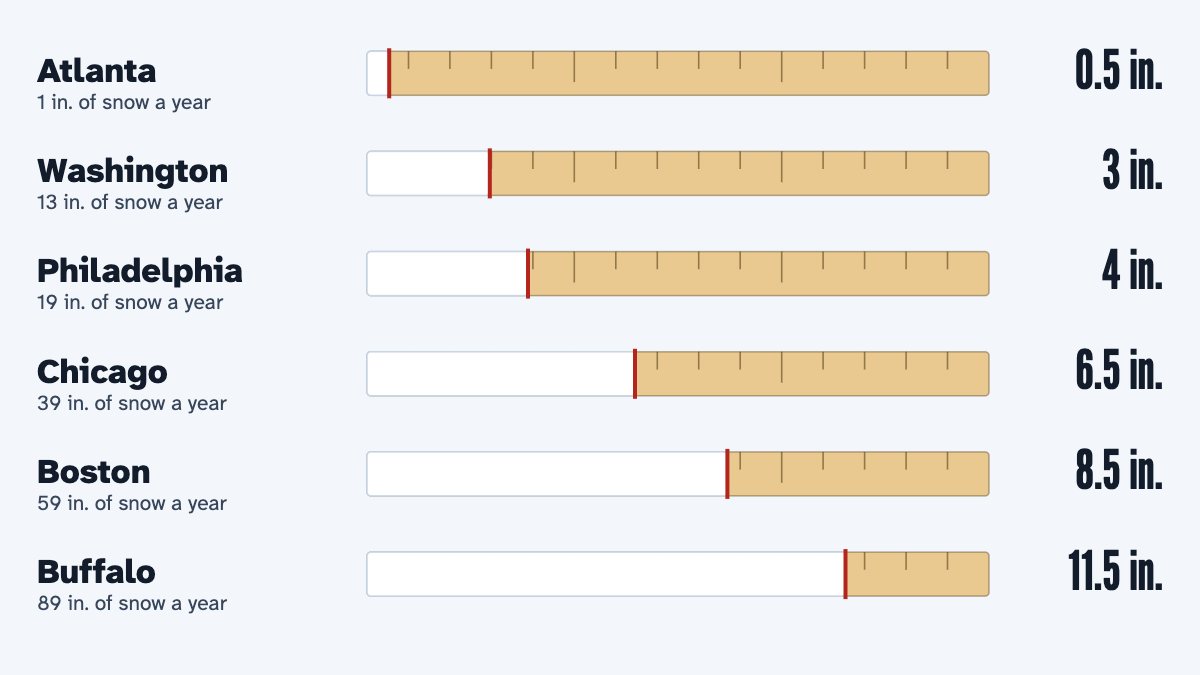
That is a wide spread, and it follows the snow. Hagerstown normally sees 31.4 inches a winter, nearly twice Bowie’s 15.9. Up at about 2,420 feet, the weather station at Oakland averages 104.9 inches.
Maryland measures the school year in 2 ways at once: 180 days and 1,080 hours. When the snow days built into a county’s calendar run out, the county may switch to virtual education days instead of closing.
How much snow closes school in Maryland?
Between 3.5 and 5.5 inches in the six cities on our map, by our rule of thumb. That is the amount at which schools close about half the time.
Maryland's six largest cities: normal snowfall a year (NOAA 1991–2020) and the snowfall and wind chill at which, by our rule of thumb, schools there usually close.
| City | Normal snowfall | Usually closes at | Cold point (wind chill) |
|---|---|---|---|
| Baltimore | 20.9 in. a year | 4 in. of snow | −16°F |
| Frederick | 31 in. a year | 5.5 in. of snow | −18°F |
| Gaithersburg | 25 in. a year | 5 in. of snow | −18°F |
| Rockville | 17.6 in. a year | 3.5 in. of snow | −17°F |
| Bowie | 15.9 in. a year | 3.5 in. of snow | −19°F |
| Hagerstown | 31.4 in. a year | 5.5 in. of snow | −20°F |
Our rule of thumb: the usual closing point is 0.5 × (normal snowfall a year)0.7, the cold point the normal December–February low minus 45°F. How the calculator works.
Hagerstown (31.4 inches a year) and Frederick (31) need the most, 5.5 inches. Bowie (15.9) and Rockville (17.6) need the least, 3.5, and Baltimore, with 20.9, sits at 4. Our rule grows more slowly than snowfall, so Hagerstown’s nearly double snowfall raises its closing point by only about half.
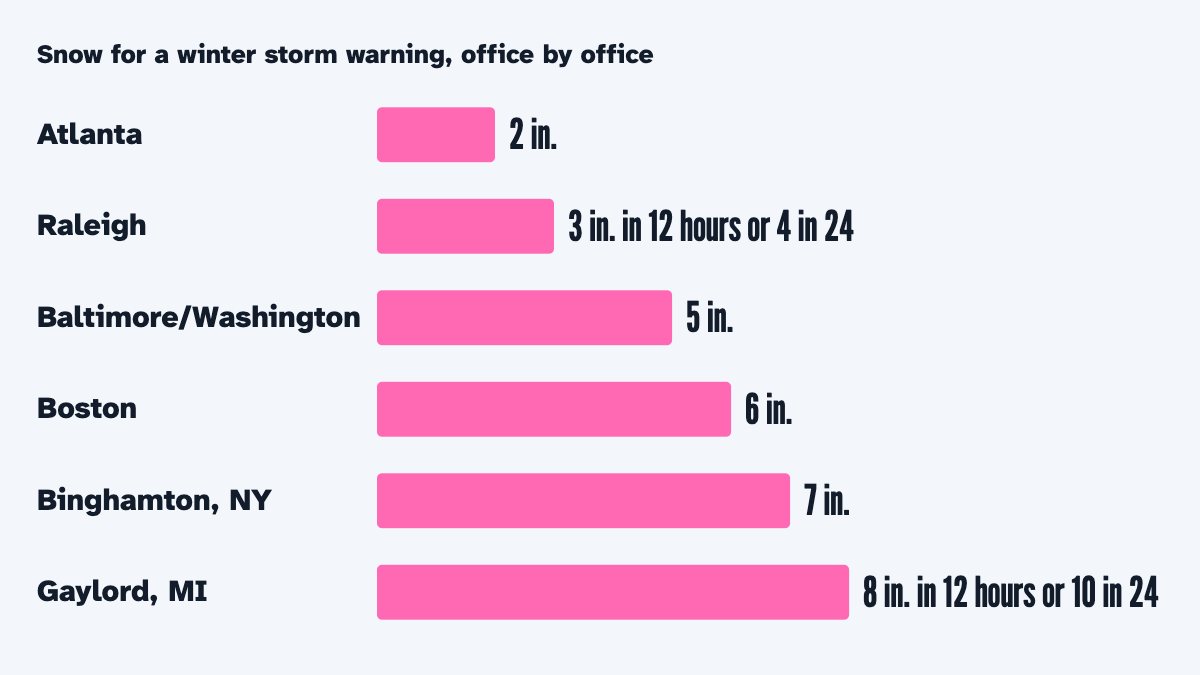
The National Weather Service office for Baltimore and Washington draws its own line: a Winter Storm Warning means 5 inches or more (6 in 6 western counties). Its page on snow threats says warnings for that much snow average lead time “approaching 24 hours,” and that about 1 in 3 does not pan out, often because less snow fell than warned.
That is why the calculator shows its reasons. A warning raises its chance more than a watch or an advisory, and snow that falls overnight or during bus hours counts in full. If tonight’s forecast drops by morning, so does the chance.
Do snow days have to be made up in Maryland?
Usually. Education Article § 7-103 asks for at least 180 school days and 1,080 hours in a 10-month year, and each school day must be open at least 3 hours.
The law bends for weather in 2 ways. When severe weather or a natural or civil disaster prevents normal attendance, the floor falls back to hours alone: at least 1,080 hours in 10 months. And a county board can apply in writing to the State Board of Education, showing “a demonstrated effort” to comply, to lengthen or shorten the year, move its dates, shorten days or open on holidays.
If the State Board approves and the year ends below 180 days, the statute says state and local funding may not be cut. Saturdays and Sundays can’t count toward the totals. The State Board can let schools open on holidays after severe weather or in an emergency.
The statute fixes no number of free snow days. Each county board sets its own start and end dates. We did not find the state education department’s own procedure or deadline for these applications. A new version of § 7-103 takes effect June 30, 2027, under Chapter 346 of 2025; its subsection on the length of the year reads the same.
Can Maryland schools switch to remote learning instead?
Yes, but only after the snow days are gone. Under § 7-103.2, a county board may “provide virtual education days to students instead of closing” during a severe weather event, once the school system has used all the days its calendar set aside for severe-weather closures.
The steps come in order:
- The county board discusses it at an open meeting and votes to authorize the superintendent.
- The plan goes on the school system’s website. It covers attendance, make-up work, devices and Wi-Fi for students and staff, and special-education services.
- On the day, the superintendent decides that weather will prevent normal attendance.
- The virtual day has at least 4 hours of live instruction, plus work students do on their own.
The teachers’ union may negotiate prep time and when live teaching starts, and staff not assigned that day get a chance to make up the work. The law we read sets no cap on how many virtual days a system may use. Our guide to snow days, delays and e-learning days compares the options.
Where does Maryland get the most snow?
Oakland has the highest normal of Maryland’s 21 NOAA weather stations by far: 104.9 inches a year. Frostburg, about 2,170 feet up, is next with 72.1, then Millers at 34.1 and Clarksburg at 32.6.
Normal snowfall a year and normal December to February low at each of the 21 weather stations in Maryland with a snowfall normal in NOAA's U.S. Climate Normals for 1991–2020, with each station's location, elevation and how complete its record is.
The 10 snowiest and 5 least snowy of 21 stations in Maryland
| Station | Normal snowfall | Dec–Feb low | Elevation |
|---|---|---|---|
| Oakland 1 Se | 104.9 in. | 21°F | 2,420 ft |
| Frostburg 2 | 72.1 in. | 21°F | 2,170 ft |
| Millers 4 Ne | 34.1 in. | 26°F | 860 ft |
| Clarksburg 2.1 Ne | 32.6 in. | — | 682 ft |
| Damascus 3 Ssw | 31.4 in. | 27°F | 700 ft |
| Cresaptown-bel Air 0.9 Sse | 30.8 in. | — | 755 ft |
| Cumberland 2 | 28.7 in. | 25°F | 730 ft |
| Columbia 2.3 N | 28.5 in. | — | 407 ft |
| Emmitsburg 2 Se | 27.5 in. | 24°F | 403 ft |
| Baltimore Wash International Airport | 19.3 in. | 27°F | 156 ft |
| … | |||
| Snow Hill 4 N | 10.2 in. | 32°F | 30 ft |
| Natl Arboretum Dc | 9.7 in. | 30°F | 50 ft |
| Salisbury Wicomico Regional Airport | 8 in. | 30°F | 48 ft |
| Dalecarlia Reservoir | 5.8 in. | 28°F | 150 ft |
| Assateague | 3.4 in. | 33°F | 10 ft |
Download “Normal snowfall at Maryland weather stations, 1991–2020” (CSV, opens in Excel)
Built from: U.S. Climate Normals, 1991–2020 (National Centers for Environmental Information).
By our rule of thumb, a place with Oakland’s snowfall would need about 13 inches to close, more than 3 times Baltimore’s 4. The middle station on the list gets 16.7 inches.
At the low end, Assateague, about 10 feet above sea level, normally sees 3.4 inches, Dalecarlia Reservoir 5.8 and the Salisbury airport 8.0. Only 4 of the 21 stations are what NOAA calls standard, with 24 or more years of records; 17 are provisional, with at least 10. The normals cover 1991 to 2020.
How cold does it have to be to close school in Maryland?
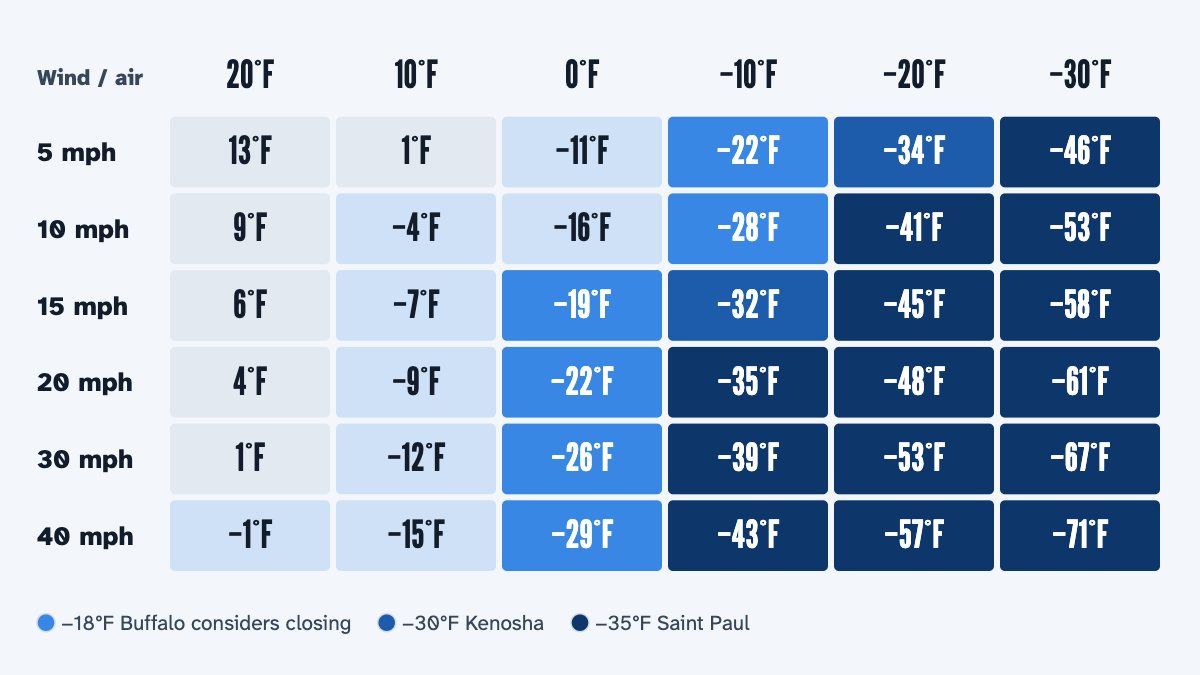
Neither Maryland’s law nor the district pages we read set a temperature, so the calculator uses our cold point: a wind chill of −16°F to −20°F in the map’s cities, by our rule of thumb. It is the normal December-to-February low minus 45°F. Districts elsewhere that do publish a number are in our guide to cold-weather closings.
Baltimore, with a normal winter low of 29°F, sits at −16°F. Hagerstown, at 25.2°F, sits at −20°F. The calculator checks the wind chill from 5 to 9 AM, around bus-stop time.
The Weather Service changed its cold alerts on or about October 1, 2024: the Extreme Cold Warning replaced the Wind Chill Warning, because cold “can be dangerous with or without wind,” as its announcement put it. A warning raises the calculator’s chance more than a Cold Weather Advisory does.
Who decides, and when do families hear?
Each county board of education, and the Baltimore City board, runs its own system. The county superintendent calls closures and virtual days; the State Board approves waivers.
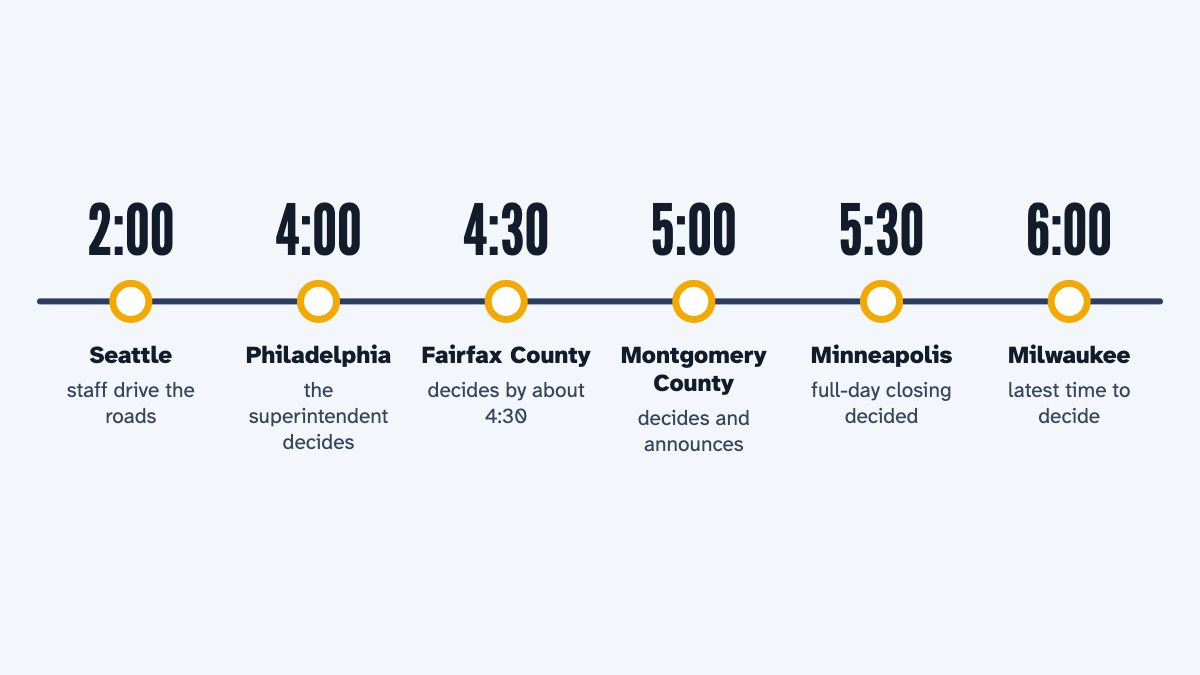
Montgomery County Public Schools publishes a clock. An evening decision is made and announced by 7 PM. If it waits, a Weather Service update comes by 4:30 AM and the morning decision by 5 AM.
An early release is called by 10:30 AM if weather threatens afternoon buses. Weather closings there always cover the entire school system.
Baltimore County Public Schools has more than 800 buses and 70,000 riders. Transportation staff patrol roads and bus stops “as early as 2:30 a.m.,” and a closing is announced by 5:30 AM. Sidewalks, bus loops and parking lots count even when main roads are clear, and a closing also closes the district’s Virtual Learning Program.
A study of Maryland’s districts by Call and Coleman, based on interviews in 2010–11, found that districts of every size decided in much the same way, almost entirely on the weather. Fridays were slightly more likely to close. Our guide to how schools decide snow days has more.
Snow days in Maryland
- Snow
- 3.5 inches in Bowie
- 4 in Baltimore
- 5.5 in Hagerstown
- Cold
- Our cold point −16°F to −20°F
- Extreme Cold Warning
- School year
- 180 days and 1,080 hours
- Hours only in severe weather
- Make-up
- State Board can adjust
- No weekends to reach totals
- Virtual days
- After calendar snow days
- Board vote first
- 4 hours live
- Who decides
- County superintendent
- Montgomery by 5 AM
- Baltimore County by 5:30 AM
Questions people ask
Do Maryland schools have virtual snow days?
They can, after the snow days in the calendar are used up. The county board must have voted to allow them, and each virtual day needs at least 4 hours of live instruction.
Do Maryland schools make up snow days on Saturdays?
Not to reach the 180 days and 1,080 hours. The law rules out Saturdays and Sundays for that. The State Board can let schools open on holidays after severe weather or in an emergency.
What time does Montgomery County announce school closings?
By 7 PM for an evening decision, or by 5 AM for a morning one. Early releases are called by 10:30 AM.
How many snow days are built into Maryland calendars?
The state law sets no number. Each county board builds its own calendar, so check yours. When its weather days run out, a virtual day becomes possible if the board has voted to allow them.
Sources: Education Article § 7-103 and § 7-103.2 (Maryland General Assembly); Montgomery County Public Schools, closings.
Facts checked October 29, 2026.
More guides
-
-
-
-

-
-