Pennsylvania Snow Day Calculator: Chances, Make-Up Days and FIDs
By our rule of thumb, about 4 inches closes Philadelphia schools and 13.5 Erie’s. Schools need 180 days or set hours, and may use up to five Flexible Instructional Days.

- Under 5%
- 5 to 24%
- 25 to 49%
- 50 to 74%
- 75% or more
The next school day in Pennsylvania
Worked out from the National Weather Service forecast, 3:07 PM EDT, Thursday.
- Philadelphia<1% snow dayFriday: no snow
- Pittsburgh<1% snow dayFriday: no snow
- Allentown<1% snow dayFriday: no snow
- Reading<1% snow dayFriday: no snow
- Erie<1% snow dayFriday: no snow
- Bethlehem<1% snow dayFriday: no snow
Pennsylvania’s snow comes in very different doses. Philadelphia averages about 19 inches a year, and by our rule of thumb its schools close about half the time once 4 inches falls overnight. Erie, on Lake Erie, averages about 108 inches and needs about 13.5. Pittsburgh, Allentown and Bethlehem sit in between at 6 inches, and Reading at 5.
Cold is more even. By our rule, schools start closing for cold at a morning wind chill near −22°F in five of the six cities on the state’s map, and about −16°F in Philadelphia. The calculator reads the National Weather Service forecast for the part of your ZIP code where most people live, hour by hour, so a lake band near Erie counts only where it actually falls.
What a closing costs depends on the calendar. Since the 2023–24 school year, Act 56 of 2023 lets a school meet either 180 days or a set number of hours, and a school with an approved program can turn up to five closings a year into Flexible Instructional Days.
How much snow closes school in Pennsylvania?
By our rule of thumb, about 4 inches overnight in Philadelphia, 5 in Reading, 6 in Allentown, Pittsburgh and Bethlehem, and 13.5 in Erie. Each is the snowfall at which schools there close about half the time, worked out from the city’s normal yearly snowfall.
Pennsylvania's six largest cities: normal snowfall a year (NOAA 1991–2020) and the snowfall and wind chill at which, by our rule of thumb, schools there usually close.
| City | Normal snowfall | Usually closes at | Cold point (wind chill) |
|---|---|---|---|
| Philadelphia | 18.7 in. a year | 4 in. of snow | −16°F |
| Pittsburgh | 34.7 in. a year | 6 in. of snow | −22°F |
| Allentown | 33.5 in. a year | 6 in. of snow | −22°F |
| Reading | 26.5 in. a year | 5 in. of snow | −22°F |
| Erie | 108.4 in. a year | 13.5 in. of snow | −22°F |
| Bethlehem | 34.2 in. a year | 6 in. of snow | −22°F |
Our rule of thumb: the usual closing point is 0.5 × (normal snowfall a year)0.7, the cold point the normal December–February low minus 45°F. How the calculator works.
Erie gets nearly six times Philadelphia’s snow, but its closing point is less than three and a half times higher: the rule grows with snowfall, but more slowly. If your district is known for closing early, or for almost never closing, tell the calculator and it moves the point.
How the snow falls matters as much as how much. Snow that comes down overnight or during the morning bus run counts in full; of what falls the afternoon and evening before, 80% counts. Snow that falls while the air is above freezing counts less, because it melts on the roads, and gusts of 25 mph or more while an inch or more falls make it count more.
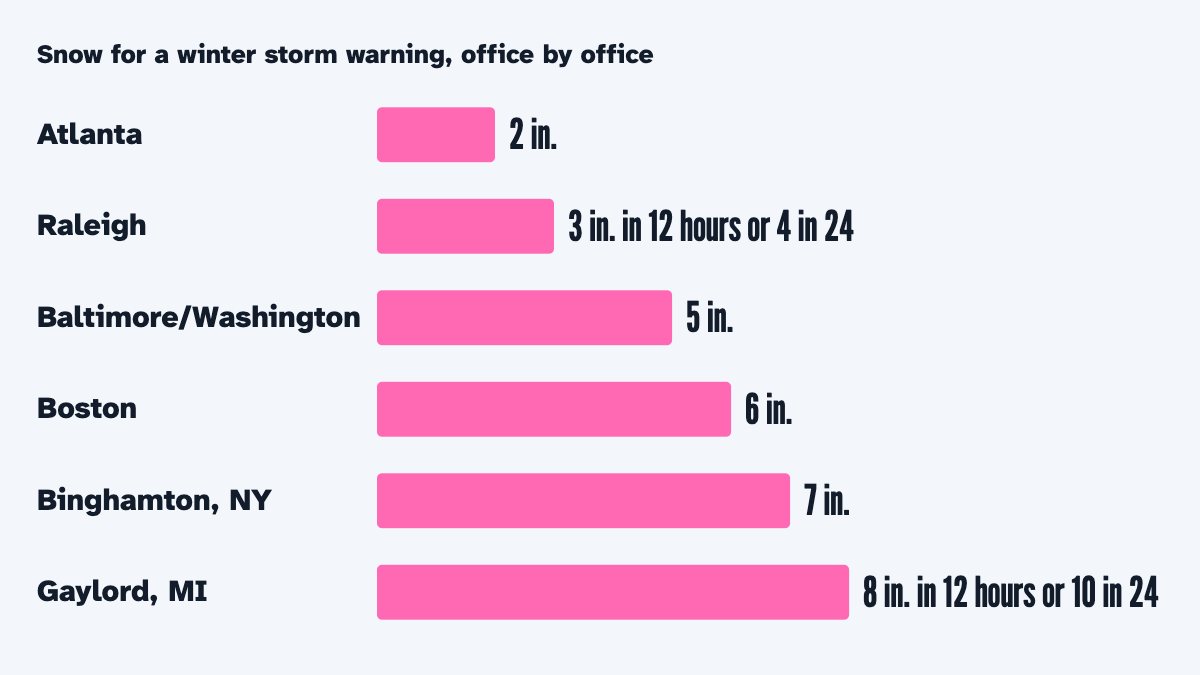
The Weather Service sets its own bar. Its Binghamton office, which covers northeastern Pennsylvania, issues a Winter Storm Warning there for 6 inches or more in one storm. A warning in force raises the calculator’s chance more than a watch or an advisory does.
Where does Pennsylvania get the most snow?
On the high ridges southeast of Pittsburgh and in the northwest corner, from Erie inland. NOAA has snowfall normals for 139 Pennsylvania stations, with a middle value of 35.8 inches a year. The snowiest, Laurel Summit, averages 142.2 inches at about 2,730 feet; next come Chandlers Valley (115.7), Union City (114.2), Springboro (111.0) and Erie’s airport (104.3).
Normal snowfall a year and normal December to February low at each of the 139 weather stations in Pennsylvania with a snowfall normal in NOAA's U.S. Climate Normals for 1991–2020, with each station's location, elevation and how complete its record is.
The 10 snowiest and 5 least snowy of 139 stations in Pennsylvania
| Station | Normal snowfall | Dec–Feb low | Elevation |
|---|---|---|---|
| Laurel Summit | 142.2 in. | 17°F | 2,730 ft |
| Chandlers Valley 1SE | 115.7 in. | 15°F | 1,490 ft |
| Union City Filtration Plant | 114.2 in. | 18°F | 1,400 ft |
| Springboro 3 Wnw | 111 in. | 19°F | 1,005 ft |
| Erie International Airport | 104.3 in. | 24°F | 730 ft |
| Buckstown 1 Se | 96.9 in. | — | 2,460 ft |
| Somerset | 96.2 in. | — | 2,100 ft |
| Kane 1NNE | 92.9 in. | 15°F | 1,750 ft |
| Titusville Wtr Wks | 89.4 in. | 17°F | 1,220 ft |
| Chalk Hill 2 Ene | 88.8 in. | 17°F | 1,980 ft |
| … | |||
| Phila Franklin Inst | 16.1 in. | 30°F | 60 ft |
| Graterford 1 E | 12.9 in. | 23°F | 279 ft |
| Charleroi Lock 4 | 10.3 in. | 24°F | 749 ft |
| Conshohocken | 7.6 in. | — | 70 ft |
| Bechtelsville 1ENE left out | 4.2 in. | — | 460 ft |
A station marked “left out” reports far less snow than the stations around it at a similar height, most likely because snowfalls went unmeasured, so the calculator does not use it. How the calculator works.
Download “Normal snowfall at Pennsylvania weather stations, 1991–2020” (CSV, opens in Excel)
Built from: U.S. Climate Normals, 1991–2020 (National Centers for Environmental Information).
Somerset (96.2 inches) and a station near Buckstown (96.9) both sit above 2,000 feet. At the other end, the Franklin Institute station in Philadelphia averages 16.1 inches, and a few stations in the southeast and along the Monongahela record less.
Do snow days have to be made up in Pennsylvania?
Not if the school still meets its minimum without the lost day. Section 133 of the Public School Code, added by Act 56, asks for 180 days or the hours: 900 at the elementary level and 990 at the secondary. The Department of Education sets 450 hours for half-time pre-kindergarten and kindergarten. Its guidance puts the rule plainly: a school that still meets the requirement “can simply declare the school closed and not have to make it up.”
There is no fixed number of forgiven days, and the department expects schools to build make-up days into their calendars. For state subsidy, an emergency closing of up to three days needs only a written request to the department; anything longer means amending the calendar or meeting the hours.
Two more rules soften the blow. The department’s instructional time circular lists a delayed opening or early dismissal for bad weather as instructional time. And under section 1501, no district has to move graduation or call graduated seniors back to make up days lost to severe weather.
Can Pennsylvania schools switch to remote learning instead?
Yes, on up to five Flexible Instructional Days a year, and only with an approved program. Section 1506 of the Public School Code, added in 2019, allows them for hazardous weather, a disease epidemic, a law enforcement emergency, buses that cannot run, and damaged or unsafe buildings.
The Department of Education sets the conditions. A school needs an application the department has accepted, approved by a vote of its board and good for three school years; the window for 2026–27 ran from April 1 to June 1, 2026. A Flexible Instructional Day cannot be put on the calendar ahead of time. Every student must be able to take part, attendance is taken, and the school needs a backup plan for power or internet failures. Lessons may be online, offline or both, and one building’s day counts as one of the five for the whole district.
A 2026 law adds some sunlight. Act 20 of 2026, signed on July 12, requires schools from 2026–27 to report each building’s Flexible Instructional Days and other whole-building remote days to the department, and to discuss their use at an open meeting before the calendar is final.
In a February 21, 2026 notice, Philadelphia announced a virtual day, citing slick roads and staff who travel in from other counties. Pittsburgh’s page says its first two weather closings are snow days and later ones become Remote Teaching and Learning Days. We found no Pennsylvania rule that lets a school hold ordinary remote days outside an approved program.
How cold does it have to be to close school in Pennsylvania?
The state sets no number, and the Philadelphia and Pittsburgh pages we read print none either. In Pittsburgh, the transportation director weighs the forecast, the roads and the energy available to heat the buildings, and the superintendent decides.
By our rule of thumb, schools start closing for cold at a morning wind chill of about −16°F in Philadelphia and −22°F in Pittsburgh, Allentown, Reading, Erie and Bethlehem: 45 degrees below each city’s normal December-to-February low. The calculator reads the forecast wind chill for bus-stop hours, 5 to 9 AM, and raises its chance when the Weather Service has an Extreme Cold Warning in force, its alert for extremely dangerous cold.
Who decides, and when do Pennsylvania families hear?
The superintendent decides. In Philadelphia the superintendent acts on a recommendation from the deputy superintendent of operations, and the district’s weather policy gives a clock to the quarter hour. For a call the day before: a decision by 5:00 PM and an announcement by 9:00 PM. For a call that morning: a decision by 4:00 AM and an announcement by 4:45 AM. Bus status follows by 6:30 AM.
Philadelphia’s team hears from the city’s emergency managers, the Weather Service, SEPTA and the Archdiocese’s schools, and sends staff to check whether roads are passable for buses, vans and cars. Pittsburgh Public Schools tries to announce by 10 p.m. when it can decide the night before, but says that in most cases the decision waits for the morning, with a goal of 5:30 a.m. If Pittsburgh makes no announcement, school is open.
Check your own district’s website, app or local TV and radio. The calculator gives odds from the forecast; only the district calls the day.
Is tomorrow a snow day in Pennsylvania?
That is your district’s call; the calculator puts odds on it from tomorrow’s forecast, and this map sums up what moves them here.
Snow days in Pennsylvania
- Snow that closes schools
- Philadelphia 4 in
- Pittsburgh 6 in
- Erie 13.5 in
- The school year
- 180 days or 900/990 hours
- no set number of forgiven days
- delays count
- Flexible Instructional Days
- Up to 5 a year
- approved program only
- never scheduled ahead
- Cold
- No state number
- our points −16°F to −22°F
- Who decides
- The superintendent
- Philadelphia by 4:45 AM
- Pittsburgh goal 5:30 a.m.
Questions people ask
How many snow days do Pennsylvania schools get?
The state sets no number. A school owes no make-up day as long as it still meets 180 days or the hours, so the spare room in its own calendar is its real count, and the Department of Education expects make-up days to be built in.
What is a Flexible Instructional Day?
It is a day of school taught away from the building, online, offline or both, in place of a closing for weather or another emergency. A school may hold up to five a year, and only if the Department of Education has accepted its program.
Does a two-hour delay count as a school day in Pennsylvania?
Yes. The Department of Education lists a delayed opening or early dismissal for bad weather as instructional time, so a delay does not have to be made up.
Do seniors have to make up snow days in Pennsylvania?
No. Under section 1501 of the Public School Code, no district has to change its graduation date or call graduated seniors back to make up days lost to severe weather. Younger students may still have days added to the calendar.
Sources: Act 56 of 2023 (Public School Code section 133); Pennsylvania Department of Education, Flexible Instructional Days; School District of Philadelphia, inclement weather policy.
Facts checked October 29, 2026.
More guides
-
-
-
-
-
-