Texas Snow Day Calculator: Ice, Snow and the New Make-Up Days
In most of Texas, half an inch of snow or a thin glaze of ice can close schools, by our rule of thumb. From 2026–27, district calendars must carry two make-up days.

- Under 5%
- 5 to 24%
- 25 to 49%
- 50 to 74%
- 75% or more
The next school day in Texas
Worked out from the National Weather Service forecast, 3:07 PM EDT, Thursday.
- Houston<1% snow dayFriday: no snow
- San Antonio<1% snow dayFriday: no snow
- Dallas<1% snow dayFriday: no snow
- Fort Worth<1% snow dayFriday: no snow
- Austin<1% snow dayFriday: no snow
- El Paso<1% snow dayFriday: no snow
Snow is rare in most of Texas. Houston’s normal snowfall is 0 inches a year, Austin’s and San Antonio’s 0.2, Dallas’s 1.4 and Fort Worth’s 1.5, by NOAA’s 1991–2020 normals. By our rule of thumb, half an inch of overnight snow is enough for schools in those cities to close about half the time, and about 1 inch in El Paso.
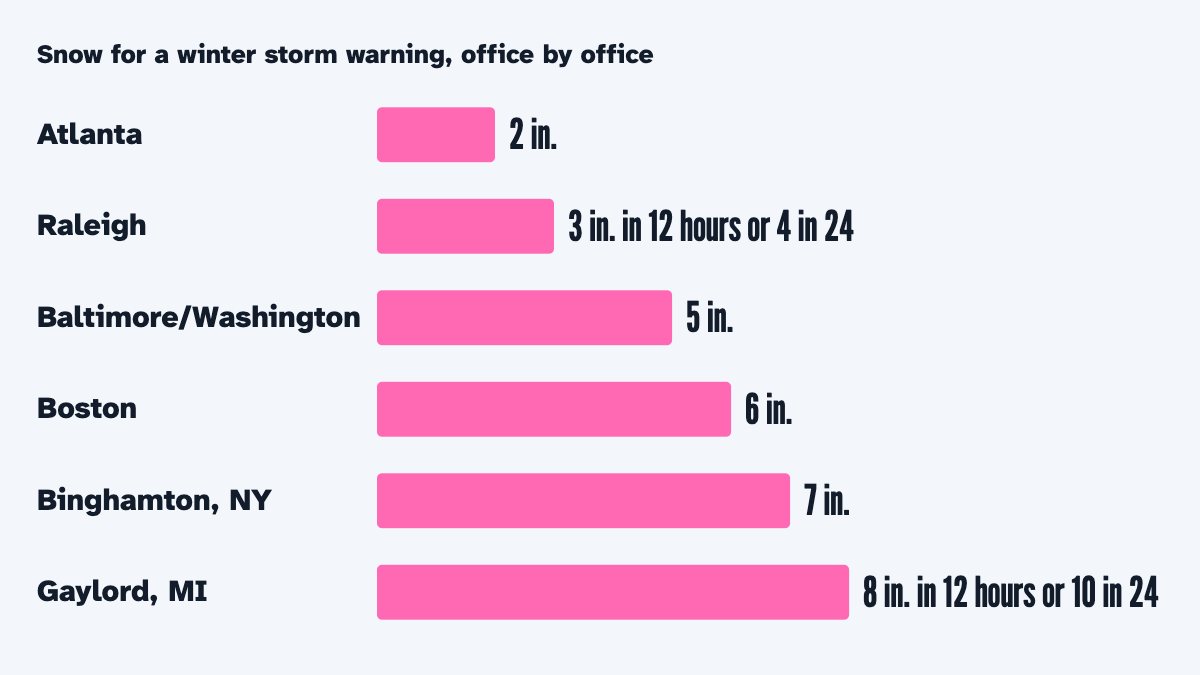
Ice counts on its own. The calculator treats about 0.08 inch of ice as enough to close schools where snow is rare, far less than the quarter inch at which the National Weather Service usually issues an Ice Storm Warning.
Texas counts its school year in minutes, 75,600 of them, under Texas Education Code §25.081. Starting in 2026–27, the Texas Education Agency’s attendance handbook says every district calendar must include two make-up days, or surplus minutes equal to two days.
How much snow closes school in Texas?
About half an inch in Houston, San Antonio, Dallas, Fort Worth and Austin, and about 1 inch in El Paso, by our rule of thumb. That is the overnight snow at which schools close about half the time.
Texas's six largest cities: normal snowfall a year (NOAA 1991–2020) and the snowfall and wind chill at which, by our rule of thumb, schools there usually close.
| City | Normal snowfall | Usually closes at | Cold point (wind chill) |
|---|---|---|---|
| Houston | 0 in. a year | 0.5 in. of snow | 0°F |
| San Antonio | 0.2 in. a year | 0.5 in. of snow | −2°F |
| Dallas | 1.4 in. a year | 0.5 in. of snow | −6°F |
| Fort Worth | 1.5 in. a year | 0.5 in. of snow | −7°F |
| Austin | 0.2 in. a year | 0.5 in. of snow | −4°F |
| El Paso | 2.4 in. a year | 1 in. of snow | −10°F |
Our rule of thumb: the usual closing point is 0.5 × (normal snowfall a year)0.7, the cold point the normal December–February low minus 45°F. How the calculator works.
Five of the six cities round to half an inch, since none averages more than 1.5 inches a year. El Paso, with 2.4 inches a year, is the exception, near 1 inch. Houston’s cold point sits at 0°F, the top of the rule’s range, because its normal winter low, 46.9°F, is so mild.
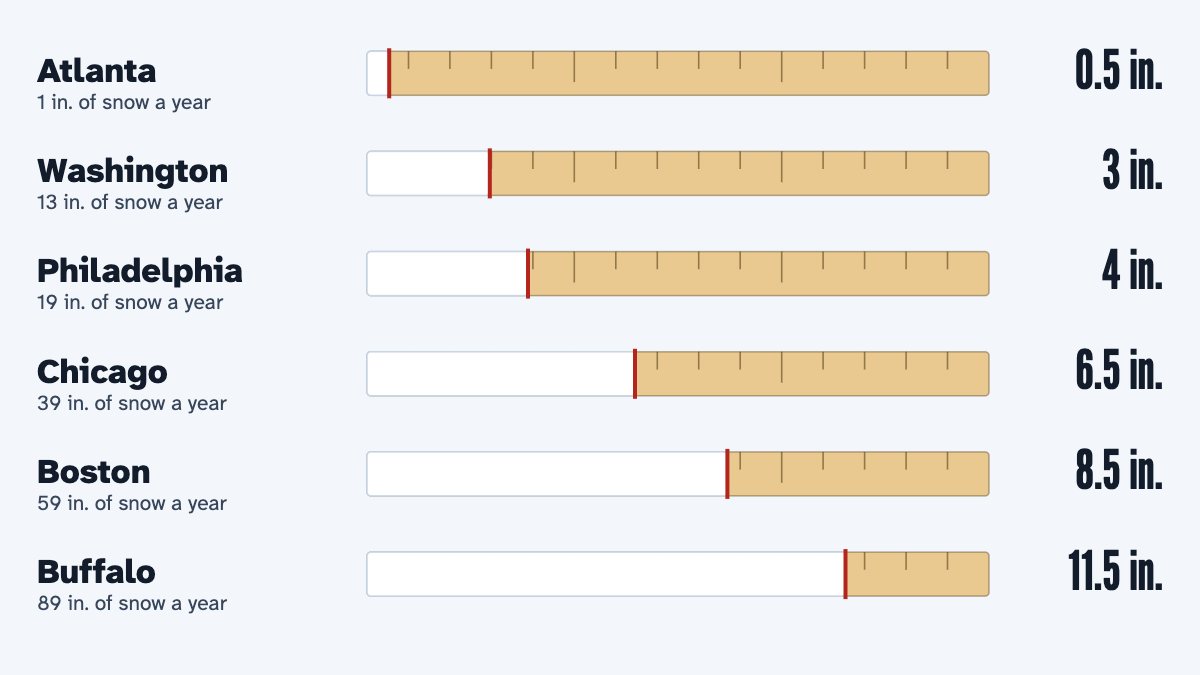
The yardsticks above show the same rule in snowier cities: the more snow a place normally gets, the more it takes to close its schools. The calculator counts snow fully when it falls overnight (9 PM to 6 AM) or while buses run (6 to 10 AM), and counts snow that falls while it is above freezing for less, since it tends to leave roads wet. More on how the calculator works.
Where does Texas get the most snow?
Up high: the snowiest stations all sit about 3,000 to 4,000 feet up. NOAA keeps snowfall normals for 505 Texas weather stations, and the Dalhart airport leads at 20.3 inches a year, followed by Stratford (17.4), Amarillo (17.2), Umbarger (15.9), Pampa (15.7) and Borger (15.0).
Normal snowfall a year and normal December to February low at each of the 505 weather stations in Texas with a snowfall normal in NOAA's U.S. Climate Normals for 1991–2020, with each station's location, elevation and how complete its record is.
The 10 snowiest and 5 least snowy of 505 stations in Texas
| Station | Normal snowfall | Dec–Feb low | Elevation |
|---|---|---|---|
| Dalhart Municipal Airport | 20.3 in. | 22°F | 3,990 ft |
| Stratford | 17.4 in. | 22°F | 3,603 ft |
| Amarillo | 17.2 in. | 26°F | 3,587 ft |
| Umbarger | 15.9 in. | — | 3,746 ft |
| Pampa #2 | 15.7 in. | 25°F | 3,150 ft |
| Borger | 15 in. | 28°F | 3,053 ft |
| Hartley | 14.5 in. | 22°F | 3,887 ft |
| Hereford | 14.3 in. | 24°F | 3,820 ft |
| Panhandle | 13.6 in. | 25°F | 3,463 ft |
| Perryton | 13.6 in. | 25°F | 2,942 ft |
| … | |||
| Waxahachie | 0 in. | 36°F | 626 ft |
| Welder Wildlife Foundation | 0 in. | 46°F | 50 ft |
| Wharton | 0 in. | — | 111 ft |
| Whitney Dam | 0 in. | 36°F | 574 ft |
| Brownsville | 0 in. | 55°F | 23 ft |
Download “Normal snowfall at Texas weather stations, 1991–2020” (CSV, opens in Excel)
Built from: U.S. Climate Normals, 1991–2020 (National Centers for Environmental Information).
Half the stations average 0.3 inches or less, and 125 average none, among them Brownsville, Wharton, Waxahachie, Whitney Dam and the Welder Wildlife Foundation station. So a Texas family’s chances depend heavily on where they live, and the calculator works from the forecast for your own ZIP code.
Do snow days have to be made up in Texas?
Yes, in minutes. Texas Education Code §25.081 requires at least 75,600 minutes a year, counting instruction, intermissions and recesses; by our arithmetic, that is 180 seven-hour days. The Commissioner of Education may approve fewer minutes when disaster, flood, extreme weather or another calamity closes schools, and if not, a district may add minutes to the end of its normal school day to make up the loss. One day is off limits: “A school district may not provide student instruction on Memorial Day.”
New for 2026–27: TEA’s Student Attendance Accounting Handbook says each adopted district calendar must include two designated make-up days, or surplus minutes equal to two days. A first closed day is absorbed by the surplus minutes or a make-up day, and a second uses the other. For days beyond the first two, a district may apply for a missed school day waiver through TEA’s online waiver system, as soon as possible after the day. TEA states the two-day rule; we did not find it in the statute.
There is also a low-attendance waiver. If school was open but attendance fell at least 10 percentage points below normal because of weather, health or safety, a district may ask TEA to leave the day out of its attendance funding math. TEA will not grant one for a make-up day.
Can Texas schools switch to remote learning instead?
Generally, no. TEA’s 2026–27 handbook says “remote or virtual instruction is generally not eligible for funding” and attendance credit, except in specific programs or by waiver. So a snow or ice day in Texas is made up with minutes or a make-up day, not replaced by a day of online classes.
How cold does it have to be to close school in Texas?
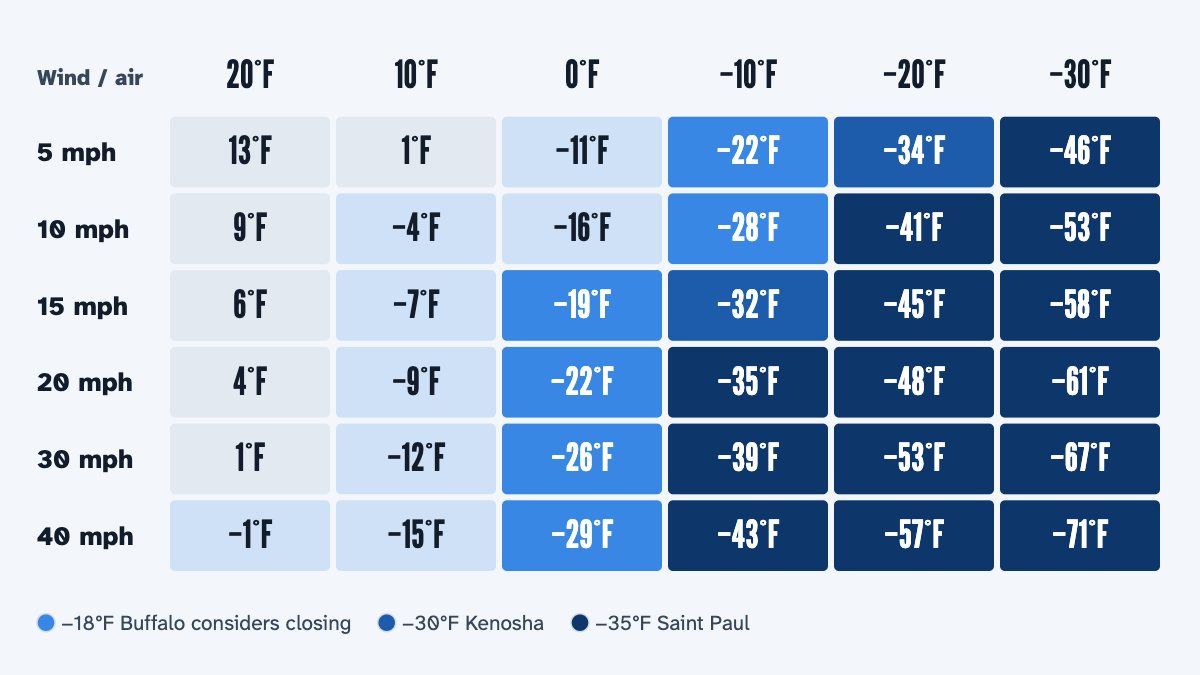
By our rule of thumb, a wind chill near 0°F at bus time in Houston, −2°F in San Antonio, −4°F in Austin, −6°F in Dallas, −7°F in Fort Worth and −10°F in El Paso, each city’s normal December–February low minus 45°F. We have no Texas district’s own cold number on file, though Dallas ISD’s policy looks at the energy available to heat its buildings (see below).
The Weather Service’s Amarillo office explains the 2024 change to cold alerts: since October 1, 2024, wind chill and freeze products have been consolidated nationwide, and they are now issued “based on the temperature or the wind chill,” with no wind threshold. The top alert is the Extreme Cold Warning, and the calculator adds to its chance when one is out.
Who decides, and when do Texas families hear?
The district superintendent. TEA’s handbook describes the superintendent delaying or cancelling the school day for health or safety, after which a campus may take attendance at another time.
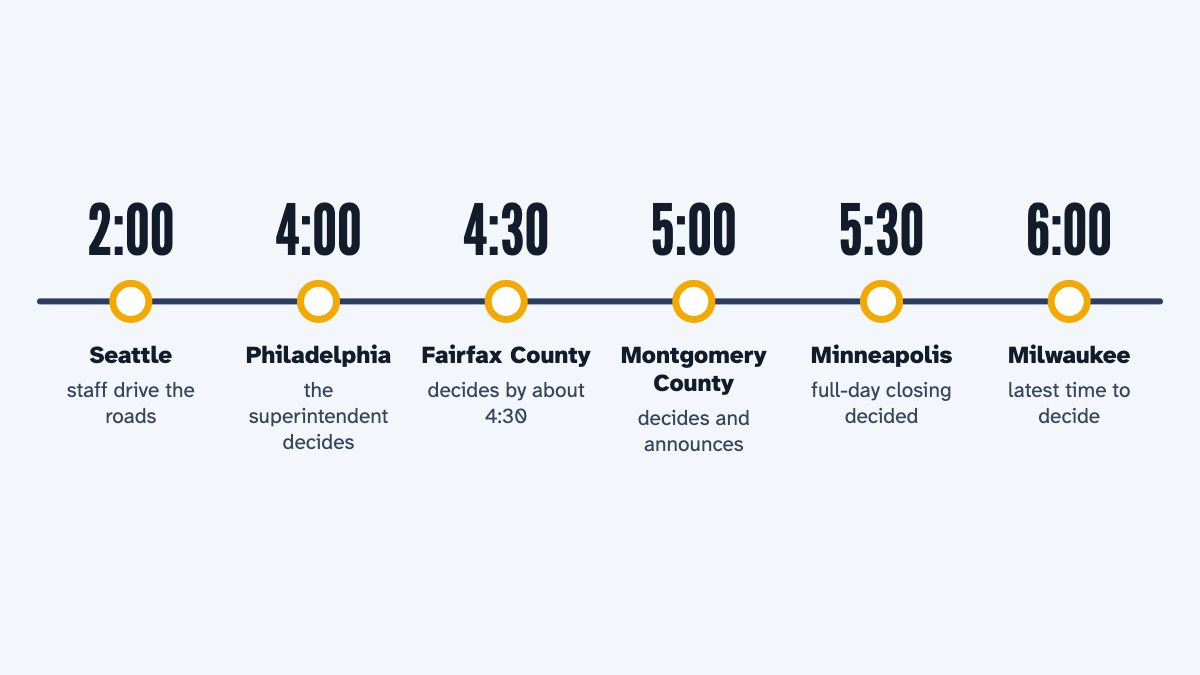
Dallas ISD’s inclement weather policy says the process “begins early in the morning” when staff drive the streets, and that staff talk with the weather bureau, police, and gas and utility companies about forecasts, roads and the energy available to heat buildings. A 2016 article on the district’s own news site said the decision comes no later than 6 a.m., and that classes are not held if buses cannot run safely, electric service is disrupted or natural gas is curtailed. The current policy page does not give the 6 a.m. time.
Check your district’s website, app or local TV and radio for the final word. The calculator is independent: not a school district, TEA or the National Weather Service. It reads the Weather Service forecast from 6 AM the day before to 3 PM on the school day, so its chance can change as a storm gets closer.
The page at a glance:
Snow days in Texas
- What closes schools
- half an inch of snow
- a thin glaze of ice
- El Paso about 1 inch
- Where it snows
- Dalhart 20 inches
- Amarillo 17 inches
- Houston 0 inches
- School year
- 75,600 minutes
- no class on Memorial Day
- Make-up
- 2 make-up days from 2026-27
- a waiver beyond 2 days
- remote days not funded
- Who decides
- the superintendent
- Dallas staff drive the streets early
Questions people ask
Do Texas schools have to make up snow days?
Yes. From 2026–27, calendars carry two make-up days or the same in surplus minutes, which cover the first two closed days. After that, a district can apply to TEA for a missed school day waiver; without one, it can add minutes to the end of its school days under §25.081.
How many bad weather days do Texas schools get?
Two built into the calendar, starting in 2026–27, under TEA’s handbook. Any more depend on a waiver from TEA.
Can Texas schools do virtual days for snow?
Not as a rule. Remote or virtual instruction generally earns no state funding or attendance credit, except in specific programs or by waiver, so a closed day is made up.
Can Texas schools use Memorial Day as a snow make-up day?
No. Texas law says a district may not provide student instruction on Memorial Day.
Sources: Texas Education Code, chapter 25; Texas Education Agency, Student Attendance Accounting Handbook 2026–27; Dallas ISD, inclement weather policy.
Facts checked October 29, 2026.
More guides
-
-
-
-

-
-