Idaho Snow Day Calculator: Chances, Snow Hours and Virtual Days
By our rule of thumb, about 4.5 inches closes Boise schools about half the time, 7 in Idaho Falls. Boards can take off 11 weather hours; a virtual day can't replace a snow day for attendance funding.

- Under 5%
- 5 to 24%
- 25 to 49%
- 50 to 74%
- 75% or more
The next school day in Idaho
Worked out from the National Weather Service forecast, 3:07 PM EDT, Thursday.
- Boise<1% snow dayFriday: no snow
- Meridian<1% snow dayFriday: no snow
- Nampa<1% snow dayFriday: no snow
- Caldwell<1% snow dayFriday: no snow
- Idaho Falls<1% snow dayFriday: no snow
- Pocatello<1% snow dayFriday: no snow
Idaho’s snow depends on the city. Boise’s normal is 21.7 inches a year and Nampa’s 13.1, while Idaho Falls gets 43.8 and Pocatello 40.5, by NOAA’s 1991–2020 normals. By our rule of thumb, about 4.5 inches of overnight snow gives Boise schools an even chance of closing, 3 inches in Nampa, 6.5 in Pocatello and 7 in Idaho Falls.
The state counts school in hours, and it is clear about virtual days. Idaho Code 33-512 lets a school board take up to 11 hours off the yearly minimum for closings caused by bad weather, and the State Department of Education’s August 2026 guidance says a virtual day does not count for attendance funding when buildings close for snow.
How much snow closes school in Idaho?
About 2.5 to 7 inches, depending on the city, by our rule of thumb. That is the overnight snow at which schools close about half the time, worked out from each city’s normal snowfall.
Idaho's six largest cities: normal snowfall a year (NOAA 1991–2020) and the snowfall and wind chill at which, by our rule of thumb, schools there usually close.
| City | Normal snowfall | Usually closes at | Cold point (wind chill) |
|---|---|---|---|
| Boise | 21.7 in. a year | 4.5 in. of snow | −19°F |
| Meridian | 18.4 in. a year | 4 in. of snow | −20°F |
| Nampa | 13.1 in. a year | 3 in. of snow | −20°F |
| Caldwell | 10.5 in. a year | 2.5 in. of snow | −20°F |
| Idaho Falls | 43.8 in. a year | 7 in. of snow | −29°F |
| Pocatello | 40.5 in. a year | 6.5 in. of snow | −26°F |
Our rule of thumb: the usual closing point is 0.5 × (normal snowfall a year)0.7, the cold point the normal December–February low minus 45°F. How the calculator works.
Caldwell (10.5 inches a year) sits near 2.5 inches, Nampa (13.1) near 3, Meridian (18.4) near 4 and Boise (21.7) near 4.5. Pocatello (40.5) is near 6.5 and Idaho Falls (43.8) near 7. Idaho Falls also has the coldest normal winter low of the six, 16.4°F, which puts its cold point at −29°F.
Timing matters as much as depth. The calculator counts snow fully when it falls overnight (9 PM to 6 AM) or while buses run (6 to 10 AM), at 80% in the afternoon and evening before, and at 45% during the school day. Gusts of 25 mph or more while an inch or more falls make it count more, and snow that falls while it is above freezing counts less. More on how the calculator works.
If your district closes more or less easily than the city near you, tell the calculator: that setting moves the closing point.
Where does Idaho get the most snow?
In the mountains. McCall, about 5,030 feet up, averages 132.2 inches a year, the most of NOAA’s 63 Idaho weather stations. Elk City (119.2), Headquarters (118.7), the Arbaugh Ranch station at Centerville (116.7) and Pierce (113.6) follow, and Ketchum, about 5,890 feet up, averages 102.0.
Normal snowfall a year and normal December to February low at each of the 63 weather stations in Idaho with a snowfall normal in NOAA's U.S. Climate Normals for 1991–2020, with each station's location, elevation and how complete its record is.
The 10 snowiest and 5 least snowy of 63 stations in Idaho
| Station | Normal snowfall | Dec–Feb low | Elevation |
|---|---|---|---|
| Mccall | 132.2 in. | 14°F | 5,025 ft |
| Elk City 1NE | 119.2 in. | 15°F | 4,058 ft |
| Headquarters | 118.7 in. | 20°F | 3,200 ft |
| Centerville Arbaugh Rch | 116.7 in. | — | 4,440 ft |
| Pierce | 113.6 in. | 19°F | 3,080 ft |
| Ketchum Rs | 102 in. | 10°F | 5,890 ft |
| Bern | 90.6 in. | 8°F | 5,964 ft |
| Winchester | 86.5 in. | 23°F | 3,972 ft |
| Cascade 1 Nw | 86.3 in. | 16°F | 4,896 ft |
| Craters Of The Moon | 80.3 in. | 8°F | 5,914 ft |
| … | |||
| Kamiah | 11.3 in. | 28°F | 1,210 ft |
| Howe | 11.1 in. | 10°F | 4,820 ft |
| Nampa Sugar Factory | 9.7 in. | 24°F | 2,470 ft |
| Emmett 2 E | 7.4 in. | 25°F | 2,390 ft |
| Riggins | 7.1 in. | 25°F | 2,056 ft |
Download “Normal snowfall at Idaho weather stations, 1991–2020” (CSV, opens in Excel)
Built from: U.S. Climate Normals, 1991–2020 (National Centers for Environmental Information).
Half the stations average 40.7 inches or more, about what Pocatello gets. The least snowy are Riggins (7.1 inches), Emmett (7.4) and the Nampa Sugar Factory station (9.7). A family in McCall and one in Riggins follow the same hour rules in very different winters.
Do snow days have to be made up in Idaho?
Only if the hours fall short. Idaho’s statute sets no minimum number of student days; Idaho Code 33-512 sets yearly instructional hours instead: 990 for grades 9–12, 900 for grades 4–8, 810 for grades 1–3 and 450 for kindergarten, and 900 at any grade in alternative schools. Transportation, passing time, recess and lunch do not count.
With the local board’s approval, a district may take off up to “eleven (11) hours of emergency school closures due to adverse weather” and facility failures, plus up to 22 hours for staff development. The State Department of Education adds that a district already far enough above the minimum hours does not need to use the 11 hours at all.
Past that, the State Board of Education may waive the minimum hours for districtwide closings caused by natural occurrences that make conditions unsafe, but only if a county or state disaster declaration covers the district. The request must describe the district’s make-up efforts and the grades and hours affected. Grade 12 may be cut by up to 11 hours, a single building can get an exemption, and these reductions may not be combined in one school year.
Funding has its own rule. Under Idaho Code 33-1003A, attendance on a day closed for a storm, flood or heating failure counts as if school had been in session, if the board certifies the cause and length of the closing to the state. The version of 33-512 in force now runs until January 1, 2028; a 2026 amendment that takes effect then keeps the same weather text.
Can Idaho schools switch to remote learning instead?
Not for attendance funding. The State Department of Education’s virtual and hybrid attendance guidance (version 2, updated August 24, 2026) says hours from a virtual day do not count toward attendance funding when in-person learning is cancelled and buildings are closed for bad weather. The law that lets a district switch to virtual or hybrid instruction applies during a state of emergency, not on a snow day.
The department also gives its view on quality: a virtual day in place of a snow day is “unlikely to provide the same level of academic integrity and instruction” as in-person learning.
So in Idaho, a snow day stays a snow day. The 11 weather hours, not a day of online classes, are what absorb it.
How cold does it have to be to close school in Idaho?
By our rule of thumb, a wind chill near −19°F at bus time in Boise, −20°F in Meridian, Nampa and Caldwell, −26°F in Pocatello and −29°F in Idaho Falls. That is each city’s normal December–February low minus 45°F. We have no Idaho district’s own cold number on file.
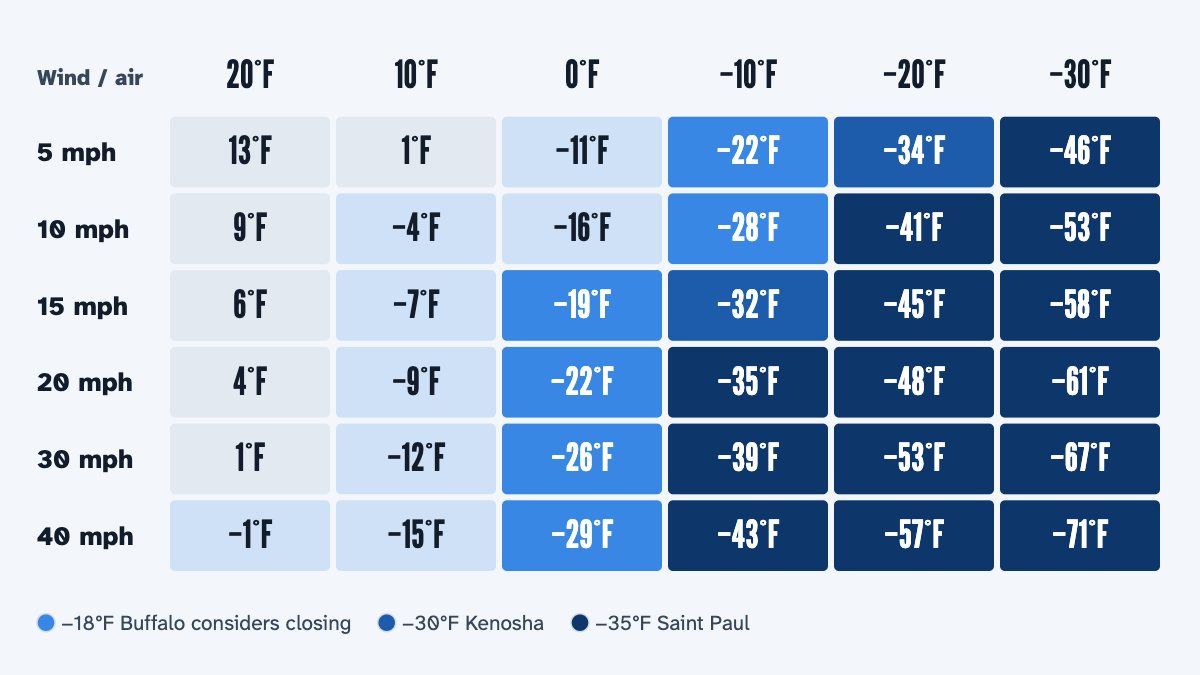
The calculator reads the wind chill from 5 to 9 AM and adds to its chance when the National Weather Service issues an Extreme Cold Warning, which replaced the Wind Chill Warning on or about October 1, 2024, or a Cold Weather Advisory. The Weather Service’s wind chill chart asks for extra caution with children, and notes that bright sunshine can raise the wind chill by 10°F to 18°F.
Who decides, and when do Idaho families hear?
Your district. Under Idaho Code 33-512, the local board of trustees fixes the days and hours when schools are in session, and it approves any use of the 11 weather hours.
We have not found an Idaho district’s announcement clock, so check your district’s website, app or local TV and radio for the final word. The calculator reads the Weather Service forecast from 6 AM the day before to 3 PM on the school day, so its chance can change as a storm gets closer.
It is independent: not a school district, the State Department of Education or the National Weather Service. It shows the reasons behind each chance so you can judge them.
The page at a glance:
Snow days in Idaho
- What closes schools
- 2.5 inches in Caldwell
- 4.5 inches in Boise
- 7 inches in Idaho Falls
- School hours
- 990 hours grades 9 to 12
- 900 hours grades 4 to 8
- 450 hours kindergarten
- Snow hours
- up to 11 hours off
- the board approves
- a waiver after a disaster declaration
- Virtual days
- no attendance funding on a snow day
- only in a state of emergency
- Where it snows
- McCall 132 inches
- Ketchum 102 inches
- Riggins 7 inches
Questions people ask
Do Idaho schools have to make up snow days?
Only if the year would fall below the minimum hours. With the board’s approval, the minimum can be reduced by up to 11 hours for weather closings under Idaho Code 33-512, and a district far enough above the minimum may not need even that.
Can Idaho schools use a virtual day instead of a snow day?
Not for attendance funding. The State Department of Education’s August 2026 guidance says hours from a virtual day do not count when buildings close for bad weather; switching to virtual instruction is for a state of emergency.
How many snow hours do Idaho schools get?
Up to 11 hours a year can come off the minimum for closings due to bad weather and facility failures, with local board approval. Beyond that, the State Board can grant a waiver only after a county or state disaster declaration.
How much snow does it take to close school in Boise?
About 4.5 inches overnight, by our rule of thumb: the amount at which Boise schools close about half the time. Timing, wind and ice can move it, and only the district decides.
Sources: Idaho Code 33-512; Idaho State Department of Education, virtual and hybrid attendance guidance (2026); Idaho Code 33-1003A.
Facts checked October 29, 2026.
More guides
-
-
-
-

-
-