Minnesota Snow Day Calculator: Cold Closings, Snow and E-Learning
Saint Paul may cancel school when 6 a.m. wind chills are forecast at −35°F or colder. By our rule of thumb, about 8 inches closes Twin Cities schools, and up to five e-learning days count as school.

- Under 5%
- 5 to 24%
- 25 to 49%
- 50 to 74%
- 75% or more
The next school day in Minnesota
Worked out from the National Weather Service forecast, 3:07 PM EDT, Thursday.
- Minneapolis<1% snow dayFriday: no snow
- St. Paul<1% snow dayFriday: no snow
- Rochester<1% snow dayFriday: no snow
- Bloomington<1% snow dayFriday: no snow
- Duluth<1% snow dayFriday: no snow
- Brooklyn Park<1% snow dayFriday: no snow
Cold is written into Minnesota’s closing rules. Saint Paul Public Schools may cancel in-person classes when wind chills are forecast at −35°F or colder at 6 a.m., and Anoka-Hennepin says a closing is likely when the Weather Service issues an Extreme Cold Warning. Our own cold points, the morning wind chills at which schools start closing for cold by our rule, run from −33°F in Bloomington to −38°F in Duluth.
Snow has its own line. The Twin Cities average about 49 to 52 inches a year, and by our rule of thumb schools there close about half the time once 7.5 to 8 inches falls overnight. Duluth, at about 81 inches, needs about 11.
A missed day is the school board’s to sort out. State law sets 165 days for grades 1 to 11 plus yearly hours, the state education department cannot waive them, and each board decides whether to make a day up. Up to five e-learning days a year count as school.
How much snow closes school in Minnesota?
By our rule of thumb, about 7.5 inches overnight in Saint Paul, 8 in Minneapolis, Bloomington, Brooklyn Park and Rochester, and 11 in Duluth. Each is the snowfall at which schools there close about half the time, worked out from the city’s normal yearly snowfall.
Minnesota's six largest cities: normal snowfall a year (NOAA 1991–2020) and the snowfall and wind chill at which, by our rule of thumb, schools there usually close.
| City | Normal snowfall | Usually closes at | Cold point (wind chill) |
|---|---|---|---|
| Minneapolis | 51.1 in. a year | 8 in. of snow | −34°F |
| St. Paul | 49.4 in. a year | 7.5 in. of snow | −34°F |
| Rochester | 50.7 in. a year | 8 in. of snow | −37°F |
| Bloomington | 51.4 in. a year | 8 in. of snow | −33°F |
| Duluth | 80.8 in. a year | 11 in. of snow | −38°F |
| Brooklyn Park | 51.9 in. a year | 8 in. of snow | −35°F |
Our rule of thumb: the usual closing point is 0.5 × (normal snowfall a year)0.7, the cold point the normal December–February low minus 45°F. How the calculator works.
Five of the six cities get almost the same snow, 49 to 52 inches a year, so the calculator gives them almost the same odds for the same storm. Duluth stands apart, with more snow and colder mornings. If your district rarely closes, or closes easily, tell the calculator and it moves the point.
Snow forecasts come with a range, and the Weather Service’s Twin Cities office shows it. Its experimental snowfall page calls the main forecast “the most likely outcome” and adds a high-end amount, with a 1 in 10 chance of more, and a low-end amount, with a 9 in 10 chance of more. The calculator reads the main forecast, hour by hour, for the part of your ZIP code where most people live; when the high end sits far above it, check again in the morning.
Timing matters too. Snow that falls overnight or while buses run counts in full, snow the morning before only about a third, and gusts of 25 mph or more while an inch or more falls make each inch count more. A Weather Service warning raises the chance more than a watch or an advisory does.
Where does Minnesota get the most snow?
Along the North Shore of Lake Superior and in the Arrowhead. NOAA has snowfall normals for 126 Minnesota stations, with a middle value of 46.8 inches a year, and the snowiest are Wolf Ridge (94.2 inches), a station northwest of Two Harbors (93.6), Duluth (90.2) and Babbitt (83.9). International Falls averages 73.
Normal snowfall a year and normal December to February low at each of the 126 weather stations in Minnesota with a snowfall normal in NOAA's U.S. Climate Normals for 1991–2020, with each station's location, elevation and how complete its record is.
The 10 snowiest and 5 least snowy of 126 stations in Minnesota
| Station | Normal snowfall | Dec–Feb low | Elevation |
|---|---|---|---|
| Wolf Ridge Elc | 94.2 in. | 4°F | 1,400 ft |
| Two Harbors 7NW | 93.6 in. | 4°F | 1,355 ft |
| Duluth | 90.2 in. | 6°F | 1,428 ft |
| Babbitt | 83.9 in. | −3°F | 1,481 ft |
| Ely 25E | 76.9 in. | −3°F | 1,444 ft |
| International Falls International Airport | 73 in. | −2°F | 1,183 ft |
| Cloquet | 71.3 in. | 5°F | 1,265 ft |
| Brimson 2S | 69.8 in. | 0°F | 1,486 ft |
| Tower 2S | 68.7 in. | −3°F | 1,430 ft |
| Gunflint Lake 10 Nw | 65.3 in. | −3°F | 1,455 ft |
| … | |||
| White Rock Dam | 35.9 in. | 5°F | 1,024 ft |
| Elk Rvr | 35.7 in. | 7°F | 880 ft |
| Lake City | 33.5 in. | — | 700 ft |
| Winnibigoshish Dam | 31.7 in. | — | 1,315 ft |
| Onamia Rs | 31.6 in. | — | 1,260 ft |
Download “Normal snowfall at Minnesota weather stations, 1991–2020” (CSV, opens in Excel)
Built from: U.S. Climate Normals, 1991–2020 (National Centers for Environmental Information).
The least snowy stations still get more than 30 inches a year: Onamia averages 31.6, the Winnibigoshish dam 31.7 and Lake City 33.5.
Do snow days have to be made up in Minnesota?
That is up to your school board. Section 120A.41 of Minnesota Statutes requires at least 165 days of instruction for grades 1 to 11, plus yearly hours: 425 for kindergarten, 850 for all-day kindergarten, 935 for grades 1 to 6 and 1,020 for grades 7 to 12.
The department cannot forgive a shortfall: the Department of Education’s guidance says the law “does not give MDE authority to waive the minimum hours or days requirements.” There is no direct financial penalty for falling short, though some students’ average daily membership may be affected. The local board decides whether to make up a cancelled day and, if it does, amends the calendar: by extending the year, turning days off into school days or lengthening the school day.
Minnesota tried a different answer once. For the hard winter of 2018–19, a one-time snow day law let boards count cancelled days as days of instruction. We found nothing like it in the law today.
Can Minnesota schools switch to e-learning instead?
Yes, for up to five days a year. Section 120A.414 says a district “may have up to five e-learning days in one school year,” each counted as a day of instruction. The board adopts the plan after negotiating with the teachers’ union, and it must reach students without internet or devices at home and students with disabilities.
Families must hear about the plan at the start of the school year, and on the day itself at least two hours before school normally starts. Teachers must be reachable online and by phone during normal school hours, and staff are paid in full. A student without access cannot be required to make up the work on another day, the department says, and e-learning days are not scheduled far in advance.
Districts add their own limits. Minneapolis Public Schools turns to e-learning only after two cancelled days for middle and high schools, or three for pre-K to grade 5. Saint Paul makes its first two weather cancellations plain days off; after that, the superintendent chooses between a day off and an e-learning day.
How cold does it have to be to close school in Minnesota?
In Saint Paul, a forecast wind chill of −35°F or colder at 6 a.m.: that is the line in the district’s weather plan, alongside snow that makes travel too difficult. Anoka-Hennepin says a closing is likely when the Weather Service issues an Extreme Cold Warning, cold enough to frostbite exposed skin in 10 minutes, but that an advisory alone is not enough. It closed all schools on January 23, 2026 because such a warning had been issued.
Minneapolis prints no number on its page today. By our rule of thumb, schools start closing for cold at a morning wind chill of about −33°F in Bloomington, −34°F in Minneapolis and Saint Paul, −35°F in Brooklyn Park, −37°F in Rochester and −38°F in Duluth: 45 degrees below each city’s normal December-to-February low. Saint Paul’s written −35°F sits right among them. The calculator reads the forecast wind chill for 5 to 9 AM, bus-stop time, and gives extra weight to an Extreme Cold Warning.
School sports use a different scale. The Minnesota State High School League guideline cancels or postpones activities at −20°F, or at a wind chill of −40°F. That rule is for games and practices, not for the school day.
Who decides, and when do Minnesota families hear?
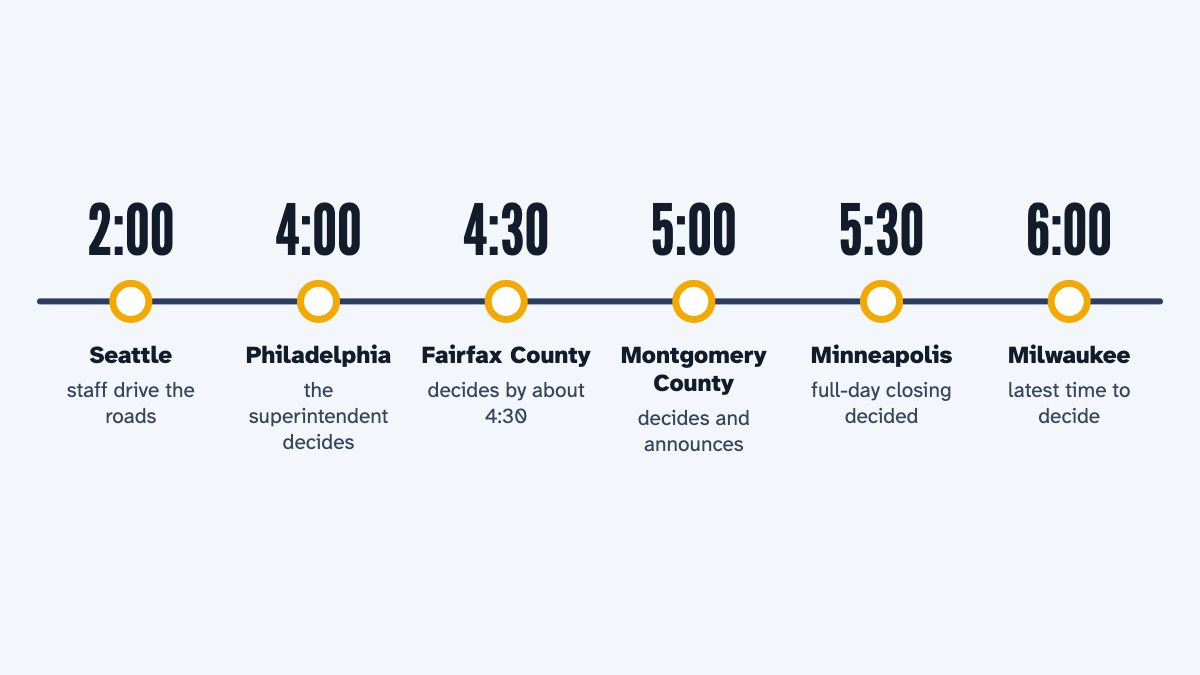
The school district decides. Minneapolis makes full-day closing decisions no later than 5:30 a.m., after a severe-weather team meets, talks with neighboring districts and has transportation staff check the roads. Anoka-Hennepin staff drive the roads between 4 and 5 a.m.
Don’t count on a late start in Saint Paul or Anoka-Hennepin. Saint Paul says delayed starts and early dismissals are “not logistically possible,” and Anoka-Hennepin says a late start is not an option there. If your school is in either district, read the calculator’s late-start share as a hard morning that ends in either a closing or a normal day.
Check your district’s website, app or local TV and radio. The calculator gives odds; the district makes the call.
Will Minnesota schools close tomorrow?
Your district decides, and the calculator puts odds on it from tomorrow’s forecast. In Minnesota, check the wind chill as closely as the snow.
Snow days in Minnesota
- Snow that closes schools
- Twin Cities 7.5 to 8 in
- Rochester 8 in
- Duluth 11 in
- Cold
- Saint Paul −35°F at 6 a.m.
- Anoka-Hennepin: Extreme Cold Warning
- our points −33°F to −38°F
- The school year
- 165 days plus hours
- no state waiver
- the board decides make-up
- E-learning
- Up to 5 days
- plan negotiated with teachers
- notice 2 hours before school
- Who decides
- The district
- Minneapolis by 5:30 a.m.
- no late starts in Saint Paul
Questions people ask
How cold does it have to be to cancel school in Minnesota?
There is no state number. Saint Paul may cancel school when wind chills are forecast at −35°F or colder at 6 a.m. Anoka-Hennepin says a closing is likely when the Weather Service issues an Extreme Cold Warning, and other districts set their own lines.
How much snow for a snow day in Minnesota?
By our rule of thumb, 7.5 to 8 inches overnight in the Twin Cities and about 11 in Duluth gives schools about even odds of closing. Minneapolis, for one, also weighs timing and whether buses and cars can travel safely.
How many e-learning days can Minnesota schools use?
Up to five a year, under a plan negotiated with the teachers’ union, and families must hear about each one at least two hours before school normally starts.
Why don’t Saint Paul schools have late starts?
The district says delayed starts and early dismissals are not logistically possible, so a weather day there is a normal day, a day off or an e-learning day.
Sources: Minnesota Statutes section 120A.41; Minnesota Statutes section 120A.414; Saint Paul Public Schools, weather plan.
Facts checked October 29, 2026.
More guides
-
-
-
-

-
-