Virginia Snow Day Calculator: Chances, Remote Days and Make-Up Rules
By our rule of thumb, 1 to 3 inches of snow closes schools in Virginia's big cities half the time. Missed days are made up by formula, or replaced by up to 10 remote days.

- Under 5%
- 5 to 24%
- 25 to 49%
- 50 to 74%
- 75% or more
The next school day in Virginia
Worked out from the National Weather Service forecast, 3:07 PM EDT, Thursday.
- Virginia Beach<1% snow dayFriday: no snow
- Chesapeake<1% snow dayFriday: no snow
- Richmond<1% snow dayFriday: no snow
- Norfolk<1% snow dayFriday: no snow
- Newport News<1% snow dayFriday: no snow
- Alexandria<1% snow dayFriday: no snow
In Virginia, it does not take much. By our rule of thumb, 1 inch of snow closes schools about half the time in Newport News, 1.5 inches in Virginia Beach, Chesapeake and Norfolk, 2.5 in Richmond, and 3 in Alexandria.
Part of the reason is how seldom it snows. Virginia Beach normally sees 5.2 inches a winter and Newport News 3.7. Fairfax County Public Schools explains the same thing for the Washington area: because the region “seldom gets significant amounts of snow,” roadways take longer to clear.
Virginia then wants most of the time back. The school year is 180 teaching days or 990 teaching hours. A division makes up all of its first 5 missed days and 1 for every 2 after that, unless it turns a closed day into one of up to 10 unscheduled remote learning days.
How much snow closes school in Virginia?
Between 1 and 3 inches in Virginia’s big cities, by our rule of thumb. That is the amount at which schools close about half the time.
Virginia's six largest cities: normal snowfall a year (NOAA 1991–2020) and the snowfall and wind chill at which, by our rule of thumb, schools there usually close.
| City | Normal snowfall | Usually closes at | Cold point (wind chill) |
|---|---|---|---|
| Virginia Beach | 5.2 in. a year | 1.5 in. of snow | −10°F |
| Chesapeake | 5.3 in. a year | 1.5 in. of snow | −10°F |
| Richmond | 9.9 in. a year | 2.5 in. of snow | −15°F |
| Norfolk | 5.1 in. a year | 1.5 in. of snow | −10°F |
| Newport News | 3.7 in. a year | 1 in. of snow | −12°F |
| Alexandria | 11.8 in. a year | 3 in. of snow | −15°F |
Our rule of thumb: the usual closing point is 0.5 × (normal snowfall a year)0.7, the cold point the normal December–February low minus 45°F. How the calculator works.
The spread tracks snowfall. Alexandria normally gets 11.8 inches a year and Virginia Beach 5.2, more than twice as much, but Alexandria’s closing point is just twice as high, 3 inches against 1.5. Our rule grows more slowly than snowfall, so a snowier city needs more snow to close, though not in proportion.
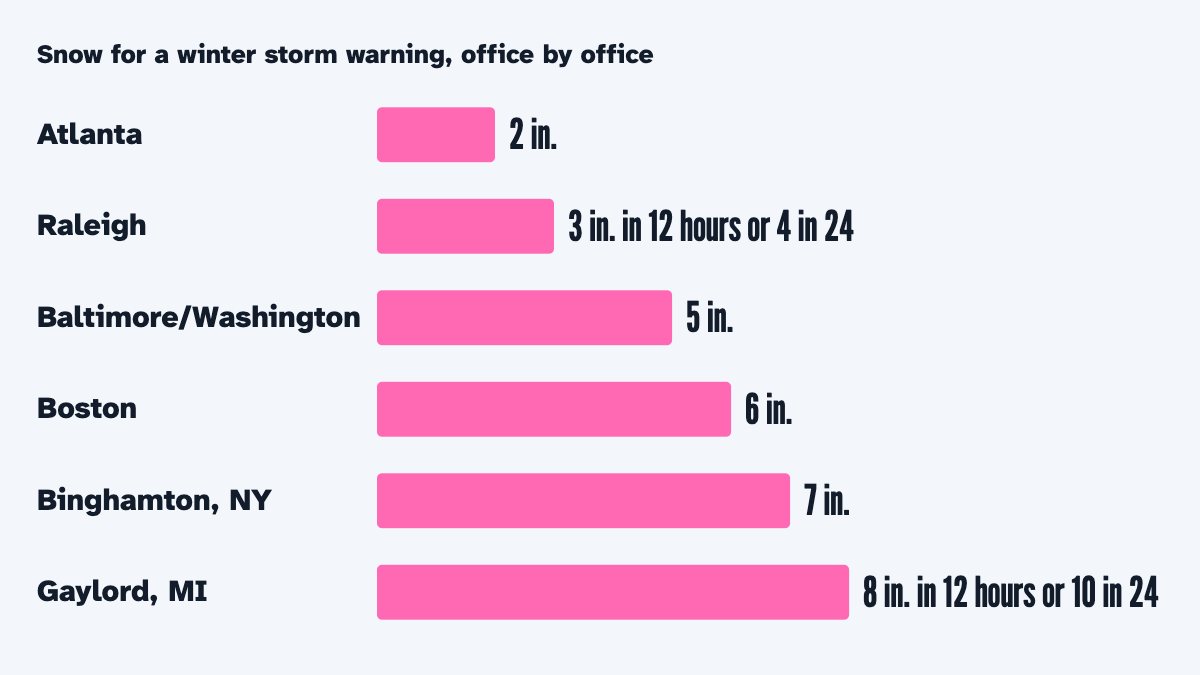
The National Weather Service office for the Baltimore–Washington area, in Sterling, uses its own yardsticks. It issues a Winter Storm Warning for 5 inches or more (6 inches in 6 western counties) and an advisory for 2 to 4 inches. In its metro areas, an advisory can go out for just 1 inch at rush hour, 4 to 9 AM or 2 to 7 PM. Our guide to watches, warnings and advisories explains each alert.
The calculator also cares about timing. Snow that falls overnight or while buses run, 6 to 10 AM, counts in full, and snow falling above freezing counts less because it lands on wet roads. Ice needs very little: by our rule of thumb, about 0.08 inch closes schools in places with little snow.
Do snow days have to be made up in Virginia?
Yes, most of them. Va. Code § 22.1-98 sets the formula for keeping full state aid:
- 5 or fewer days closed: make up every one, by adding days or lengthening the school day.
- 6 or more days closed: make up the first 5, plus “one day for each two days missed in excess of the first five.”
Worked out, 7 days closed means 6 made up, 9 means 7, and 15 means 10. A division that cannot reach 180 days may instead add enough instructional hours to meet the 990-hour minimum.
Skipping the make-up costs money: under the same section, state aid is cut in the same proportion as the shortened term. The Board of Education may waive the extra days or hours, but only if the local board shows every reasonable effort to make them up was exhausted, and the division superintendent and board chair certify it. If the Board says no, the time is made up.
The same section has 2 more rules. If the Governor orders an evacuation, the Board must waive make-up for up to 5 teaching days. And every division’s calendar must include a plan for making up time lost to emergencies.
Can Virginia schools switch to remote learning instead?
Yes, up to 10 days a year. When severe weather or another emergency closes schools for in-person teaching, a division may declare an unscheduled remote learning day under Va. Code § 22.1-98, and it counts. The Virginia Department of Education (VDOE) defines it as “an instructional day that was originally scheduled to be in-person.”
Before declaring one, a division needs a plan that meets VDOE’s conditions:
- utilities are still working;
- students with IEPs or 504 plans can get their services;
- student support services continue;
- school meals keep going.
VDOE’s guidance also says students who cannot get online should get a fair chance to finish the work without penalty. It suggests help desk support on those days, too.
More than 10 takes an extension. The Superintendent of Public Instruction may grant an extension, case by case, after more than 10 days of severe weather or emergency, with the local board certifying each day met the guidelines. The request is due within 30 days, and an extension lasts only for that school year. The remote-day law dates from 2021; VDOE’s page is as posted in May 2026.
Where does Virginia get the most snow?
Wise, at about 2,560 feet, has the highest normal of Virginia’s 106 NOAA weather stations, 47.1 inches a year. Burkes Garden, about 3,070 feet up, is close behind at 46.9, then Mustoe at 39.1 and Clintwood at 38.4.
Normal snowfall a year and normal December to February low at each of the 106 weather stations in Virginia with a snowfall normal in NOAA's U.S. Climate Normals for 1991–2020, with each station's location, elevation and how complete its record is.
The 10 snowiest and 5 least snowy of 106 stations in Virginia
| Station | Normal snowfall | Dec–Feb low | Elevation |
|---|---|---|---|
| Wise 1SE | 47.1 in. | 27°F | 2,564 ft |
| Burkes Garden | 46.9 in. | 23°F | 3,068 ft |
| Mustoe 1 Sw | 39.1 in. | 20°F | 2,367 ft |
| Clintwood 1W | 38.4 in. | 24°F | 1,566 ft |
| Nora 4 Sse | 38.3 in. | 27°F | 2,658 ft |
| Mill Gap | 33.7 in. | 18°F | 2,421 ft |
| Bland | 26.9 in. | 23°F | 2,000 ft |
| Hot Springs | 25.3 in. | 23°F | 2,244 ft |
| Star Tannery | 25.1 in. | 23°F | 950 ft |
| Blacksburg Nwso | 24.7 in. | 24°F | 2,103 ft |
| … | |||
| Oceana Nas | 3.4 in. | 33°F | 23 ft |
| Ft Pickett | 3.3 in. | 28°F | 330 ft |
| Norfolk Nas | 3 in. | 36°F | 17 ft |
| Langley Afb | 2.7 in. | 34°F | 10 ft |
| Emporia 1 Wnw | 1.4 in. | 31°F | 100 ft |
Download “Normal snowfall at Virginia weather stations, 1991–2020” (CSV, opens in Excel)
Built from: U.S. Climate Normals, 1991–2020 (National Centers for Environmental Information).
Those high stations get about 9 times Virginia Beach’s snow. By our rule of thumb, a place with Wise’s 47.1 inches would close at about 7.5 inches, 5 times the 1.5 inches that does it in Virginia Beach.
The middle of the list is 12.3 inches, and the least snowy station, Emporia, normally sees 1.4. Of the 106 stations, 26 are what NOAA calls standard, with 24 or more years of records, and 80 are provisional, with at least 10. The normals cover 1991 to 2020.
How cold does it have to be to close school in Virginia?
Virginia’s school-year law sets no temperature, so the calculator uses our cold point: a wind chill of −10°F to −15°F in the map’s cities, by our rule of thumb. It is the normal December-to-February low minus 45°F, so it follows what a place is used to.
Norfolk, Virginia Beach and Chesapeake, with normal winter lows near 35°F, sit at −10°F. Richmond (29.9°F) and Alexandria (29.7°F) sit at −15°F. The Weather Service’s wind chill applies only at 50°F or colder and in winds above 3 mph.
The calculator reads the wind chill from 5 to 9 AM, around bus time. An Extreme Cold Warning, the name that replaced the Wind Chill Warning on or about October 1, 2024, raises its chance more than a Cold Weather Advisory does.
Who decides, and when do families hear?
Your school division decides. Its superintendent and board close schools and declare remote days; the state handles extensions and waivers.
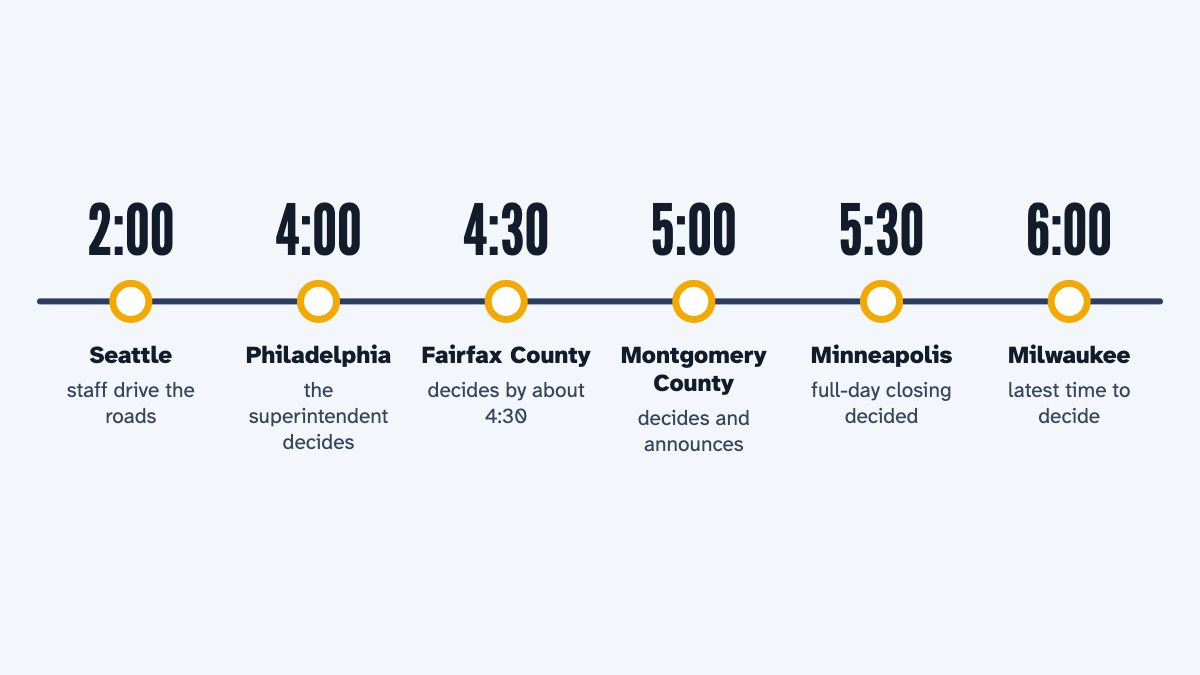
Fairfax County Public Schools shows how one large division does it. It aims to decide the evening before, but when the forecast is uncertain it waits, and the superintendent decides whether to delay or close “by approximately 4:30 a.m.” Staff inspect roads, sidewalks, parking lots and bus lanes; VDOT plows the roads, and building custodians clear school sidewalks.
Fairfax closes or delays the whole county at once, because buses and teachers cross it. A 2-hour delay moves every pickup 2 hours later, so a 7:10 a.m. bus comes at 9:10.
For your own school, check your division’s website, app, or local TV and radio. The calculator gives a chance the night before and shows its reasons, but forecasts change, and only the division decides. Our guide to how schools decide snow days covers the rest of the country.
Snow days in Virginia
- Snow
- 1.5 inches in Virginia Beach
- 2.5 in Richmond
- 3 in Alexandria
- Cold
- Our cold point −10°F to −15°F
- Extreme Cold Warning
- School year
- 180 days or 990 hours
- Aid cut for short years
- Make-up
- All of the first 5
- Then 1 for every 2
- Board waiver
- Remote days
- Up to 10 a year
- Extension case by case
- Meals keep going
- Who decides
- Your school division
- Fairfax by about 4:30 AM
Questions people ask
How many snow days does Virginia allow?
None are free. A division makes up all of its first 5 missed days, then 1 for every 2 more, unless the Board of Education grants a waiver. Remote learning days, up to 10 a year, count and do not need making up.
How many remote learning days can Virginia schools use?
Up to 10 unscheduled remote learning days in a school year. More need an extension from the Superintendent of Public Instruction, and it lasts only for that year.
What time does Fairfax County announce school closings?
Fairfax aims for the evening before. When the forecast is uncertain, the superintendent decides by about 4:30 a.m. whether to delay or close.
Why do Virginia schools close for so little snow?
Fairfax County gives its answer for the Washington area: big snow is rare there, so roads take longer to clear. Our rule of thumb follows the same idea by tying the closing point to a place’s normal snowfall, which puts Norfolk at 1.5 inches and snowier Alexandria at 3.
Sources: Va. Code § 22.1-98; VDOE, Unscheduled Remote Learning; Fairfax County Public Schools, weather cancellation procedures.
Facts checked October 29, 2026.
More guides
-
-
-
-

-
-