Michigan Snow Day Calculator: Chances, Forgiven Days and Virtual Days
By our rule of thumb, about 6 inches closes Detroit schools and 10.5 Grand Rapids’. Michigan forgives 6 days, 3 more with a waiver, and from 2026–27 allows up to 3 virtual days.

- Under 5%
- 5 to 24%
- 25 to 49%
- 50 to 74%
- 75% or more
The next school day in Michigan
Worked out from the National Weather Service forecast, 3:07 PM EDT, Thursday.
- Detroit<1% snow dayFriday: no snow
- Grand Rapids<1% snow dayFriday: no snow
- Warren<1% snow dayFriday: no snow
- Sterling Heights<1% snow dayFriday: no snow
- Ann Arbor<1% snow dayFriday: no snow
- Lansing<1% snow dayFriday: no snow
Michigan’s snow comes off the lakes, and it does not fall evenly. Grand Rapids averages 75 inches a year, more than twice Detroit’s 35, and the Upper Peninsula is snowier still: the Marquette station averages nearly 197 inches. By our rule of thumb, schools close about half the time at around 5.5 to 6 inches overnight in Detroit, Warren and Sterling Heights, 7 in Lansing, 8.5 in Ann Arbor and 10.5 in Grand Rapids.
Cold can close schools too. Our cold points, the morning wind chills at which schools start closing for cold by our rule, run from −24°F around Detroit to −27°F in Ann Arbor. The calculator reads the National Weather Service forecast for the part of your ZIP code where most people live, hour by hour, so a lake band over Grand Rapids does not raise the odds in Detroit.
When schools do close, the law is forgiving up to a point. A district must provide 180 days and 1,098 hours under section 101 of the State School Aid Act, but the first 6 days lost to weather still count, up to 3 more can be forgiven with the state superintendent’s approval, and from the 2026–27 school year a district that has used all 9 may hold up to 3 virtual days.
How much snow closes school in Michigan?
By our rule of thumb, about 5.5 inches overnight in Warren, 6 in Detroit and Sterling Heights, 7 in Lansing, 8.5 in Ann Arbor and 10.5 in Grand Rapids. Each is the snowfall at which schools there close about half the time, worked out from the city’s normal yearly snowfall.
Michigan's six largest cities: normal snowfall a year (NOAA 1991–2020) and the snowfall and wind chill at which, by our rule of thumb, schools there usually close.
| City | Normal snowfall | Usually closes at | Cold point (wind chill) |
|---|---|---|---|
| Detroit | 35 in. a year | 6 in. of snow | −24°F |
| Grand Rapids | 75 in. a year | 10.5 in. of snow | −25°F |
| Warren | 30.6 in. a year | 5.5 in. of snow | −24°F |
| Sterling Heights | 32.8 in. a year | 6 in. of snow | −24°F |
| Ann Arbor | 57.7 in. a year | 8.5 in. of snow | −27°F |
| Lansing | 42.2 in. a year | 7 in. of snow | −26°F |
Our rule of thumb: the usual closing point is 0.5 × (normal snowfall a year)0.7, the cold point the normal December–February low minus 45°F. How the calculator works.
Grand Rapids gets more than twice Detroit’s snow, and its closing point is 4.5 inches higher. Ann Arbor, at 57.7 inches a year, needs 8.5. The rule grows with snowfall but more slowly, so a snowy city needs more snow to close, though not in proportion. If you know your district rarely closes, or closes at the first flakes, tell the calculator and it moves the point.
Timing matters as well. Snow that falls overnight or while buses run counts in full; snow the morning before counts about a third, since roads have time to be cleared. Snow that falls with the air above freezing counts less, and gusts of 25 mph or more while an inch or more falls make each inch count more.
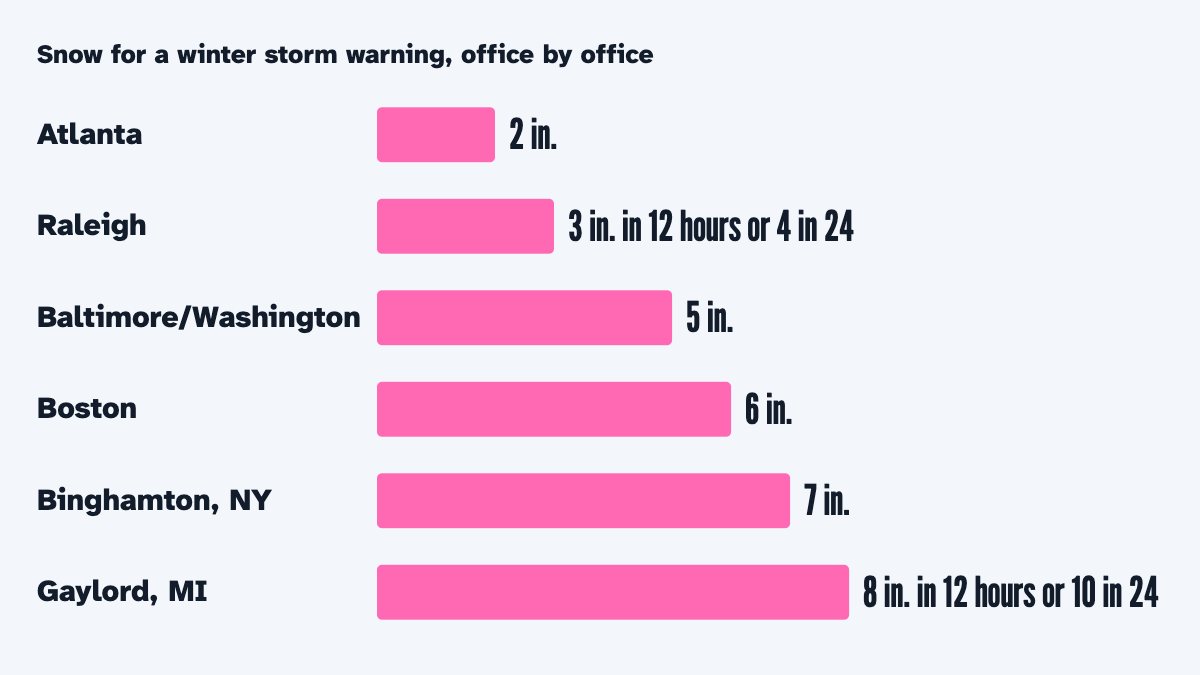
Up north the Weather Service sets a high bar. Its Gaylord office, which covers northern Michigan, issues a Winter Storm Warning for 8 inches or more in 12 hours or 10 inches in 24, less with strong winds, and its Winter Weather Advisory is often issued for 3 to 8 inches. A warning raises the calculator’s chance more than an advisory does.
Where does Michigan get the most snow?
In the Upper Peninsula. NOAA has snowfall normals for 117 Michigan stations, with a middle value of 66 inches a year, and all eight of the snowiest are in the U.P. Herman leads at 207.8 inches, then Marquette (196.8), Ironwood (185.5), Bergland Dam (180.0) and a station near Ontonagon (177.7).
Normal snowfall a year and normal December to February low at each of the 117 weather stations in Michigan with a snowfall normal in NOAA's U.S. Climate Normals for 1991–2020, with each station's location, elevation and how complete its record is.
The 10 snowiest and 5 least snowy of 117 stations in Michigan
| Station | Normal snowfall | Dec–Feb low | Elevation |
|---|---|---|---|
| Herman | 207.8 in. | 9°F | 1,717 ft |
| Marquette | 196.8 in. | 9°F | 1,411 ft |
| Ironwood | 185.5 in. | 7°F | 1,430 ft |
| Bergland Dam | 180 in. | 5°F | 1,300 ft |
| Ontonagon 6 Se | 177.7 in. | 11°F | 790 ft |
| Tahquamenon Falls Sp | 169.9 in. | 10°F | 745 ft |
| Chatham Experiment Farm 2 | 164 in. | 10°F | 870 ft |
| Munising | 161 in. | 14°F | 680 ft |
| Gaylord 9SSW | 148.8 in. | 14°F | 1,468 ft |
| Maple City 1E | 143.3 in. | 18°F | 799 ft |
| … | |||
| Mount Clemens Ang Base | 32.2 in. | 20°F | 580 ft |
| Morenci | 32 in. | 17°F | 770 ft |
| Dearborn | 30.8 in. | 20°F | 605 ft |
| Grosse Pointe Farms | 27.9 in. | 19°F | 613 ft |
| Adrian 2 Nne | 26 in. | 19°F | 760 ft |
Download “Normal snowfall at Michigan weather stations, 1991–2020” (CSV, opens in Excel)
Built from: U.S. Climate Normals, 1991–2020 (National Centers for Environmental Information).
Herman’s station sits about 1,717 feet up; Tahquamenon Falls State Park (169.9 inches) and Munising (161.0) make the list too. The least snowy stations are in the southeast, near Detroit and the Ohio line: Adrian averages 26 inches, Grosse Pointe Farms 27.9 and Dearborn 30.8.
Do snow days have to be made up in Michigan?
Only after the first six, or nine with a waiver. Section 101 of the State School Aid Act requires 180 days and 1,098 hours of instruction, and a district that falls short loses a matching share of its state aid. But the first 6 days, or the same number of hours, lost to weather and similar conditions are counted as if school had been held.
Up to 3 more days can be counted with the approval of the state superintendent of public instruction. A Michigan Department of Education overview says this is commonly called a “snow-day waiver,” and the application, the Additional Forgiven Days Waiver, is on the department’s pupil accounting page. Any day beyond those 9 must be rescheduled to keep full state aid, and the department encourages adding whole days rather than adding the missed hours to the end of school days.
Attendance matters too: under the same section, a day when fewer than 75% of students attend is paid only in part. Last winter also brought a one-time exception: for 2025–26 only, districts in counties named in the governor’s March 2026 storm orders could count up to 4 or 5 extra forgiven days. That does not carry into 2026–27.
Can Michigan schools switch to virtual learning instead?
Yes, from the 2026–27 school year, but only as a last resort. Section 21f of the State School Aid Act, last amended by a 2026 law that took effect on October 1, 2026, says “a maximum of 3 days of virtual instruction may be provided” for conditions outside a district’s control. A district may use them only after it has used all its emergency closing days under section 101: the 6 forgiven days and any waiver days.
The school board must approve a plan each year and tell families about it before it is used. The department’s questions and answers, revised in July 2026, fill in the rest. Lessons may be live, self-paced or a mix; parents do not have to consent; paper packets do not count as virtual instruction; teachers must be reachable by email, phone, video or chat at set hours; and the days cannot be saved for the end of the year as make-up days. The plan must also say how students get devices and internet access.
The department’s guidance speaks of 6 virtual days in all: 3 are tied to testing, and only the other 3 can stand in for a closing.
How cold does it have to be to close school in Michigan?
State law sets no temperature, so each district decides. By our rule of thumb, schools start closing for cold at a morning wind chill of about −24°F in Detroit, Warren and Sterling Heights, −25°F in Grand Rapids, −26°F in Lansing and −27°F in Ann Arbor: 45 degrees below each city’s normal December-to-February low. The calculator reads the forecast wind chill for 5 to 9 AM, bus-stop time.
The Weather Service sets the bar lower still up north. Gaylord’s criteria page gives its old Wind Chill Warning levels as −35°F in the eastern Upper Peninsula and −30°F in northern Lower Michigan. Since October 2024 that alert has been called an Extreme Cold Warning, and when one is in force for your area the calculator raises its chance.
Who decides, and when do Michigan families hear?
Your local superintendent. The state education department calls closing for bad weather “a decision local district superintendents must make.” The state’s part comes afterwards, in counting the days and granting any waiver.
Each district sets its own clock, and we could not find Detroit’s written procedure, so we will not guess at a time. Watch your district’s website, app and local TV and radio. Check the calculator the night before and again early in the morning: it uses the newest forecast each time, and forecasts can shift overnight.
Is tomorrow a snow day in Michigan?
Your district will say; the calculator puts odds on it from tomorrow’s forecast, and this map sums up what moves them in Michigan.
Snow days in Michigan
- Snow that closes schools
- Detroit 6 in
- Lansing 7 in
- Ann Arbor 8.5 in
- Grand Rapids 10.5 in
- Forgiven days
- First 6 count anyway
- 3 more with a waiver
- then make up
- Virtual days
- New in 2026–27
- up to 3
- only after the 6 + 3
- Cold
- No state number
- our points −24°F to −27°F
- Who decides
- Local superintendent
- check district news
Questions people ask
How many snow days are Michigan schools allowed?
Six are forgiven automatically, and up to 3 more with the state superintendent’s approval. From 2026–27 a district that has used all 9 may hold up to 3 virtual days; a closing beyond that has to be made up.
How many inches of snow for a snow day in Michigan?
By our rule of thumb, about 5.5 to 6 inches overnight around Detroit, 7 in Lansing and 10.5 in Grand Rapids gives schools about even odds of closing. Timing matters too: snow at bus time counts more than snow the morning before.
Do paper packets count as a virtual day in Michigan?
No. The Michigan Department of Education’s guidance says paper packets are not virtual instruction, so a day of take-home packets cannot be one of the 3 virtual days.
How cold does it have to be for a snow day in Michigan?
There is no state number; each district decides. By our rule of thumb, schools in Michigan’s six largest cities start closing for cold at a morning wind chill of about −24°F to −27°F.
Sources: State School Aid Act section 101 (MCL 388.1701); State School Aid Act section 21f (MCL 388.1621f); Michigan Department of Education, virtual learning days questions and answers.
Facts checked October 29, 2026.
More guides
-
-
-
-

-
-