Illinois Snow Day Calculator: Chances, Emergency Days and E-Learning
By our rule of thumb, 5 to 6.5 inches closes schools around Chicago. Illinois calendars hold at least five emergency days, and up to five can be e-learning days instead.

- Under 5%
- 5 to 24%
- 25 to 49%
- 50 to 74%
- 75% or more
The next school day in Illinois
Worked out from the National Weather Service forecast, 3:07 PM EDT, Thursday.
- Chicago<1% snow dayFriday: no snow
- Aurora<1% snow dayFriday: no snow
- Naperville<1% snow dayFriday: no snow
- Joliet<1% snow dayFriday: no snow
- Rockford<1% snow dayFriday: no snow
- Elgin<1% snow dayFriday: no snow
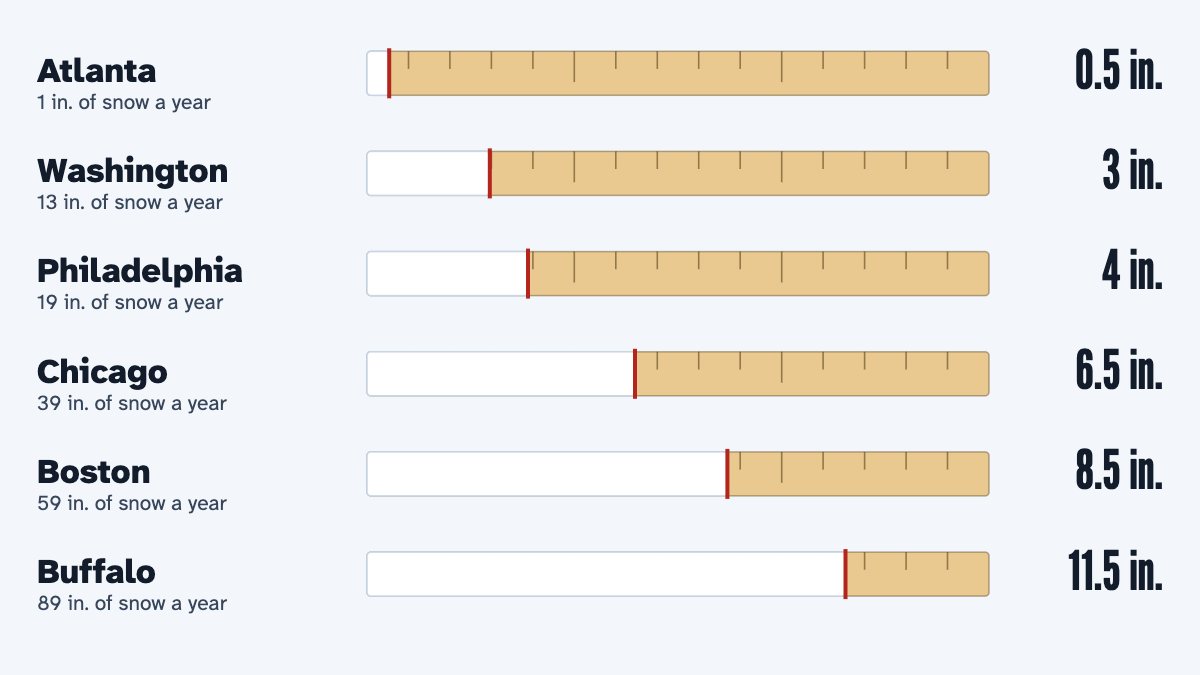
Illinois snow falls mostly in the north. Chicago averages about 39 inches a year and its suburbs and Rockford 25 to 38, while stations on the rivers at the state’s southern tip average 3 to 6. By our rule of thumb, schools close about half the time at 5 inches overnight in Naperville and Joliet, 5.5 in Aurora, 6 in Rockford, and 6.5 in Chicago and Elgin.
Cold closes schools here too. On January 23, 2026, Chicago Public Schools closed after the Weather Service warned that wind chills could reach −35°F. Our own cold points, the morning wind chills at which schools start closing for cold by our rule, run from −23°F in Chicago to −28°F in Rockford and Elgin.
Illinois builds the snow days in. Under section 10-19 of the School Code, a calendar runs at least 185 days to make sure of 176 days of actual attendance, the state board’s guidelines require at least five emergency days in it, and up to five can be e-learning days instead.
How much snow closes school in Illinois?
By our rule of thumb, about 5 inches overnight in Naperville and Joliet, 5.5 in Aurora, 6 in Rockford, and 6.5 in Chicago and Elgin. Each is the snowfall at which schools there close about half the time, worked out from the city’s normal yearly snowfall.
Illinois's six largest cities: normal snowfall a year (NOAA 1991–2020) and the snowfall and wind chill at which, by our rule of thumb, schools there usually close.
| City | Normal snowfall | Usually closes at | Cold point (wind chill) |
|---|---|---|---|
| Chicago | 38.7 in. a year | 6.5 in. of snow | −23°F |
| Aurora | 31 in. a year | 5.5 in. of snow | −26°F |
| Naperville | 28.1 in. a year | 5 in. of snow | −26°F |
| Joliet | 25.4 in. a year | 5 in. of snow | −26°F |
| Rockford | 36.4 in. a year | 6 in. of snow | −28°F |
| Elgin | 37.7 in. a year | 6.5 in. of snow | −28°F |
Our rule of thumb: the usual closing point is 0.5 × (normal snowfall a year)0.7, the cold point the normal December–February low minus 45°F. How the calculator works.
The spread is narrow because the six largest cities are all in the north, with 25 to 39 inches a year. Downstate, where snow is rarer, the same rule gives a much lower closing point, so an inch or two counts for more there than it does in Chicago. If your district rarely closes, or closes easily, tell the calculator and it moves the point.
Wind and warmth change the count. The calculator reads the National Weather Service forecast for the part of your ZIP code where most people live, hour by hour. Gusts of 25 mph or more while an inch or more falls make each inch count more, and snow that falls with the air above freezing counts less, because it melts on the roads. Snow overnight or during the bus run counts in full; snow the morning before, only about a third. A Weather Service warning raises the chance more than a watch or an advisory does.
Where does Illinois get the most snow?
In the Chicago suburbs and the far north. NOAA has snowfall normals for 192 Illinois stations, with a middle value of 19.6 inches a year, and the snowiest are St. Charles (46.2 inches), Lake Villa (43.4), Mundelein (43.1) and Oak Brook (42.3). A station near Midway Airport averages 38.8.
Normal snowfall a year and normal December to February low at each of the 192 weather stations in Illinois with a snowfall normal in NOAA's U.S. Climate Normals for 1991–2020, with each station's location, elevation and how complete its record is.
The 10 snowiest and 5 least snowy of 192 stations in Illinois
| Station | Normal snowfall | Dec–Feb low | Elevation |
|---|---|---|---|
| St. Charles 0.1 E | 46.2 in. | — | 760 ft |
| Lake Villa 2NE | 43.4 in. | 18°F | 840 ft |
| Mundelein 4 Wsw | 43.1 in. | 17°F | 840 ft |
| Oak Brook 2W | 42.3 in. | — | 715 ft |
| Genoa 2SW | 38.9 in. | — | 826 ft |
| Chicago Midway Airport 3SW | 38.8 in. | 23°F | 620 ft |
| Barrington 3SW | 38.5 in. | 17°F | 875 ft |
| Elburn | 38.5 in. | — | 870 ft |
| Chicago Ohare International Airport | 38.4 in. | 22°F | 658 ft |
| Roscoe 2 Se | 38 in. | — | 863 ft |
| … | |||
| Grand Twr 2 N | 6.2 in. | — | 383 ft |
| Kaskaskia Rvr Navigation Lock | 4.3 in. | 27°F | 380 ft |
| Smithland L&d | 3.8 in. | 28°F | 357 ft |
| Rosiclare 5NW | 3.3 in. | 25°F | 400 ft |
| Brookport Dam 52 | 3.1 in. | 27°F | 330 ft |
Download “Normal snowfall at Illinois weather stations, 1991–2020” (CSV, opens in Excel)
Built from: U.S. Climate Normals, 1991–2020 (National Centers for Environmental Information).
The least snowy stations sit on the rivers at the southern tip: the Brookport dam on the Ohio averages 3.1 inches, Rosiclare 3.3 and the Smithland locks and dam 3.8. A school there and a school in Lake County live through very different winters, and the calculator reads each place’s own normals.
Do snow days have to be made up in Illinois?
Not while the calendar’s emergency days last. Section 10-19 requires a calendar of at least 185 days “to insure 176 days of actual pupil attendance,” and a day counts only with at least 5 clock hours of school work. The gap leaves room. The state board’s 2026–27 calendar guidelines require at least five proposed emergency days, and a snow closing turns one of them into an emergency day.
Once those are gone, the guidelines say, a lost day that is needed to reach the attendance minimum must be made up before the end of the school year. Section 10-19 lets a board end the year early once the minimum is met, but not run past the closing date unless that is needed to reach the minimum.
The last resort is an Act of God day, which is not made up and needs approval from the regional superintendent and the state. The guidelines consider one only after a district has used every proposed emergency day and, if it has an e-learning program, all five e-learning days. The term comes from the state board’s guidance; we did not find it in the statute text we read.
Can Illinois schools switch to e-learning instead?
Yes, up to five days a year, in place of emergency days. Under section 10-20.56 of the School Code, a school board may adopt an e-learning program to use “in lieu of the district’s scheduled emergency days,” and an e-learning day counts as a full day of attendance. The state board caps them at five a year, not counting days when a school is used as a polling place.
Getting there takes work. The board must adopt the program by resolution after a public hearing with 10 days’ notice, the regional office of education must verify it every year before any e-learning day, and approval lasts three school years. The program must deliver at least 5 clock hours of work, give paper materials to students without technology, plan for students with special needs and tell staff, families and students how it works 30 days before its first use each year. Support staff are still paid on closing and e-learning days.
Districts still choose. When Chicago Public Schools closed for the cold on January 23, 2026, it said there would be no remote learning that day. A separate remote-learning law applies only when the governor has declared a public health disaster, not for snow.
How cold does it have to be to close school in Illinois?
The state rules we read set no temperature, and Chicago’s weather guidelines list air temperature and wind chill among their factors without printing a number. In practice, Chicago closed on January 23, 2026 after watching the forecast for 24 hours and seeing a Weather Service warning that wind chills could reach −35°F.
By our rule of thumb, schools start closing for cold at a morning wind chill of about −23°F in Chicago, −26°F in Aurora, Naperville and Joliet, and −28°F in Rockford and Elgin: 45 degrees below each city’s normal December-to-February low. The calculator reads the forecast wind chill for 5 to 9 AM, bus-stop time, and gives extra weight to an Extreme Cold Warning, the name the Weather Service has used since October 2024 for what was the Wind Chill Warning.
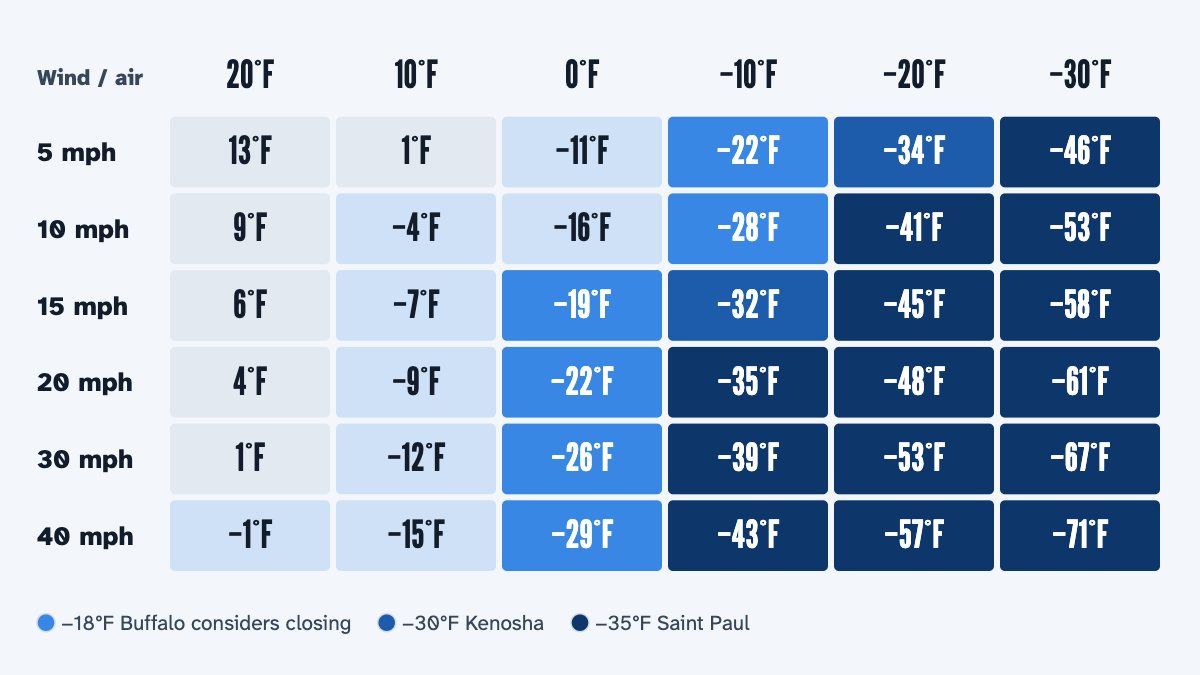
The Weather Service’s wind chill chart puts the cold in numbers: at 0°F with a 15 mph wind it feels like −19°F, and exposed skin can freeze in 30 minutes.
Who decides, and when do Illinois families hear?
The district does, through its superintendent, and the regional superintendent of schools approves the calendar and any change to it under section 10-19. Chicago Public Schools starts from a promise to “keep classes in session as long as it is safe,” working with the city’s emergency management office.
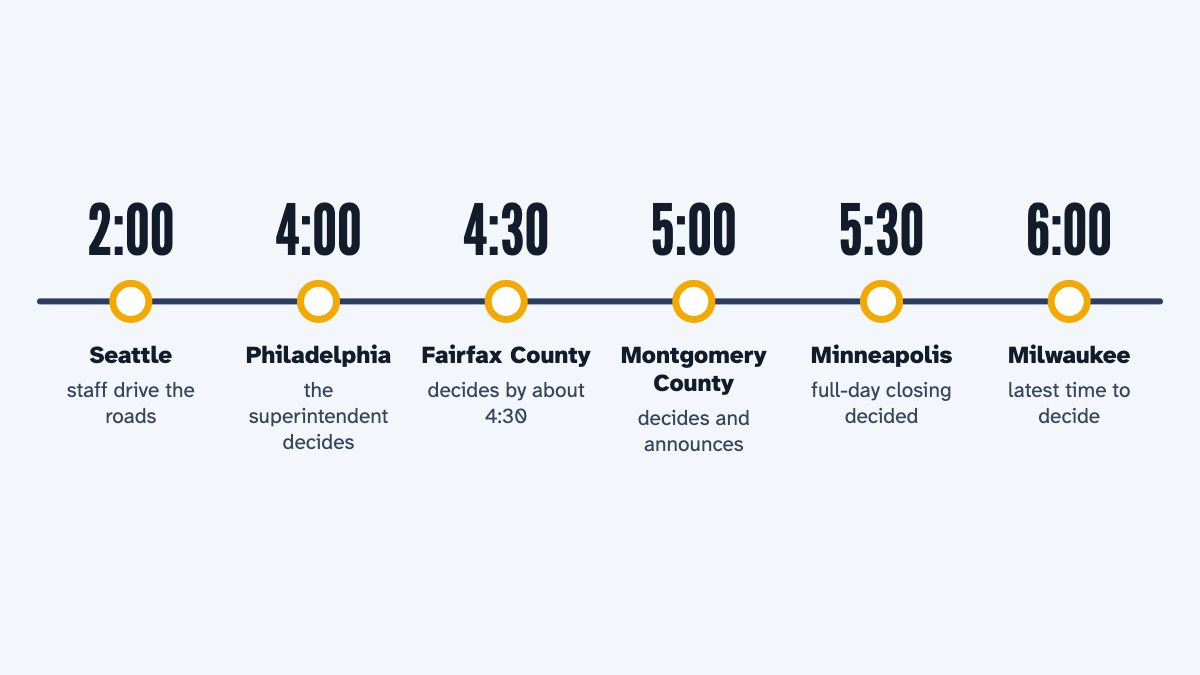
Chicago’s page lists what it weighs: cold and wind chill, snow and ice on the ground, access to buildings and roads, heating or power problems, and whether buses can run safely. We found no clock on it, so watch the district’s own channels and local TV and radio. The calculator gives odds; the decision is the district’s.
Will Illinois schools close tomorrow?
Only your district can say. The calculator’s odds come from tomorrow’s forecast for your ZIP code, and this map sums up what moves them in Illinois.
Snow days in Illinois
- Snow that closes schools
- Naperville, Joliet 5 in
- Rockford 6 in
- Chicago 6.5 in
- The school year
- 185-day calendar
- 176 attendance days
- at least 5 emergency days
- E-learning
- Up to 5 a year
- verified program
- counts as a full day
- Act of God days
- After all emergency days
- all e-learning days too, where approved
- state approval
- not made up
- Cold
- Chicago closed for forecast −35°F wind chills
- our points −23°F to −28°F
Questions people ask
How much snow does it take to cancel school in Illinois?
There is no state number. By our rule of thumb, schools around Chicago close about half the time at 5 to 6.5 inches overnight, and downstate, where snow is rarer, at less.
What is an emergency day in Illinois?
A spare day the calendar holds for closings. Illinois calendars must list at least five proposed emergency days; when snow closes school, the district uses one, and nothing has to be made up until they are gone.
What is an Act of God day in Illinois?
A closing the state forgives without a make-up day. The state board considers one only after a district has used all its emergency days and, if it has an e-learning program, all five e-learning days, and both the regional superintendent and the state must approve it.
Does Chicago have remote learning on snow days?
Not on January 23, 2026: Chicago Public Schools closed for the cold and said there would be no remote learning that day. Illinois law lets a district swap emergency days for e-learning days, so check what your own district has adopted.
Sources: School Code section 10-19 (105 ILCS 5/10-19); Illinois State Board of Education, public school calendar guidelines 2026–27; School Code section 10-20.56 (105 ILCS 5/10-20.56).
Facts checked October 29, 2026.
More guides
-
-
-
-
-
-