North Carolina Snow Day Calculator: Chances, Make-Up and Remote Days
In most of North Carolina, 1 to 2 inches of snow or a thin glaze of ice can close schools, by our rule of thumb. Every calendar must plan how weather days are made up.

- Under 5%
- 5 to 24%
- 25 to 49%
- 50 to 74%
- 75% or more
The next school day in North Carolina
Worked out from the National Weather Service forecast, 3:07 PM EDT, Thursday.
- Charlotte<1% snow dayFriday: no snow
- Raleigh<1% snow dayFriday: no snow
- Greensboro<1% snow dayFriday: no snow
- Durham<1% snow dayFriday: no snow
- Winston-Salem<1% snow dayFriday: no snow
- Fayetteville<1% snow dayFriday: no snow
Most of North Carolina sees only a few inches of snow in a normal year. Charlotte’s normal is 3.2 inches and Raleigh’s 4.9, by NOAA’s 1991–2020 normals. By our rule of thumb, about 1 inch of overnight snow is enough for Charlotte schools to close about half the time, 1.5 inches in Raleigh and Durham, and 2 inches in Greensboro and Winston-Salem.
Ice and the mountains change the picture. The calculator treats about a tenth of an inch of ice as enough to close schools almost anywhere, and slightly less where snow is rare. Up high it is another winter: Mount Mitchell averages 89.1 inches of snow a year.
Missed days are not simply lost. North Carolina’s calendar law, G.S. 115C-84.2, requires at least 185 days or 1,025 hours of instruction, and every school calendar must include a plan for making up time lost to bad weather. Districts may also count a few remote days.
How much snow closes school in North Carolina?
About half an inch to 2 inches of overnight snow in the state’s big cities, by our rule of thumb. That is the amount at which schools close about half the time, so it is a middle point, not a line.
North Carolina's six largest cities: normal snowfall a year (NOAA 1991–2020) and the snowfall and wind chill at which, by our rule of thumb, schools there usually close.
| City | Normal snowfall | Usually closes at | Cold point (wind chill) |
|---|---|---|---|
| Charlotte | 3.2 in. a year | 1 in. of snow | −11°F |
| Raleigh | 4.9 in. a year | 1.5 in. of snow | −12°F |
| Greensboro | 6.3 in. a year | 2 in. of snow | −13°F |
| Durham | 4.5 in. a year | 1.5 in. of snow | −12°F |
| Winston-Salem | 6.5 in. a year | 2 in. of snow | −16°F |
| Fayetteville | 1.3 in. a year | 0.5 in. of snow | −11°F |
Our rule of thumb: the usual closing point is 0.5 × (normal snowfall a year)0.7, the cold point the normal December–February low minus 45°F. How the calculator works.
The spread follows normal snowfall. Fayetteville gets the least of the six cities, 1.3 inches a year, so its closing point rounds to half an inch. Charlotte lands near 1 inch, Raleigh (4.9 inches a year) and Durham (4.5) near 1.5, and Greensboro (6.3) and Winston-Salem (6.5) near 2.
Timing counts as much as depth. The calculator reads the National Weather Service forecast hour by hour and counts snow fully when it falls overnight (9 PM to 6 AM) or while buses run (6 to 10 AM), at 80% in the afternoon and evening before, and at 45% during the school day. Snow that falls while it is above freezing counts less, since it tends to leave roads wet. More on how the calculator works.
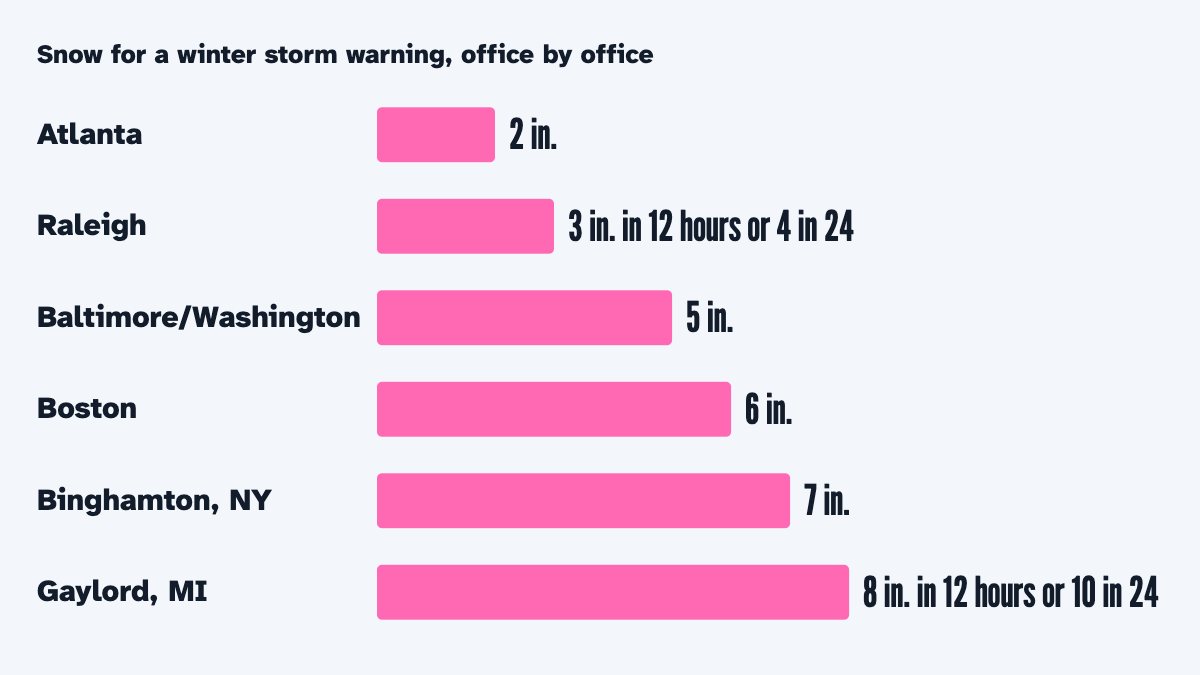
The Weather Service office in Raleigh uses its own yardstick. It issues a Winter Storm Warning when about 3 inches of snow is expected in 12 hours or 4 inches in 24 hours, averaged over a county, or for half an inch of sleet or a quarter inch of freezing rain. Its Winter Weather Advisory starts at about 1 inch in 12 hours. The calculator adds to its chance when a warning is out, and less for watches and advisories.
Where does North Carolina get the most snow?
High in the mountains. NOAA keeps snowfall normals for 123 North Carolina weather stations, and the top of the list is all high ground: Mount Mitchell, about 6,240 feet up, averages 89.1 inches a year, Beech Mountain 66.5, Flat Springs 48.2 and Banner Elk 31.4. Boone and Marshall each average 25.6 inches.
Normal snowfall a year and normal December to February low at each of the 123 weather stations in North Carolina with a snowfall normal in NOAA's U.S. Climate Normals for 1991–2020, with each station's location, elevation and how complete its record is.
The 10 snowiest and 5 least snowy of 123 stations in North Carolina
| Station | Normal snowfall | Dec–Feb low | Elevation |
|---|---|---|---|
| Mount Mitchell | 89.1 in. | 19°F | 6,240 ft |
| Beech Mountain | 66.5 in. | 22°F | 5,053 ft |
| Flat Springs 1E | 48.2 in. | 26°F | 3,330 ft |
| Banner Elk | 31.4 in. | 24°F | 3,770 ft |
| Swannanoa 2 Sse | 28.5 in. | 27°F | 4,320 ft |
| Boone 1 Se | 25.6 in. | 23°F | 3,100 ft |
| Marshall | 25.6 in. | 25°F | 1,920 ft |
| Sparta 3.5 Ssw | 18.6 in. | 24°F | 3,011 ft |
| Jefferson 2 E | 14.4 in. | 24°F | 2,759 ft |
| Celo 2 S | 12.7 in. | 25°F | 2,700 ft |
| … | |||
| Red Springs 1 Se | 0.4 in. | — | 180 ft |
| Rhodhiss Hydro Plt | 0.3 in. | — | 976 ft |
| Aurora 6 N | 0.2 in. | 38°F | 20 ft |
| Elizabeth City | 0.2 in. | 35°F | 8 ft |
| Wilmington 7 N | 0.2 in. | 35°F | 40 ft |
Download “Normal snowfall at North Carolina weather stations, 1991–2020” (CSV, opens in Excel)
Built from: U.S. Climate Normals, 1991–2020 (National Centers for Environmental Information).
Half the stations average 3.3 inches or less. The least snowy sit barely above sea level: Elizabeth City, Aurora and a Wilmington-area station each average 0.2 inches. A family in Boone and a family in Wilmington live under the same school laws but in very different winters, and the calculator’s closing point moves with the snowfall where you live.
Do snow days have to be made up in North Carolina?
Yes, in the sense that every calendar must still reach the state minimum. Under G.S. 115C-84.2, each local board adopts a calendar with at least 185 days or 1,025 hours of instruction covering at least nine calendar months, and the calendar must hold “a plan for making up days and instructional hours missed” when schools close for bad weather.
The law sets no fixed number of free snow days. The flexibility comes from the hours option: a district that schedules more than 1,025 hours may be able to absorb some closings without adding days, though that depends on its own calendar. A board may also mark teacher workdays after the last student day as make-up days, and the state’s Department of Public Instruction says a Saturday may be used as a make-up day after a weather closing.
The same law limits how far a calendar can stretch. Students start no earlier than the Monday closest to August 26 and finish no later than the Friday closest to June 11, unless a waiver applies, though a board may move its closing date when it needs to in order to meet the minimum. A day that opens and then closes early for weather can still count, to the extent State Board policy allows.
Can North Carolina schools switch to remote learning instead?
Yes, for a few days a year. Under G.S. 115C-84.3, most districts may count up to five remote instruction days or 30 remote instruction hours when schools cannot open because of severe weather, energy shortages, power failures or other emergencies.
Districts in counties with a good-cause waiver may use up to 15 days or 90 hours. Under G.S. 115C-84.2, a county qualifies when its schools closed eight days a year, in four of the last ten years, because of severe weather.
There are strings attached. Each district must send the State Board a remote instruction plan by July 1 every year, and beyond those limits a district “shall not use remote instruction” to meet the minimum days or hours. Once the remote days are used, further closings have to be made up under the calendar’s plan.
A bill titled Remote Instruction for Excess Emergencies, House Bill 1026, was re-referred to the Appropriations committee on June 2, 2026. It is not law, so it changes nothing for 2026–27.
How cold does it have to be to close school in North Carolina?
Far colder than a normal winter morning, by our rule of thumb. The calculator’s cold point is the normal December–February low minus 45°F: a wind chill near −11°F at bus time in Charlotte and Fayetteville, −12°F in Raleigh and Durham, −13°F in Greensboro and −16°F in Winston-Salem. We have no North Carolina district’s own cold rule on file.
The calculator reads the wind chill from 5 to 9 AM, while children wait at bus stops, and adds to its chance when the National Weather Service issues cold alerts. The Weather Service’s top cold alert is now the Extreme Cold Warning, for “extremely dangerous cold conditions or wind chill values”; it replaced the Wind Chill Warning on or about October 1, 2024. A Cold Weather Advisory is the step below.
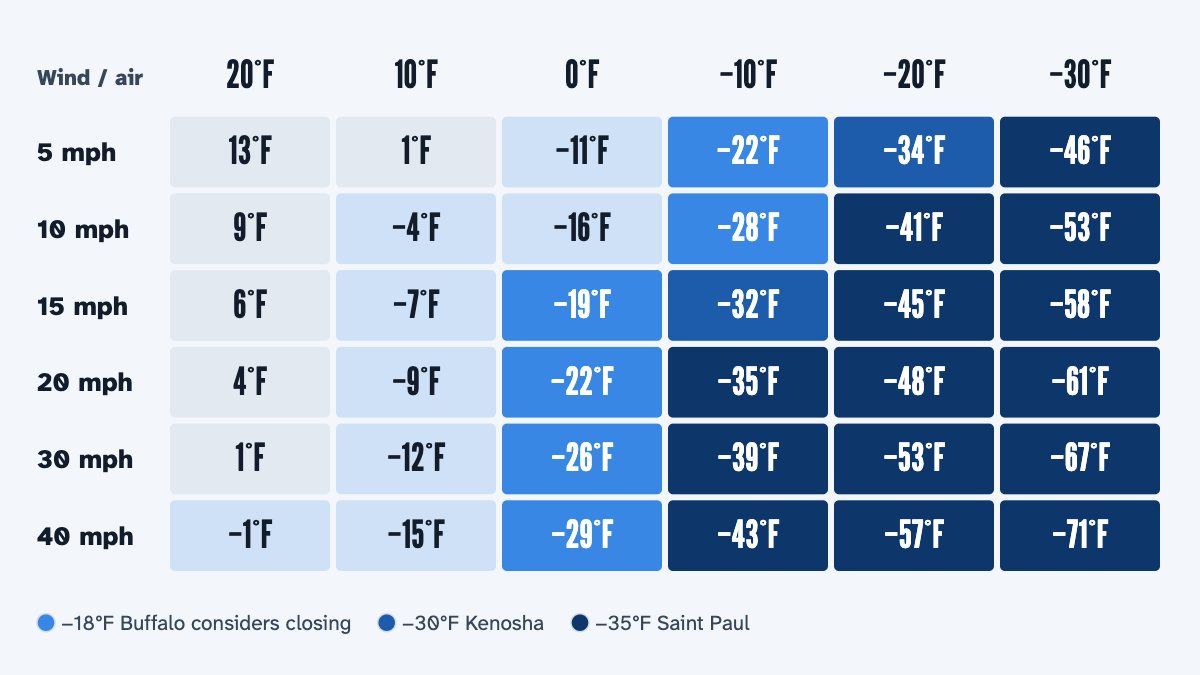
The Weather Service’s wind chill chart gives a sense of scale: at 0°F with a 15 mph wind, the wind chill is −19°F and exposed skin can freeze in 30 minutes. It also asks for extra caution with children.
Who decides, and when do North Carolina families hear?
Your school district decides, not the state and not this calculator. Each local board of education adopts its own calendar under G.S. 115C-84.2, and each district makes its own call on a stormy morning. Its website, app and local TV and radio have the final word.
We have not found a North Carolina district’s announcement clock, so we will not guess one. The Weather Service gives some lead time: in the Raleigh office’s area, a watch comes 18 to 36 hours ahead of a storm, and a warning covers weather expected in the next 12 to 24 hours. The calculator reads the forecast from 6 AM the day before through 3 PM on the school day, so its chance can move as the storm gets closer.
This site is independent: not a school district, a state agency or the National Weather Service. It shows the reasons behind each chance so you can judge them, and forecasts change.
The whole page on one map:
Snow days in North Carolina
- What closes schools
- half an inch to 2 inches in big cities
- a tenth of an inch of ice
- overnight timing
- Where it snows
- Mount Mitchell 89 inches
- Boone 26 inches
- Elizabeth City 0.2 inches
- Making up days
- 185 days or 1,025 hours
- a plan in every calendar
- Saturdays allowed
- Remote days
- 5 days or 30 hours
- 15 days in good-cause counties
- plan due July 1
- Who decides
- your district
- check its site or app
Questions people ask
How many snow days do North Carolina schools get?
The state does not give a set number. A district must reach 185 days or 1,025 hours and plan its make-ups under G.S. 115C-84.2; any slack comes from extra hours and remote days. Your district’s calendar lists its make-up days.
Can North Carolina schools make up snow days on Saturday?
Yes. The Department of Public Instruction says a Saturday may be used as a make-up day when a school has been closed for bad weather. Your board decides whether to.
Does ice close schools in North Carolina?
It can, and the calculator counts it: about a tenth of an inch of ice closes schools almost anywhere by its rule, and a bit less where snow is rare. The Raleigh Weather Service office treats a quarter inch of freezing rain as warning level.
How many remote days can North Carolina schools use for snow?
Up to five days or 30 hours a year, or 15 days or 90 hours in counties with a good-cause waiver, under G.S. 115C-84.3. The district needs a remote instruction plan on file with the State Board by July 1.
Sources: G.S. 115C-84.2, the school calendar law; G.S. 115C-84.3, remote instruction; National Weather Service Raleigh, warning criteria.
Facts checked October 29, 2026.
More guides
-
-
-
-

-
-