Massachusetts Snow Day Calculator: Chances and the 185-Day Calendar
By our rule of thumb, 7.5 to 9 inches of snow closes schools in the big cities of Massachusetts half the time. Districts schedule 185 days but must hold only 180.

- Under 5%
- 5 to 24%
- 25 to 49%
- 50 to 74%
- 75% or more
The next school day in Massachusetts
Worked out from the National Weather Service forecast, 3:07 PM EDT, Thursday.
- Boston<1% snow dayFriday: no snow
- Worcester<1% snow dayFriday: no snow
- Springfield<1% snow dayFriday: no snow
- Cambridge<1% snow dayFriday: no snow
- Lowell<1% snow dayFriday: no snow
- Brockton<1% snow dayFriday: no snow
In Massachusetts it takes a sizable storm. By our rule of thumb, schools in Boston, Cambridge and Brockton close about half the time at 8.5 inches of snow, Worcester and Lowell at 9, and Springfield at 7.5.
Snow is an ordinary part of winter here: the six cities on our map get 46.6 to 63.2 inches in a normal year. Massachusetts is also where an economist measured what snow does to learning, and found that scattered absences, not closings, were what hurt math scores.
The school year has a cushion. Every school committee must schedule at least 185 days and operate at least 180, so 5 closings fit before the minimum is in danger. Under the same regulation, remote learning counts only in a declared public-health emergency or when the state board finds exigent circumstances.
How much snow closes school in Massachusetts?
Between 7.5 and 9 inches in the six cities on our map, by our rule of thumb. That is the amount at which schools close about half the time.
Massachusetts's six largest cities: normal snowfall a year (NOAA 1991–2020) and the snowfall and wind chill at which, by our rule of thumb, schools there usually close.
| City | Normal snowfall | Usually closes at | Cold point (wind chill) |
|---|---|---|---|
| Boston | 59.1 in. a year | 8.5 in. of snow | −22°F |
| Worcester | 60.8 in. a year | 9 in. of snow | −26°F |
| Springfield | 46.6 in. a year | 7.5 in. of snow | −26°F |
| Cambridge | 59 in. a year | 8.5 in. of snow | −22°F |
| Lowell | 63.2 in. a year | 9 in. of snow | −26°F |
| Brockton | 56 in. a year | 8.5 in. of snow | −24°F |
Our rule of thumb: the usual closing point is 0.5 × (normal snowfall a year)0.7, the cold point the normal December–February low minus 45°F. How the calculator works.
Springfield, with 46.6 inches a year, has the lowest point at 7.5 inches. Lowell (63.2) and Worcester (60.8) have the highest, 9. Boston’s 59.1 inches put it at 8.5. For cities in other states, see how much snow it takes to close school.
A real closing shows the scale. When Boston Public Schools closed on Tuesday, February 24, 2026, the city’s announcement cited 15 inches of snow in the previous 24 hours, more snow and wind to come, and crews needing time to clear sidewalks and widen main roads for 700 buses.
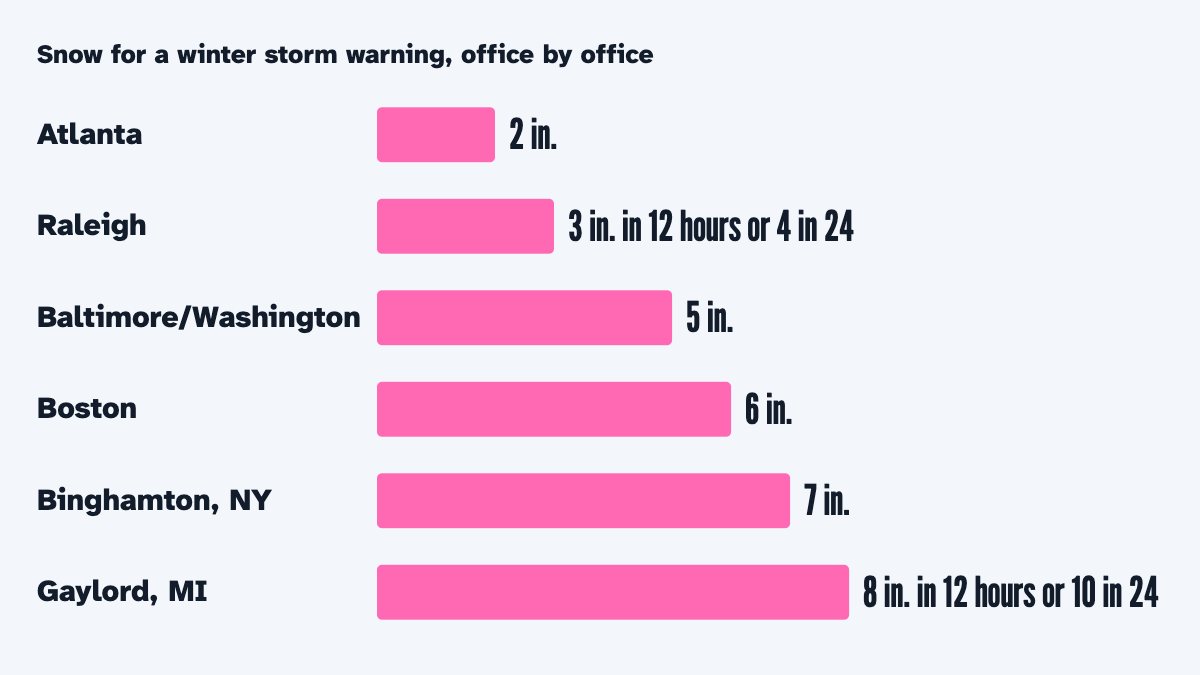
The National Weather Service office in Norton, which covers Boston, sets its own bars. It issues a Winter Storm Warning for 6 inches averaged over a forecast zone (7 in the Berkshires) and an advisory for 3 inches in 12 hours. Its warnings cover snow expected “within the next 12 to 36 hours.” A warning raises the calculator’s chance more than a watch or an advisory.
Do snow days have to be made up in Massachusetts?
Only when closings push a district below 180 days. Under 603 CMR 27.03, every school committee must schedule at least 185 days and operate the schools “at least 180 school days in a school year.” The first 5 closings come out of that gap.
Hours count too. The same regulation asks for at least 900 hours of structured learning time a year for elementary students and 990 for secondary students, and at least 425 hours for kindergarten programs.
Past the cushion, a district can ask for relief. The Commissioner may waive the 180 days on a district’s written request when an emergency or extraordinary circumstance forces one or more of its schools to close, and the Board can waive the rule for good cause. A school committee may also let seniors finish up to 12 school days early.
What we did not find: how many weather days the Commissioner usually forgives, or a deadline for asking. We read the regulation itself, most recently amended May 25, 2021, not separate department guidance.
Can Massachusetts schools switch to remote learning instead?
Not for an ordinary snow day, as far as the rules we read go. 603 CMR 27.00 allows remote education models only after the Governor declares a public-health emergency, or after the Board finds “exigent circumstances” that keep students from attending safely.
Even then, remote time counts as structured learning time only if the district’s model meets the regulation’s standards. They include regular contact with teachers, attendance tracking, live instruction every school day, and at least 40 hours of live instruction over 10 school days. We found no provision that lets a remote day replace a snow day, and still count toward the 180, outside such an emergency or Board finding.
What does research say about snow days in Massachusetts?
A 2014 study of Massachusetts students found that closings showed no effect on math scores; absences did. Economist Joshua Goodman’s paper for the National Bureau of Economic Research put it this way: “moderate snowfall induces student absences while extreme snowfall induces school closures.”
He counted days with 4 to 10 inches as moderately snowy and 10 or more as extremely snowy. The average student had 2.3 school days a year with 4 or more inches and 0.3 with 10 or more. In his account, the state did not track closings, so he emailed about 350 districts for their counts from 2003 to 2010.
Each absence caused by bad weather lowered math achievement by about 0.05 standard deviations, while closings showed no such effect. His explanation is that teachers handle a disruption that hits everyone at once far better than scattered absences.
The paper gives no single closing number, though a footnote says most schools would also shut on days with 9 inches. Our rule of thumb lands near that for Boston (8.5) and Worcester (9), but the study was not a test of our rule.
Where does Massachusetts get the most snow?
Ashfield, about 1,340 feet up, has the highest normal of the state’s 43 NOAA weather stations: 85.3 inches a year. Worthington (77.1), Ashburnham (75.2) and the Worcester airport (72.9) follow.
Normal snowfall a year and normal December to February low at each of the 43 weather stations in Massachusetts with a snowfall normal in NOAA's U.S. Climate Normals for 1991–2020, with each station's location, elevation and how complete its record is.
The 10 snowiest and 5 least snowy of 43 stations in Massachusetts
| Station | Normal snowfall | Dec–Feb low | Elevation |
|---|---|---|---|
| Ashfield | 85.3 in. | — | 1,340 ft |
| Worthington | 77.1 in. | 14°F | 1,285 ft |
| Ashburnham | 75.2 in. | 16°F | 1,108 ft |
| Worcester Regional Airport | 72.9 in. | 20°F | 1,000 ft |
| Blue Hill Coop | 69.7 in. | 21°F | 625 ft |
| Blue Hill | 69.3 in. | 22°F | 625 ft |
| Groveland | 67.1 in. | 20°F | 30 ft |
| E Brimfield Lake | 63.5 in. | 19°F | 700 ft |
| Reading | 63.5 in. | 21°F | 110 ft |
| Newburyport | 61.9 in. | — | 55 ft |
| … | |||
| Rochester | 30.8 in. | 23°F | 65 ft |
| Taunton | 25.7 in. | 22°F | 20 ft |
| Edgartown | 25.3 in. | 28°F | 30 ft |
| Chatham | 24.5 in. | 27°F | 40 ft |
| Hyannis | 21.5 in. | 25°F | 60 ft |
Download “Normal snowfall at Massachusetts weather stations, 1991–2020” (CSV, opens in Excel)
Built from: U.S. Climate Normals, 1991–2020 (National Centers for Environmental Information).
By our rule of thumb, a place with Ashfield’s snowfall would need about 11 inches to close. The least snowy stations are Hyannis (21.5 inches), Chatham (24.5) and Edgartown (25.3); a place with Hyannis’s snowfall would need about 4.5.
The middle station gets 49.2 inches. Of the 43, 11 are what NOAA calls standard, with 24 or more years of records, and 32 are provisional, with at least 10. The normals cover 1991 to 2020.
How cold does it have to be to close school in Massachusetts?
The regulation we read sets no temperature, so the calculator uses our cold point: a wind chill of −22°F to −26°F in the map’s cities, by our rule of thumb. It is the normal December-to-February low minus 45°F. Districts that publish a cold number are listed in our guide to cold-weather closings.
Boston and Cambridge, with normal winter lows near 23°F, sit at −22°F. Worcester and Springfield, near 19°F, sit at −26°F. The calculator checks the wind chill from 5 to 9 AM.
The number is not the whole story. NOAA’s wind chill page shows that −40°F with a 5 mph wind and −20°F with a 45 mph wind both give about −58°F, yet frostbite comes faster in the windier case: “you cannot rely on the wind chill value alone.” The Weather Service’s Extreme Cold Warning, the name it has used since on or about October 1, 2024, weighs most of the cold alerts in the calculator.
Who decides, and when do families hear?
Your school committee and superintendent close schools; the Commissioner handles waivers of the 180 days. In Boston, the mayor announced the February 2026 closing.
We did not find a written Boston Public Schools decision clock, so we cannot give you a time. For any district, check its website, app, or local TV and radio.
The calculator gives you a chance the night before. It reads the National Weather Service forecast for the part of your ZIP code where most people live, weighs snow by when it falls, and shows its reasons. If your district tends to stay open, set it to rarely closes; forecasts change, so look again in the morning.
Snow days in Massachusetts
- Snow
- 7.5 inches in Springfield
- 8.5 in Boston
- 9 in Worcester
- Cold
- Our cold point −22°F to −26°F
- Extreme Cold Warning
- School year
- 185 days scheduled
- 180 required
- 900 or 990 hours
- Make-up
- Cushion of 5 days
- Commissioner waiver
- Seniors up to 12 days early
- Remote learning
- Declared emergencies only
- Daily live teaching
- Research
- Absences hurt scores
- Closings did not
- 9-inch footnote
Questions people ask
How many snow days do Massachusetts schools have?
The rules build in 5. Districts schedule at least 185 days and must operate at least 180, so the first 5 closings need no make-up. Beyond that, days are added or the Commissioner grants a waiver.
Can Massachusetts schools do remote learning on a snow day?
Not as a counted school day, under the rules we read, unless the Governor has declared a public-health emergency or the Board has found exigent circumstances.
Do Massachusetts seniors have to make up snow days?
Not always. The regulation lets a school committee release seniors up to 12 school days before the end of the year.
How much snow closes Boston Public Schools?
There is no published number. The February 2026 closing followed 15 inches in 24 hours. By our rule of thumb, Boston closes about half the time at 8.5 inches.
Sources: 603 CMR 27.00, Student Learning Time (Massachusetts DESE); Goodman, Flaking Out, NBER Working Paper 20221 (2014); City of Boston, February 2026 storm update.
Facts checked October 29, 2026.
More guides
-
-
-
-
-
-