New Jersey Snow Day Calculator: Chances, 180 Days and Remote Rules
By our rule of thumb, 5 to 5.5 inches of snow closes schools in New Jersey's big cities half the time. Remote days count only in longer, declared emergencies.

- Under 5%
- 5 to 24%
- 25 to 49%
- 50 to 74%
- 75% or more
The next school day in New Jersey
Worked out from the National Weather Service forecast, 3:07 PM EDT, Thursday.
- Newark<1% snow dayFriday: no snow
- Jersey City<1% snow dayFriday: no snow
- Paterson<1% snow dayFriday: no snow
- Elizabeth<1% snow dayFriday: no snow
- Trenton<1% snow dayFriday: no snow
- Clifton<1% snow dayFriday: no snow
In New Jersey’s big cities, 5 to 5.5 inches of snow is where schools close about half the time, by our rule of thumb. Newark, Jersey City, Paterson, Elizabeth and Clifton all sit at 5.5 inches. Trenton, with a little less snow, sits at 5.
Those six cities have very similar winters, 25 to 29.8 inches of snow a year, so the bigger differences lie elsewhere. The state’s snowiest NOAA station, Sussex, about 670 feet up, normally gets 38.7 inches. Brant Beach–Beach Haven, about 5 feet above sea level, gets 10.2.
The school-year rule is plain and strict. A district gets no state aid unless it held school for at least 180 days, and a day closed for weather is not a day in session. A remote day can count only when a closure runs more than 3 school days in a row under a declared emergency.
How much snow closes school in New Jersey?
About 5.5 inches in most of New Jersey’s big cities, and 5 in Trenton, by our rule of thumb. That is the amount at which schools close about half the time.
New Jersey's six largest cities: normal snowfall a year (NOAA 1991–2020) and the snowfall and wind chill at which, by our rule of thumb, schools there usually close.
| City | Normal snowfall | Usually closes at | Cold point (wind chill) |
|---|---|---|---|
| Newark | 29 in. a year | 5.5 in. of snow | −18°F |
| Jersey City | 29.8 in. a year | 5.5 in. of snow | −16°F |
| Paterson | 29.4 in. a year | 5.5 in. of snow | −20°F |
| Elizabeth | 29.1 in. a year | 5.5 in. of snow | −18°F |
| Trenton | 25 in. a year | 5 in. of snow | −21°F |
| Clifton | 29.4 in. a year | 5.5 in. of snow | −20°F |
Our rule of thumb: the usual closing point is 0.5 × (normal snowfall a year)0.7, the cold point the normal December–February low minus 45°F. How the calculator works.
The cities barely differ. Newark (29 inches a year), Jersey City (29.8), Paterson and Clifton (29.4) and Elizabeth (29.1) all round to the same closing point. Trenton’s 25 inches put it half an inch lower.
Across the whole state, the range is wider. By our rule of thumb, a place with Sussex’s 38.7 inches would need about 6.5 inches to close, and one with Beach Haven’s 10.2 about 2.5. Type your ZIP code and the calculator reads the forecast for the part of it where most people live.
Wind changes the math. If gusts reach 25 mph or more while an inch or more of snow falls, the calculator counts that snow more heavily. Snow in the afternoon and evening before school counts at 80%, and snow overnight or during bus hours counts in full.
Do snow days have to be made up in New Jersey?
When they leave a district short of 180 days, yes. A district needs 180 days in session for state aid under N.J.S.A. 18A:7F-9, as rewritten by P.L.2020, c.27, and under the state’s regulations a day closed for inclement weather does not count as one.
A day in session must last at least 4 hours, not counting recess and lunch, under N.J.A.C. 6A:32-8.3. Kindergarten can be one continuous session of 2.5 hours. The rules we read set no yearly hours minimum.
The only relief written into the section belongs to the Commissioner of Education, who, “for good cause shown, may remit the penalty.” The rules we read do not set a number of free snow days, say how many spare days a calendar should hold, or describe the Department’s current make-up procedure.
A note on what we read. The legislature’s database would not open the current text of N.J.S.A. 18A:7F-9 for us, so these facts come from the 2020 law that rewrote it and from the state’s regulations as compiled August 4, 2025. Any later change is not reflected here.
Can New Jersey schools switch to remote learning instead?
Only in a long, declared emergency. Under P.L.2020, c.27, approved April 14, 2020, virtual or remote days count toward the 180 only when a district must close “for more than three consecutive school days due to a declared state of emergency.” A declared public health emergency or a health agency’s directive also qualifies.
A one-night storm does not meet that test. Nothing in the rules we read lets a single snow day be replaced by a remote day that counts toward the 180.
When the test is met, the chief school administrator may start the district’s approved virtual program under N.J.A.C. 6A:32-13.1. Each board must send its program to the Commissioner by July 31 every year, covering equal access, students with disabilities, multilingual learners, attendance and meals.
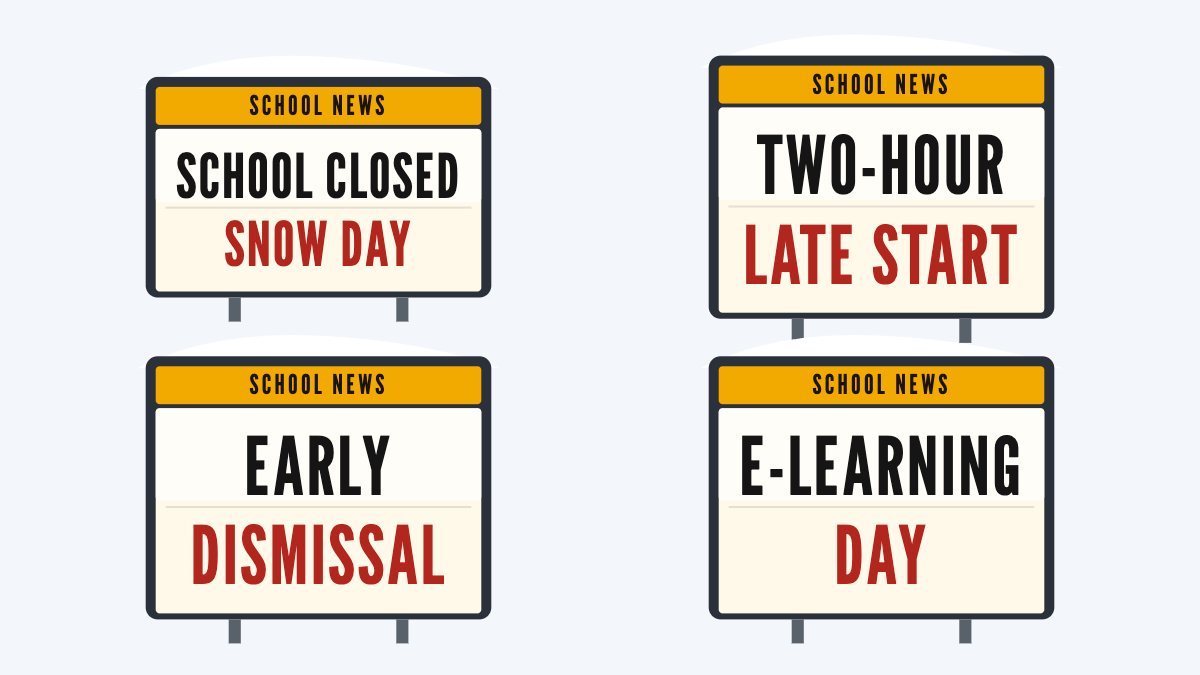
On such a day, a student counts as present with at least half a day of instruction or instruction-related activity. If your district calls a virtual day after a single storm, ask how that day counts toward the 180; the state texts we read do not cover it. Our guide to snow days, delays and e-learning days explains the terms.
Where does New Jersey get the most snow?
Sussex has the highest normal of New Jersey’s 27 NOAA weather stations, 38.7 inches a year. The Newark airport, only about 7 feet above sea level, is second at 31.5, then Pottersville at 29.6 and New Brunswick at 29.0.
Normal snowfall a year and normal December to February low at each of the 27 weather stations in New Jersey with a snowfall normal in NOAA's U.S. Climate Normals for 1991–2020, with each station's location, elevation and how complete its record is.
The 10 snowiest and 5 least snowy of 27 stations in New Jersey
| Station | Normal snowfall | Dec–Feb low | Elevation |
|---|---|---|---|
| Sussex 3 Wnw | 38.7 in. | 19°F | 667 ft |
| Newark International Airport | 31.5 in. | 28°F | 7 ft |
| Pottersville 2 Nnw | 29.6 in. | — | 365 ft |
| New Brunswick 3 Se | 29 in. | 25°F | 111 ft |
| Harrison | 28.2 in. | 27°F | 24 ft |
| Oak Ridge Reservoir | 28.1 in. | — | 847 ft |
| Flemington 5 Nnw | 27.1 in. | 23°F | 265 ft |
| Ewing Twp 0.8 Ese | 26.6 in. | — | 100 ft |
| Trenton Mercer County Airport | 26.6 in. | 27°F | 184 ft |
| Cranford | 26.3 in. | 27°F | 80 ft |
| … | |||
| Cape May 2 Nw | 14.8 in. | 30°F | 20 ft |
| Lambertville | 13.4 in. | 22°F | 68 ft |
| Woodstown Pittsgrov 4E | 13.3 in. | 27°F | 98 ft |
| Seabrook Farms | 11.8 in. | 27°F | 104 ft |
| Brant Beach-beach Haven | 10.2 in. | 30°F | 5 ft |
Download “Normal snowfall at New Jersey weather stations, 1991–2020” (CSV, opens in Excel)
Built from: U.S. Climate Normals, 1991–2020 (National Centers for Environmental Information).
The middle of the list is 23.7 inches. The 5 least snowy stations all normally see under 15 inches: Cape May (14.8), Lambertville (13.4), Woodstown (13.3), Seabrook Farms (11.8) and Brant Beach–Beach Haven (10.2).
Only 4 of the 27 stations are what NOAA calls standard, with 24 or more years of records; the other 23 are provisional, with at least 10. The normals cover 1991 to 2020.
How cold does it have to be to close school in New Jersey?
The New Jersey rules we read set no temperature, so the calculator uses our cold point: a wind chill of −16°F to −21°F in the map’s cities, by our rule of thumb. It is the normal December-to-February low minus 45°F. Districts that do publish a number are gathered in our guide to cold-weather closings.
Jersey City, with a normal winter low of 28.8°F, sits at −16°F. Trenton, at 24.3°F, sits at −21°F, the coldest point on our New Jersey map. The calculator checks the wind chill from 5 to 9 AM.
Weather Service alerts matter too. An Extreme Cold Watch means dangerous cold is possible but its timing or place is still uncertain; an Extreme Cold Warning means it is expected or happening. Those names replaced the wind chill alerts on or about October 1, 2024. A warning moves the calculator’s chance more than a watch.
Who decides, and when do families hear?
Your district calls the closure. In a declared emergency of more than 3 school days, its chief school administrator starts any approved virtual program, under N.J.A.C. 6A:32-13.1. The Commissioner of Education handles relief from the 180-day penalty.
Each district sets its own announcement routine, so check its website, app, or local TV and radio. If you hear about a virtual day, check whether the district calls it a closure or a school day. Our guide to how schools decide snow days covers the morning routine elsewhere.
The calculator’s job is the night before. It reads the National Weather Service forecast for the part of your ZIP code where most people live, weighs the snow by when it falls, and shows its reasons. Forecasts change, so look again in the morning.
Snow days in New Jersey
- Snow
- 5.5 inches in Newark
- 5 in Trenton
- About 6.5 at Sussex
- Cold
- Our cold point −16°F to −21°F
- Extreme Cold Warning
- School year
- 180 days for state aid
- Days of 4 hours or more
- Make-up
- Snow day is not a day in session
- Commissioner may remit penalty
- Remote days
- Closed more than 3 days
- Declared emergency
- Plan filed by July 31
- Who decides
- Your district
- Commissioner for penalties
Questions people ask
How many snow days do New Jersey schools get?
The state rules we read set no number. A district needs 180 days in session for state aid, and a snow day does not count, so the answer depends on how many spare days your district built into its calendar.
Can New Jersey schools have a virtual snow day?
A virtual day counts toward the 180 only when schools must close for more than 3 school days in a row under a declared emergency, a declared public health emergency or a health agency’s directive. The rules we read do not provide for a counted remote day after an ordinary storm.
How long does a New Jersey school day have to be?
At least 4 hours, not counting recess and lunch. A kindergarten day can be a single 2.5-hour session.
What happens if a New Jersey district falls short of 180 days?
The law withholds state aid, but the Commissioner of Education may excuse the penalty for good cause.
Sources: P.L.2020, c.27 (amending N.J.S.A. 18A:7F-9); N.J.A.C. 6A:32 (New Jersey Department of Education); National Weather Service, cold alerts.
Facts checked October 29, 2026.
More guides
-
-
-
-
-
-