Connecticut Snow Day Calculator: Chances, Make-Ups and Remote Days
By our rule of thumb, 6 to 8 inches of snow closes schools in Connecticut's big cities half the time. Make-up days can't fall on weekends, and remote learning can count.

- Under 5%
- 5 to 24%
- 25 to 49%
- 50 to 74%
- 75% or more
The next school day in Connecticut
Worked out from the National Weather Service forecast, 3:07 PM EDT, Thursday.
- Bridgeport<1% snow dayFriday: no snow
- Stamford<1% snow dayFriday: no snow
- New Haven<1% snow dayFriday: no snow
- Hartford<1% snow dayFriday: no snow
- Waterbury<1% snow dayFriday: no snow
- Norwalk<1% snow dayFriday: no snow
In Connecticut’s big cities, 6 to 8 inches of snow is where schools close about half the time, by our rule of thumb. Bridgeport, Stamford, Norwalk and New Haven sit at 6 inches, Waterbury at 7.5, and Hartford at 8.
The split follows the snow. Bridgeport, Stamford, Norwalk and New Haven normally get 34 to 37 inches a winter, while Hartford gets 51.3 and Waterbury 50. Our rule assumes that a city expecting more snow needs more of it to close.
Connecticut asks for 180 days and 900 hours of school a year. On a snowy morning, 2 rules matter: make-up sessions cannot fall on a Saturday or Sunday, and remote learning counts as an actual school session when it meets the state’s standards.
How much snow closes school in Connecticut?
Between 6 and 8 inches in the six cities on our map, by our rule of thumb. That is the amount at which schools close about half the time.
Connecticut's six largest cities: normal snowfall a year (NOAA 1991–2020) and the snowfall and wind chill at which, by our rule of thumb, schools there usually close.
| City | Normal snowfall | Usually closes at | Cold point (wind chill) |
|---|---|---|---|
| Bridgeport | 34.8 in. a year | 6 in. of snow | −19°F |
| Stamford | 34.3 in. a year | 6 in. of snow | −20°F |
| New Haven | 36.6 in. a year | 6 in. of snow | −22°F |
| Hartford | 51.3 in. a year | 8 in. of snow | −23°F |
| Waterbury | 50 in. a year | 7.5 in. of snow | −24°F |
| Norwalk | 35.4 in. a year | 6 in. of snow | −20°F |
Our rule of thumb: the usual closing point is 0.5 × (normal snowfall a year)0.7, the cold point the normal December–February low minus 45°F. How the calculator works.
The cities at 6 inches share that point because their normals sit close together, 34.3 to 36.6 inches a year. Hartford, with 51.3 inches, needs 2 inches more to reach the same odds, and Waterbury, with 50, needs 1.5 more.
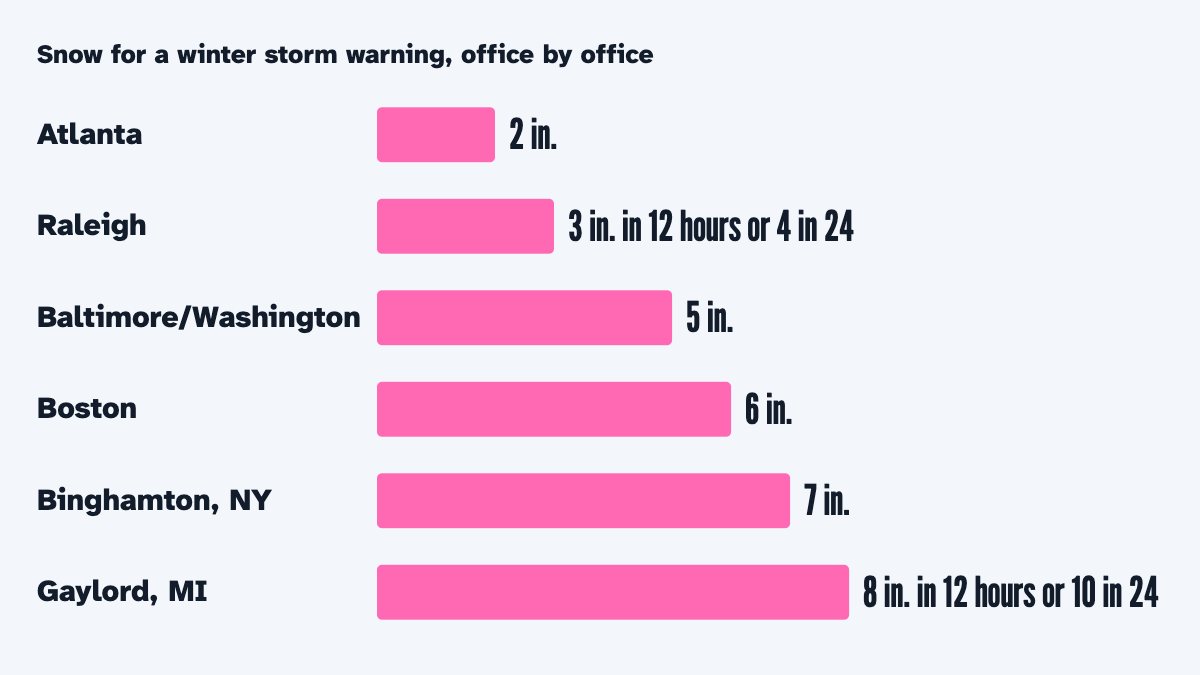
Each National Weather Service office sets its own alert criteria (NWS winter alerts). For the Connecticut zones covered by the office in Norton, Massachusetts, its criteria say a Winter Storm Warning means 6 inches averaged over a zone, and an advisory means 3 inches in 12 hours, or any freezing rain on roads.
Ice needs far less than snow. By our rule of thumb, about a tenth of an inch of ice closes schools almost anywhere; the exact point runs from 0.08 inch where snow is rare to 0.18 where it is common. The calculator also counts snow in full only when it falls overnight or during bus hours, 6 to 10 AM.
Your district may not match its city. If it is known for holding out, tell the calculator it rarely closes; if it calls off school at the first sign of trouble, choose closes easily. The closing point moves either way.
Do snow days have to be made up in Connecticut?
Yes, when they leave a district short of 180 days or 900 hours. Conn. Gen. Stat. § 10-16 asks for “no less than one hundred eighty days of actual school sessions” for kindergarten through grade 12, and 900 hours of actual school work. Half-day kindergarten needs 450 hours.
The make-up has 2 limits. Under § 10-15, sessions cancelled for bad weather cannot be rescheduled on a Saturday or Sunday. And § 10-16 counts no more than 7 hours of work in any school day, so a longer day past 7 hours adds nothing.
The State Board of Education may shorten a school year for an unavoidable emergency, for a whole district, a school or part of a school. It may also approve a one-year alternative schedule that still gives at least 900 hours, or 450 for half-day kindergarten.
We did not find a fixed number of forgiven days, or the State Board’s written waiver procedure. § 10-16 was last amended by Public Act 23-160, effective June 28, 2023.
Can Connecticut schools switch to remote learning instead?
Yes. Under § 10-16, “Remote learning shall be considered an actual school session,” as long as it follows the standards the Commissioner of Education sets under § 10-4w.
From the school year that began July 1, 2024, a board may authorize remote learning for kindergarten through grade 12 if it follows those standards and adopts an attendance policy. A student counts as present after spending at least half of the school day in virtual classes or meetings, in learning systems that log time, or turning in assignments. The law bars dual instruction, teaching a live class and remote students at the same time, except for students with IEPs or 504 plans and for approved cooperative programs.
Neither section caps the number of remote days. We did not read the Commissioner’s standards themselves, so ask your district what its remote day looks like. The remote-learning wording entered § 10-16 in 2021, and the K-12 rule in § 10-4w applies from 2024–25. Our guide to snow days, delays and e-learning days compares the options.
Where does Connecticut get the most snow?
Norfolk, about 1,340 feet up, has the highest normal of Connecticut’s 14 NOAA weather stations: 74.9 inches a year. Bakersville (59.1), the Hartford Bradley airport (51.7) and Barkhamsted (51.4) follow.
Normal snowfall a year and normal December to February low at each of the 14 weather stations in Connecticut with a snowfall normal in NOAA's U.S. Climate Normals for 1991–2020, with each station's location, elevation and how complete its record is.
Every station in Connecticut, snowiest first
| Station | Normal snowfall | Dec–Feb low | Elevation |
|---|---|---|---|
| Norfolk 2 Sw | 74.9 in. | 17°F | 1,340 ft |
| Bakersville | 59.1 in. | 17°F | 686 ft |
| Hartford Bradley International Airport | 51.7 in. | 21°F | 190 ft |
| Barkhamsted | 51.4 in. | 17°F | 710 ft |
| Danbury | 49.3 in. | 23°F | 405 ft |
| Woodbury | 46.8 in. | — | 650 ft |
| Storrs | 39 in. | 22°F | 665 ft |
| Burlington | 38.6 in. | 20°F | 505 ft |
| W Thompson Lake | 38.5 in. | 18°F | 360 ft |
| Jewett City | 38 in. | — | 400 ft |
| Stamford 5 N | 34 in. | 24°F | 190 ft |
| Bridgeport Sikorsky Mem Airport | 33.6 in. | 27°F | 5 ft |
| Norwich Public Utility Plt | 27.8 in. | 24°F | 20 ft |
| Groton | 24.5 in. | 26°F | 40 ft |
Download “Normal snowfall at Connecticut weather stations, 1991–2020” (CSV, opens in Excel)
Built from: U.S. Climate Normals, 1991–2020 (National Centers for Environmental Information).
By our rule of thumb, a place with Norfolk’s snowfall would need about 10.5 inches to close, about 1.75 times the 6 inches of Bridgeport. The least snowy stations are Groton, at 24.5 inches, and the Norwich utility plant, at 27.8.
The middle of the 14 is 38.8 inches. Only 3 are what NOAA calls standard, with 24 or more years of records; 11 are provisional, with at least 10. The normals cover 1991 to 2020.
How cold does it have to be to close school in Connecticut?
Connecticut’s school-year laws set no temperature, so the calculator uses our cold point: a wind chill of −19°F to −24°F in the map’s cities, by our rule of thumb. It is the normal December-to-February low minus 45°F. For the districts that do publish a cold number, see how cold is too cold for school.
Bridgeport, with a normal winter low of 25.9°F, sits at −19°F. Waterbury, at 21.2°F, sits at −24°F. The calculator checks the wind chill from 5 to 9 AM.
Wind chill and frostbite are not the same thing. The Weather Service’s wind chill page says you “can only get frostbite if the actual air temperature” is below freezing. An Extreme Cold Warning, which replaced the Wind Chill Warning on or about October 1, 2024, raises the calculator’s chance more than a Cold Weather Advisory.
Who decides, and when do families hear?
Your local or regional board of education and its superintendent close schools. The State Board of Education approves a shortened year.
Because a remote day counts as a school session, read the announcement closely: it may be a school day at home rather than a day off. Your district’s website, app, or local TV and radio carry the decision. Our guide to how schools decide snow days explains what superintendents weigh.
The calculator gives you a chance the night before. It reads the National Weather Service forecast for the part of your ZIP code where most people live and shows its reasons, so you can tell a snow-driven chance from an ice-driven one. Forecasts change, so check again in the morning.
Snow days in Connecticut
- Snow
- 6 inches in Bridgeport
- 7.5 in Waterbury
- 8 in Hartford
- Cold
- Our cold point −19°F to −24°F
- Extreme Cold Warning
- School year
- 180 days and 900 hours
- 7 hours a day at most
- Make-up
- No Saturdays or Sundays
- State Board can shorten the year
- Remote learning
- Counts as a session
- State standards
- Half-day attendance rule
- Who decides
- Local board
- Superintendent
Questions people ask
Do Connecticut schools make up snow days on Saturdays?
No. When sessions are cancelled for bad weather, state law says the rescheduled sessions cannot be held on a Saturday or Sunday.
Do remote learning days count in Connecticut?
Yes, as actual school sessions, if they follow the Commissioner’s standards and the board’s attendance policy. A student must spend at least half the school day in remote work to count as present.
How many snow days do Connecticut schools get?
State law sets no number. Districts need 180 days and 900 hours, so how many closings a calendar can absorb depends on the days your district scheduled beyond 180.
What happens to half-day kindergarten on a late opening?
On a late opening or early dismissal for weather, a district that runs separate morning and afternoon kindergarten sessions may hold either one that day, under § 10-16. Your district decides which.
Can a Connecticut teacher teach in class and online at once?
Not as a rule. Dual instruction is barred, except for students with IEPs or 504 plans and approved cooperative programs.
Sources: Conn. Gen. Stat. §§ 10-15 and 10-16 and § 10-4w (Connecticut General Assembly); National Weather Service Boston/Norton, alert criteria.
Facts checked October 29, 2026.
More guides
-
-
-
-

-
-