West Virginia Snow Day Calculator: Chances, NTI and Make-Up Days
By our rule of thumb, 3 to 5 inches of snow closes West Virginia schools about half the time. Lost days are made up, up to 5 NTI days can count, and hours replace days in 2027.

- Under 5%
- 5 to 24%
- 25 to 49%
- 50 to 74%
- 75% or more
The next school day in West Virginia
Worked out from the National Weather Service forecast, 3:07 PM EDT, Thursday.
- Charleston<1% snow dayFriday: no snow
- Huntington<1% snow dayFriday: no snow
- Morgantown<1% snow dayFriday: no snow
- Parkersburg<1% snow dayFriday: no snow
- Wheeling<1% snow dayFriday: no snow
- Martinsburg<1% snow dayFriday: no snow
West Virginia gets real snow, and far more of it up high. Charleston’s normal is 26.1 inches a year and Martinsburg’s 27.3, while Huntington’s is 11.7, by NOAA’s 1991–2020 normals. By our rule of thumb, it takes about 5 inches of overnight snow for Charleston or Martinsburg schools to close about half the time, and about 3 inches in Huntington or Parkersburg.
The mountains are another matter. Weather stations at Terra Alta and near Davis each average more than 170 inches of snow a year, and Snowshoe almost 145.
The school year has firm rules. For 2026–27, state law requires 180 separate instructional days, and counties must put make-up days in the calendar; that text comes from a 2017 law. From July 1, 2027, a 2026 law switches the count to 900 hours of instruction.
How much snow closes school in West Virginia?
About 3 to 5 inches in the state’s larger cities, by our rule of thumb. That is the overnight snow at which schools close about half the time, worked out from each city’s normal snowfall.
West Virginia's six largest cities: normal snowfall a year (NOAA 1991–2020) and the snowfall and wind chill at which, by our rule of thumb, schools there usually close.
| City | Normal snowfall | Usually closes at | Cold point (wind chill) |
|---|---|---|---|
| Charleston | 26.1 in. a year | 5 in. of snow | −19°F |
| Huntington | 11.7 in. a year | 3 in. of snow | −17°F |
| Morgantown | 19.1 in. a year | 4 in. of snow | −20°F |
| Parkersburg | 14.1 in. a year | 3 in. of snow | −19°F |
| Wheeling | 16.1 in. a year | 3.5 in. of snow | −21°F |
| Martinsburg | 27.3 in. a year | 5 in. of snow | −20°F |
Our rule of thumb: the usual closing point is 0.5 × (normal snowfall a year)0.7, the cold point the normal December–February low minus 45°F. How the calculator works.
The spread is wide for a small state. Huntington, the least snowy of the six cities at 11.7 inches a year, and Parkersburg (14.1) sit near 3 inches. Wheeling (16.1) is near 3.5, Morgantown (19.1) near 4, and Charleston (26.1) and Martinsburg (27.3) near 5.
A county in the high country gets far more snow than any of these cities, so the nearest city’s number may not fit your district. If your schools close more or less easily than the city near you, tell the calculator: that setting moves the closing point.
Timing matters as much as depth. Snow that falls overnight (9 PM to 6 AM) or while buses run (6 to 10 AM) counts fully; snow during the school day counts at 45%. Gusts of 25 mph or more while an inch or more falls make snow count more, and snow falling above freezing counts less. More on how the calculator works.
Where does West Virginia get the most snow?
On the high ground. NOAA keeps snowfall normals for 66 West Virginia weather stations, and the top two are almost tied: Terra Alta, about 2,630 feet up, averages 171.1 inches a year, and a station near Davis 170.2. Snowshoe, about 4,850 feet up, averages 144.7 inches, Bayard 117.8, Glady 102.7 and Richwood 100.0.
Normal snowfall a year and normal December to February low at each of the 66 weather stations in West Virginia with a snowfall normal in NOAA's U.S. Climate Normals for 1991–2020, with each station's location, elevation and how complete its record is.
The 10 snowiest and 5 least snowy of 66 stations in West Virginia
| Station | Normal snowfall | Dec–Feb low | Elevation |
|---|---|---|---|
| Terra Alta #1 | 171.1 in. | 20°F | 2,630 ft |
| Davis 3SE | 170.2 in. | 18°F | 3,715 ft |
| Snowshoe | 144.7 in. | 17°F | 4,847 ft |
| Bayard | 117.8 in. | 18°F | 2,412 ft |
| Glady 1 N | 102.7 in. | 18°F | 2,840 ft |
| Richwood 1SSE | 100 in. | 22°F | 3,090 ft |
| Webster Springs 8 N | 91.1 in. | 22°F | 1,850 ft |
| Dailey 1 Se | 75.2 in. | — | 2,000 ft |
| Hacker Valley | 70.8 in. | 21°F | 1,582 ft |
| Elkins Randolph County Airport | 68.9 in. | 22°F | 1,979 ft |
| … | |||
| Ripley | 11.6 in. | 24°F | 608 ft |
| Parkersburg | 11.3 in. | 26°F | 620 ft |
| Winfield Locks | 10.7 in. | 26°F | 621 ft |
| Huntington Swg Pl | 10.2 in. | 27°F | 520 ft |
| Pea Ridge Psd | 9.6 in. | 29°F | 584 ft |
Download “Normal snowfall at West Virginia weather stations, 1991–2020” (CSV, opens in Excel)
Built from: U.S. Climate Normals, 1991–2020 (National Centers for Environmental Information).
Half the stations average 26.1 inches or more, about what Charleston gets. Even the least snowy get some: Pea Ridge averages 9.6 inches, a Huntington station 10.2, Winfield Locks 10.7 and Parkersburg 11.3. The calculator works from the normal for your own area, which is why one storm can give two counties very different chances.
Do snow days have to be made up in West Virginia?
Yes, for the 2026–27 school year. The version of W. Va. Code 18-5-45 in force until June 30, 2027, written by House Bill 2711 of 2017, requires “no less than one hundred eighty separate instructional days” inside a 200-day employment term, with at least 315 minutes of instruction a day in grades K–5, 330 in grades 6–8 and 345 in grades 9–12.
Counties have three tools under the same law. They can lengthen the school day by at least 30 minutes and apply up to five days of that banked time to cancel days lost to necessary closings. They must schedule out-of-calendar days to use for instruction if school is canceled. And if 180 days still cannot be reached, the county board must schedule instruction on any available non-instructional day, though not on holidays, election day or weekends. Late arrivals and early dismissals are made up under a county policy.
In a disaster, the state superintendent can shorten the minimum term in a county declared a federal disaster area, or covered by a Governor’s emergency declaration tied to the lost days, and the State Board can grant a county waivers.
The rules change on July 1, 2027. Senate Bill 890, approved by the Governor on April 1, 2026 as Chapter 119 of the 2026 Acts, sets the minimum at 900 hours a year, in the bill’s enrolled text. If a calendar cannot reach 900 hours, the county must add hours or use any available day, including out-of-calendar days. The 200-day employment term stays.
Can West Virginia schools switch to remote learning instead?
Yes, on up to five days, with a plan the state has approved. Under the law in force now, as rewritten in 2017, a county whose plan the State Board has approved may “deliver instruction through alternative methods” on up to five days when schools close for bad weather or other unforeseen circumstances, and those days count as instructional days. They are known as NTI days, for non-traditional instruction: teachers assign and grade work for students to do on the closed days.
From July 1, 2027, alternative methods can count for up to 25 hours of instruction when schools close for bad weather, with the State Board approving the plan and the number of hours, under the bill’s enrolled text. A 2026 bill to raise the limit from five days to ten, Senate Bill 176, was sent to the Senate Finance Committee in February 2026 and went no further.
We did not find the State Board’s criteria for approving a plan, or a list of counties that have one, so ask your county schools whether NTI days are part of their calendar.
How cold does it have to be to close school in West Virginia?
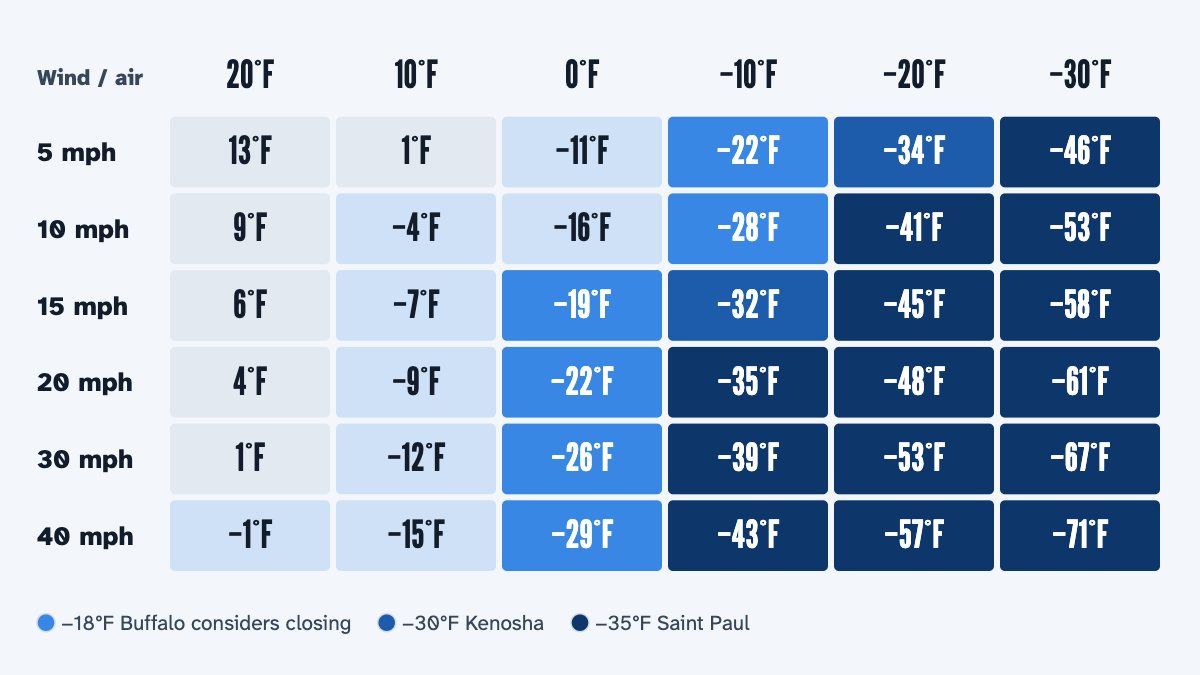
Far colder than a normal winter morning, by our rule of thumb: a wind chill near −17°F at bus time in Huntington, −19°F in Charleston and Parkersburg, −20°F in Morgantown and Martinsburg, and −21°F in Wheeling. That is each city’s normal December–February low minus 45°F. We have no West Virginia county’s own cold number on file.
The calculator reads the wind chill from 5 to 9 AM and adds to its chance when the National Weather Service issues cold alerts. The top one is now the Extreme Cold Warning, which took over from the Wind Chill Warning on or about October 1, 2024, with the Cold Weather Advisory below it.
Wind chill has limits. The Weather Service’s wind chill chart says it is defined only at 50°F or colder with wind above 3 mph, and that bright sunshine can raise it by 10°F to 18°F.
Who decides, and when do West Virginia families hear?
The county superintendent. W. Va. Code 18-4-10 gives the county superintendent the power to “close a school temporarily when conditions are detrimental” to pupils’ health, safety or welfare.
We have not found a West Virginia county’s announcement clock, so check your county schools’ website, app or local TV and radio for the final word. The calculator reads the Weather Service forecast from 6 AM the day before to 3 PM on the school day, so its chance can change overnight as the forecast does.
It is independent: not a school system, a state agency or the National Weather Service. It shows the reasons behind each chance so you can judge them.
The page in one picture:
Snow days in West Virginia
- What closes schools
- 3 inches in Huntington
- 5 inches in Charleston
- overnight timing
- Where it snows
- Terra Alta 171 inches
- Snowshoe 145 inches
- Huntington 10 inches
- Making up days
- 180 days in 2026-27
- longer days bank 5 days
- out-of-calendar days
- NTI days
- up to 5 days now
- up to 25 hours from 2027
- state-approved plan
- Who decides
- the county superintendent
- check county schools
Questions people ask
What is an NTI day in West Virginia?
A day when buildings are closed but instruction goes on, through work teachers assign and grade. Under the law in force now, as rewritten in 2017, a county with a State Board-approved plan may use up to five such days for closings, and they count as instructional days. From July 1, 2027, the limit becomes 25 hours.
How many snow days do West Virginia schools get?
There is no set number of free days. A county can cover up to five lost days with banked time from longer school days and up to five with NTI days; the rest are made up on out-of-calendar or other non-instructional days until it reaches 180.
Will West Virginia schools count hours instead of days?
Yes, from July 1, 2027. Senate Bill 890, passed March 14, 2026, sets the minimum at 900 hours of instruction a year and lets alternative methods count for up to 25 hours when schools close for bad weather. The 2026–27 school year still runs on 180 days.
Can West Virginia schools hold class on a day off to make up snow days?
Yes. If a county cannot reach 180 days, the county board must schedule instruction on any available non-instructional day, whatever it was first planned for, except holidays, election day and weekends.
Sources: W. Va. Code 18-5-45, as in force until June 30, 2027 (House Bill 2711 of 2017, enrolled text); Senate Bill 890 (2026), enrolled text, in force from July 1, 2027; W. Va. Code 18-4-10.
Facts checked October 29, 2026.
More guides
-
-
-
-

-
-