Tennessee Snow Day Calculator: Chances and Stockpile Days
Half an inch to 1.5 inches of snow or a thin glaze of ice can close Tennessee schools, by our rule of thumb. Districts can bank up to 13 stockpile days to cover weather closings.

- Under 5%
- 5 to 24%
- 25 to 49%
- 50 to 74%
- 75% or more
The next school day in Tennessee
Worked out from the National Weather Service forecast, 3:07 PM EDT, Thursday.
- Nashville<1% snow dayFriday: no snow
- Memphis<1% snow dayFriday: no snow
- Knoxville<1% snow dayFriday: no snow
- Chattanooga<1% snow dayFriday: no snow
- Clarksville<1% snow dayFriday: no snow
- Murfreesboro<1% snow dayFriday: no snow
Snow is scarce in most of Tennessee. Nashville’s normal is 3.6 inches a year and Memphis’s 2.5, by NOAA’s 1991–2020 normals. By our rule of thumb, about 1 inch of overnight snow is enough for schools in Nashville, Memphis or Murfreesboro to close about half the time; Knoxville sits near 1.5 inches, and Chattanooga and Clarksville near half an inch.
Ice can do it on its own. The calculator treats about a tenth of an inch of ice as enough to close schools almost anywhere, and slightly less where snow is rare. In late January 2026, an ice storm closed Clarksville-Montgomery County schools for five days in a row.
What happens to the school year turns on stockpile days. Under state law, a district that runs its school day half an hour longer than the required 6.5 hours, all year, banks 13 days it can use for dangerous or extreme weather; the Department of Education’s January 2025 memo restates the law, T.C.A. 49-6-3004. Once the stockpile is used up, days are made up, and the state’s waiver is narrow.
How much snow closes school in Tennessee?
About half an inch to 1.5 inches in the state’s big cities, by our rule of thumb. That is the overnight snow at which schools close about half the time, worked out from each city’s normal snowfall, so treat it as a middle point rather than a line.
Tennessee's six largest cities: normal snowfall a year (NOAA 1991–2020) and the snowfall and wind chill at which, by our rule of thumb, schools there usually close.
| City | Normal snowfall | Usually closes at | Cold point (wind chill) |
|---|---|---|---|
| Nashville | 3.6 in. a year | 1 in. of snow | −14°F |
| Memphis | 2.5 in. a year | 1 in. of snow | −12°F |
| Knoxville | 4.4 in. a year | 1.5 in. of snow | −15°F |
| Chattanooga | 1.6 in. a year | 0.5 in. of snow | −11°F |
| Clarksville | 1.3 in. a year | 0.5 in. of snow | −15°F |
| Murfreesboro | 2.3 in. a year | 1 in. of snow | −16°F |
Our rule of thumb: the usual closing point is 0.5 × (normal snowfall a year)0.7, the cold point the normal December–February low minus 45°F. How the calculator works.
The six cities sit close together because none gets much snow. Knoxville (4.4 inches a year) needs the most, about 1.5 inches. Nashville (3.6), Memphis (2.5) and Murfreesboro (2.3) sit near 1 inch, and Chattanooga (1.6) and Clarksville (1.3) round to half an inch.
When the snow falls matters as much as how much. The calculator counts it fully overnight (9 PM to 6 AM) and while buses run (6 to 10 AM), less in the afternoon and evening before, and only 45% during the school day. Snow that falls while it is above freezing counts less, since it tends to leave roads wet. More on how the calculator works.
For ice, the National Weather Service usually issues an Ice Storm Warning at about a quarter inch of ice or more. The calculator’s ice point is lower than that, about a tenth of an inch, and Weather Service warnings add to its chance while watches and advisories add less.
Where does Tennessee get the most snow?
On the highest ground. NOAA keeps snowfall normals for 97 Tennessee weather stations, and Mount LeConte, about 6,490 feet up, leads by far with 76.8 inches a year. Next come towns about 1,600 to 1,900 feet up: Jamestown (18.9 inches), Monterey (16.0), Crossville (14.1) and Allardt (13.2), then Mountain City (12.0) and Morristown (10.2).
Normal snowfall a year and normal December to February low at each of the 97 weather stations in Tennessee with a snowfall normal in NOAA's U.S. Climate Normals for 1991–2020, with each station's location, elevation and how complete its record is.
The 10 snowiest and 5 least snowy of 97 stations in Tennessee
| Station | Normal snowfall | Dec–Feb low | Elevation |
|---|---|---|---|
| Mount Leconte | 76.8 in. | 20°F | 6,493 ft |
| Jamestown | 18.9 in. | 27°F | 1,690 ft |
| Monterey | 16 in. | 30°F | 1,860 ft |
| Crossville Ed & Research | 14.1 in. | 27°F | 1,810 ft |
| Allardt | 13.2 in. | 29°F | 1,645 ft |
| Mountain City 2 | 12 in. | 25°F | 2,419 ft |
| Morristown Weather Office | 10.2 in. | 31°F | 1,320 ft |
| Townsend 5S | 9.4 in. | 28°F | 1,893 ft |
| Erwin 1 W | 9.3 in. | 27°F | 1,720 ft |
| Bristol Tri City Airport | 9.2 in. | 28°F | 1,500 ft |
| … | |||
| Selmer | 1 in. | 32°F | 470 ft |
| Columbia 3 Wnw | 0.9 in. | 29°F | 650 ft |
| Lewisburg Experiment Station | 0.9 in. | 29°F | 787 ft |
| Clarksville Wwtp | 0.5 in. | 30°F | 402 ft |
| Dresden | 0.4 in. | 29°F | 450 ft |
Download “Normal snowfall at Tennessee weather stations, 1991–2020” (CSV, opens in Excel)
Built from: U.S. Climate Normals, 1991–2020 (National Centers for Environmental Information).
Half the stations average 3.3 inches or less. At the bottom, Dresden averages 0.4 inches and a Clarksville station 0.5. A district on high ground and a district around Clarksville follow the same stockpile rules in very different winters, which is why the calculator works from the snowfall where you live, not a state average.
Do snow days have to be made up in Tennessee?
Yes, once a district’s stockpile days are gone. State law, T.C.A. 49-6-3004, requires a term of at least 200 days with 6.5 hours of instruction a day, as the Department’s January 2025 memo restates. Of those days, 180 are for classroom instruction, as a 2025 state letter to Giles County repeats.
Stockpile days come first. Lengthening the school day by half an hour for the whole year banks 13 days, the legal maximum, and a district may use them for dangerous or extreme weather without asking the state. Unused days do not carry over to the next year.
After that, the state’s attendance manual lists ways to make up a day, as quoted in a Department letter to Scott County Schools: lengthen the school day by at least 30 minutes, hold Saturday or Sunday classes, use a scheduled holiday, shorten spring break, or extend the school year. Study hall does not count.
The state’s waiver is narrow. The Commissioner of Education may waive days only for a natural disaster or a serious illness outbreak, and the Department “will not consider such requests” until a district has used all its stockpiled days, the Department’s January 2025 memo says.
Two letters show where the line falls. In March 2025 the Department turned down Scott County’s request for an ordinary bad-weather day, February 19, 2025, but granted four days that fell under a Level 3 state of emergency once its stockpile was gone. In February 2026 it granted Clarksville-Montgomery County’s request for its five ice-storm days, January 26 to 30, noting that the district had used all its stockpile days.
Can Tennessee schools switch to remote learning instead?
For a few days. As of March 2025, the law allowed up to two remote days a semester toward the 180 days, and the Commissioner has granted more by waiver, as the Department’s Giles County letter shows. We could not confirm the count since then, so ask your district.
Since July 1, 2025, Public Chapter 484 has added hybrid days: up to four of the 180 days a year may be taught with some students in the building and others learning remotely, in dangerous or extreme weather or another emergency. The director of schools decides when to use them, and more need the Commissioner’s approval in a natural disaster or serious illness outbreak.
Remote days are not always workable. Metro Nashville Public Schools’ weather page says that, as of January 30, 2026, it had used all its allotted weather days and that remote options were “not viable” at that time.
How cold does it have to be to close school in Tennessee?
Far colder than a normal winter morning, by our rule of thumb: a wind chill near −11°F at bus time in Chattanooga, −12°F in Memphis, −14°F in Nashville, −15°F in Knoxville and Clarksville, and −16°F in Murfreesboro. That is each city’s normal December–February low minus 45°F. We have no Tennessee district’s own cold number on file.
The calculator reads the wind chill from 5 to 9 AM, when children wait for buses, and adds to its chance when the National Weather Service issues cold alerts. The top one is now the Extreme Cold Warning, which replaced the Wind Chill Warning on or about October 1, 2024; the Cold Weather Advisory is the step below.
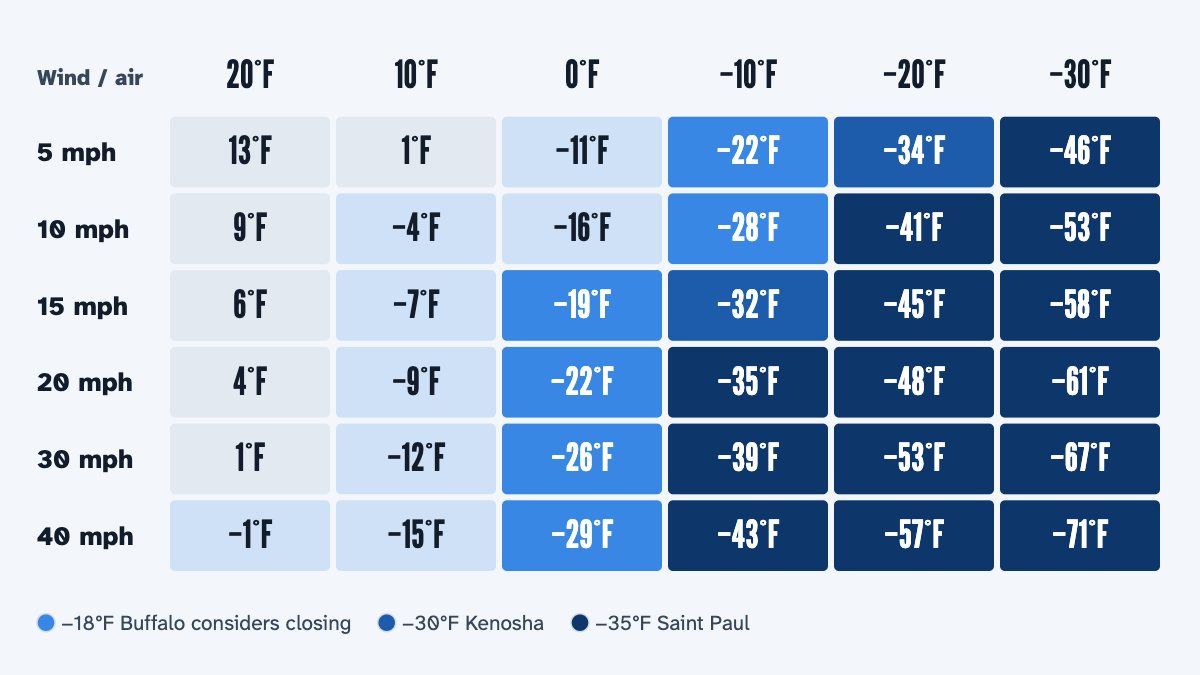
The Weather Service’s wind chill chart shows how fast cold bites: at 0°F with a 15 mph wind, the wind chill is −19°F and “exposed skin can freeze in 30 minutes.” It also says to be even more careful with children.
Who decides, and when do Tennessee families hear?
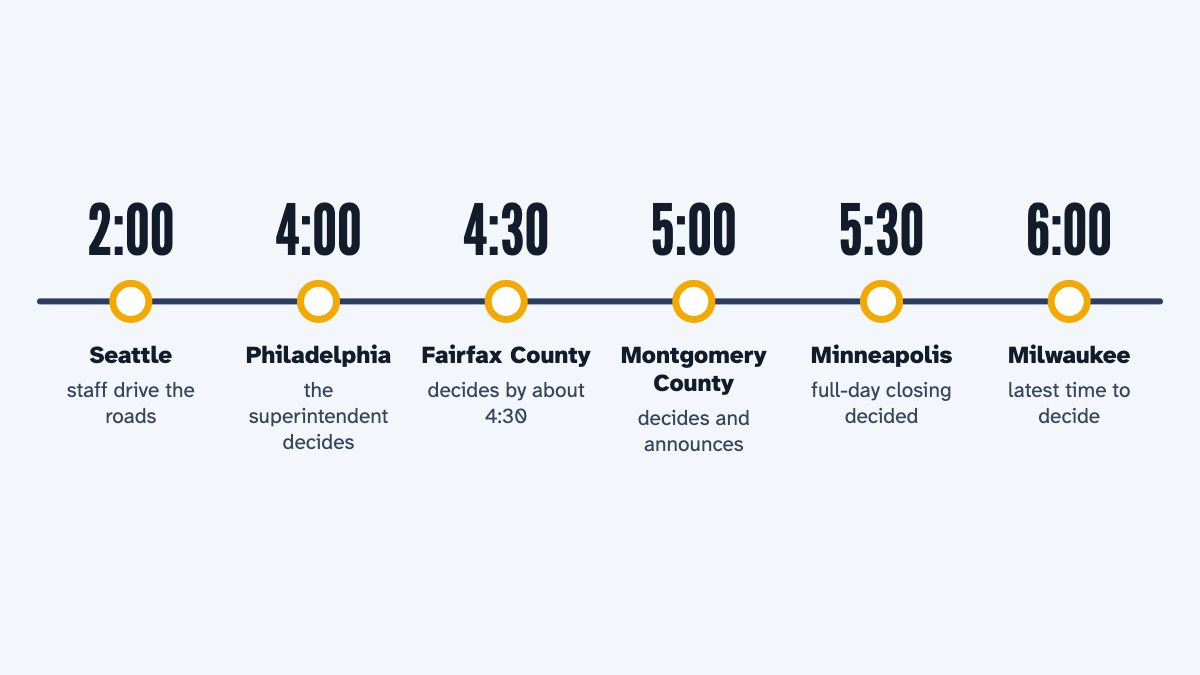
Your district decides. Metro Nashville’s weather page says the call rests on staff who check with many public agencies and travel the roads across the county, and that its intent is to notify families by at least 5:30 a.m. If there is no notice, school is on time. The page also warns that icy roads may affect transportation in parts of a large county.
For hybrid days, the 2025 law leaves the call to the director of schools.
Check your district’s website, app or local TV and radio for the final word. This calculator is independent: not a school district, the state or the National Weather Service. It reads the Weather Service forecast from 6 AM the day before to 3 PM on the school day, so its chance can change as a storm gets closer.
Here is the page at a glance:
Snow days in Tennessee
- What closes schools
- half an inch to 1 inch of snow
- a tenth of an inch of ice
- Knoxville about 1.5 inches
- Stockpile days
- 30 extra minutes a day
- up to 13 days
- no carry-over
- After the stockpile
- weekend classes or shorter breaks
- waiver only for disasters
- Remote and hybrid
- a few remote days
- 4 hybrid days a year
- the director decides
- Who decides
- your district
- Nashville aims for 5:30 a.m.
Questions people ask
What are stockpile days in Tennessee?
Days a district banks ahead of time by making each school day longer. Adding half an hour to every day for the full year banks 13 days, the most state law allows, as the Department’s January 2025 memo restates. They cover dangerous or extreme weather without the state’s approval, and unused ones do not carry over.
How many snow days do Tennessee schools get?
As many stockpile days as the district banked, up to 13; your district’s calendar shows how many. After those, missed days are made up, though a few remote days and up to four hybrid days a year can take the place of some closings.
What happens when a Tennessee district runs out of stockpile days?
It makes the days up: longer days, weekend classes, a holiday, a shorter spring break or a longer year. A state waiver is possible only for a natural disaster or a serious illness outbreak, and the Scott County letter shows that an ordinary bad-weather day did not qualify.
Can Tennessee schools do virtual days for snow?
A few. As of March 2025, the law allowed up to two remote days a semester, and the Commissioner has granted more by waiver, as the Giles County letter shows. Since July 2025, up to four hybrid days a year are allowed too, under Public Chapter 484. A district can also judge remote days unworkable, as Nashville did in January 2026.
Sources: Tennessee Department of Education, January 2025 memo restating T.C.A. 49-6-3004; Tennessee Department of Education, Scott County waiver letter (2025); Metro Nashville Public Schools, weather page.
Facts checked October 29, 2026.
More guides
-
-
-
-

-
-