Alabama Snow Day Calculator: Ice, Rare Snow and Make-Up Days
Snow is rare in Alabama, so little of it closes schools: by our rule of thumb half an inch to 1 inch, or about 0.08 inch of ice. Missed days must be made up to reach 180.

- Under 5%
- 5 to 24%
- 25 to 49%
- 50 to 74%
- 75% or more
The next school day in Alabama
Worked out from the National Weather Service forecast, 3:07 PM EDT, Thursday.
- Huntsville<1% snow dayFriday: no snow
- Mobile<1% snow dayFriday: no snow
- Birmingham<1% snow dayFriday: no snow
- Montgomery<1% snow dayFriday: no snow
- Tuscaloosa<1% snow dayFriday: no snow
- Hoover<1% snow dayFriday: no snow
Snow is rare in Alabama, so it takes little of it to close schools. Huntsville averages 1.8 inches a year, Birmingham and Hoover 1.2, and Mobile, Montgomery and Tuscaloosa 0.2 inch or less. By our rule of thumb, schools close about half the time at 1 inch of overnight snow in Huntsville and half an inch in the other five cities.
Ice can do it too: by our rule of thumb, about 0.08 inch of ice closes schools where snow is rare, and a National Weather Service Ice Storm Warning raises the calculator’s chance. Type your ZIP code above to see the chance for your school.
Closed days come back later. Alabama requires 180 full instructional days, or 1,080 hours, and the state’s 2026–27 attendance manual says missed days must be made up to that minimum (Alabama State Department of Education).
How much snow closes school in Alabama?
About half an inch to 1 inch of overnight snow, by our rule of thumb. The calculator sets each city’s usual closing point from its normal snowfall, and in most of Alabama that is close to none.
Alabama's six largest cities: normal snowfall a year (NOAA 1991–2020) and the snowfall and wind chill at which, by our rule of thumb, schools there usually close.
| City | Normal snowfall | Usually closes at | Cold point (wind chill) |
|---|---|---|---|
| Huntsville | 1.8 in. a year | 1 in. of snow | −11°F |
| Mobile | 0.2 in. a year | 0.5 in. of snow | −2°F |
| Birmingham | 1.2 in. a year | 0.5 in. of snow | −9°F |
| Montgomery | 0.2 in. a year | 0.5 in. of snow | −6°F |
| Tuscaloosa | 0.1 in. a year | 0.5 in. of snow | −7°F |
| Hoover | 1.2 in. a year | 0.5 in. of snow | −9°F |
Our rule of thumb: the usual closing point is 0.5 × (normal snowfall a year)0.7, the cold point the normal December–February low minus 45°F. How the calculator works.
Huntsville, with 1.8 inches a year, is the only one of the 6 at 1 inch. Birmingham and Hoover (1.2 inches a year), Montgomery and Mobile (0.2) and Tuscaloosa (0.1) all sit at about half an inch, at or just above the rule’s floor.
When it falls matters. The calculator counts snow and ice fully overnight (9 p.m. to 6 a.m.) and while buses run (6 to 10 a.m.), and less from the afternoon before. Snow that falls while it is above freezing counts for less, because roads stay wet.
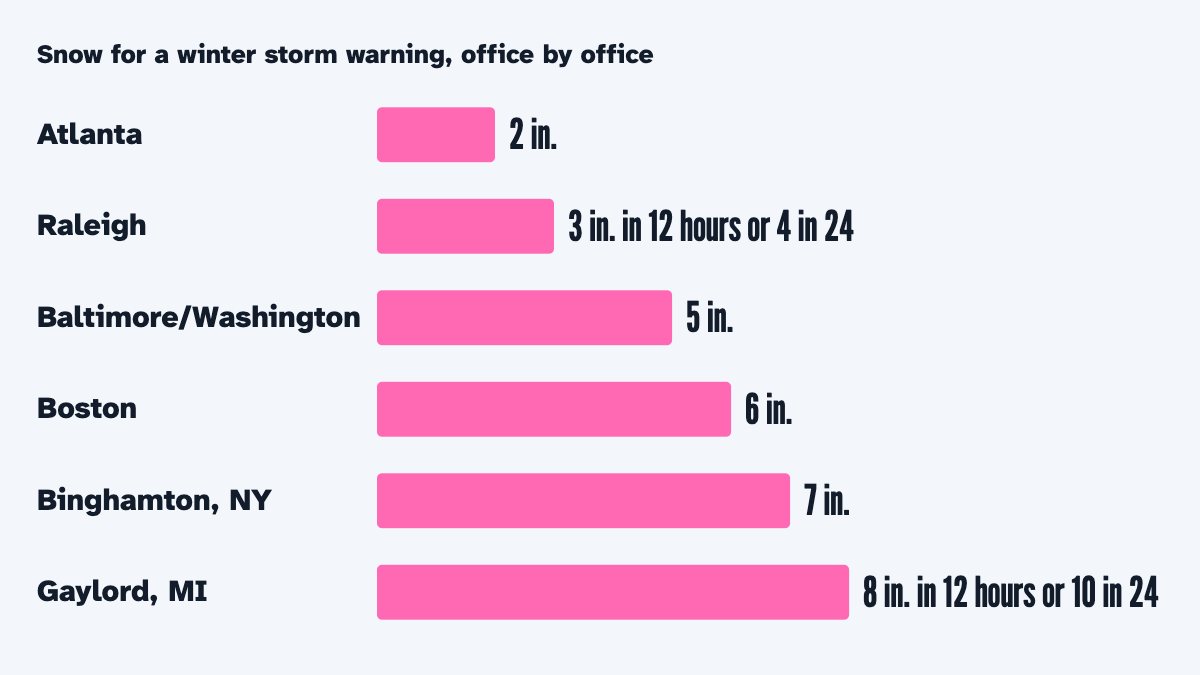
Weather Service alerts are local too. Each office sets its own criteria: the snow needed for a Winter Storm Warning is typically much higher in the Northern Plains than in the Southeast, and an Ice Storm Warning is usually issued for around a quarter inch of ice or more (NWS winter alerts).
Where does Alabama get the most snow?
Nowhere gets much. The snowiest of NOAA’s 84 Alabama stations with a snowfall normal for 1991–2020 is Valley Head, at about 1,120 feet, with 5 inches a year. Huntsville’s airport (2.4 inches), Moulton (2.1), Sylacauga (1.7), Walnut Grove (1.7), Ashland (1.6), Pinson (1.4) and Birmingham’s airport (1.4) follow.
Normal snowfall a year and normal December to February low at each of the 84 weather stations in Alabama with a snowfall normal in NOAA's U.S. Climate Normals for 1991–2020, with each station's location, elevation and how complete its record is.
The 10 snowiest and 5 least snowy of 84 stations in Alabama
| Station | Normal snowfall | Dec–Feb low | Elevation |
|---|---|---|---|
| Valley Head | 5 in. | 32°F | 1,121 ft |
| Huntsville International Airport | 2.4 in. | 35°F | 624 ft |
| Moulton 2 | 2.1 in. | 32°F | 622 ft |
| Sylacauga 4 Ne | 1.7 in. | 33°F | 490 ft |
| Walnut Grove | 1.7 in. | — | 850 ft |
| Ashland 3 Ene | 1.6 in. | 33°F | 1,022 ft |
| Pinson | 1.4 in. | 33°F | 608 ft |
| Birmingham Airport | 1.4 in. | 37°F | 615 ft |
| Athens | 1.3 in. | 36°F | 689 ft |
| Hamilton 3 S | 1.3 in. | 30°F | 435 ft |
| … | |||
| Seale | 0 in. | — | 400 ft |
| Tuscaloosa Acfd | 0 in. | 38°F | 169 ft |
| Tuscaloosa Oliver Dam | 0 in. | — | 152 ft |
| Wallace 2 E | 0 in. | — | 205 ft |
| Warrior L&d | 0 in. | — | 110 ft |
Download “Normal snowfall at Alabama weather stations, 1991–2020” (CSV, opens in Excel)
Built from: U.S. Climate Normals, 1991–2020 (National Centers for Environmental Information).
The middle of the list is 0.3 inch a year, and 22 of the 84 stations, among them 2 in Tuscaloosa, average none. The calculator blends the NOAA stations nearest your ZIP code, so its numbers follow your own corner of the state.
Do snow days have to be made up in Alabama?
Yes. Alabama law sets a school term of at least 180 full instructional days, or the hourly equivalent of at least 1,080 instructional hours (Code of Alabama 16-13-231). The state board’s rule adds that a school day has at least 6 hours of actual teaching, not counting lunch and recess (Alabama Administrative Code 290-3-1-.02).
The 2026–27 attendance manual is plain: “Any days missed must be made up” to the 180-day minimum, or its hour equivalent. After a closure for inclement weather, the superintendent files the state’s School Closure Notification Form, then a School Day Make-Up Form for the State Superintendent of Education to approve (2026–27 Alabama Attendance Manual).
A board can also make up time with longer days. After natural occurrences or other extenuating circumstances, it may submit a plan to replace cancelled days by extending the hours of actual teaching. When the Governor declares a state of emergency, a school system that closes and loses days may appeal to the State Superintendent for relief (Code of Alabama 16-13-231). We found no set number of free snow days.
Can Alabama schools switch to remote learning instead?
Districts can assign it, but the state does not say it counts. The 2026–27 attendance manual says remote learning could be assigned “based on need, such as a temporary school closure,” yet it does not say a remote day counts as one of the 180 instructional days (2026–27 Alabama Attendance Manual).
We found no state rule that lets a virtual day replace a weather closure day. If your district offers one, ask it how the day is counted.
How cold does it have to be to close school in Alabama?
We found no state cold rule and no Alabama district’s cold number in our research. Our rule of thumb watches the wind chill from 5 to 9 a.m. and sets cold points of about −2°F in Mobile, −6°F in Montgomery, −7°F in Tuscaloosa, −9°F in Hoover and Birmingham and −11°F in Huntsville. Each is the city’s normal December–February low, from 33.6°F in Huntsville to 43.1°F in Mobile, minus 45 degrees.
The alert to watch is the Extreme Cold Warning, which means extremely dangerous cold or wind chills are expected or occurring (NWS cold alerts). Each local Weather Service office sets its own thresholds (NWS wind chill chart), and the calculator raises the chance when a warning is out for your area.
Who decides, and when do families hear?
Your local school system decides, and its superintendent reports the closure to the state; the State Superintendent of Education approves make-up plans (2026–27 Alabama Attendance Manual) and relief after a governor’s emergency (Code of Alabama 16-13-231).
We did not find an Alabama district’s closing clock in our research, so check your district’s website, app or local news. The calculator reads snow and ice from 6 a.m. the day before to 3 p.m. on the school day, so look the evening before and again early in the morning, since forecasts change.
Snow days in Alabama
- Closing snow
- Huntsville 1 inch
- Five cities half an inch
- Ice
- About 0.08 inch by our rule
- Ice Storm Warning raises the chance
- School year
- 180 days or 1,080 hours
- 6 hours of teaching a day
- Make-up
- Missed days made up
- Longer days with a plan
- Relief after a governor’s emergency
- Remote days
- Districts may assign
- Not said to count
Questions people ask
Does Alabama make up snow days?
Yes. Any days missed must be made up to 180 full instructional days, or the 1,080-hour equivalent, and the superintendent sends a make-up form to the State Superintendent of Education for approval (2026–27 Alabama Attendance Manual).
How many days of school does Alabama require?
At least 180 full instructional days, or the hourly equivalent of at least 1,080 instructional hours; the local board chooses (Code of Alabama 16-13-231).
Do virtual days count as school days in Alabama?
The state’s 2026–27 Alabama Attendance Manual lets districts assign remote learning during a temporary closure, but it does not say a remote day counts toward the 180 days. We found no state rule that does, so ask your district.
How much snow does it take to close school in Huntsville?
By our rule of thumb, about 1 inch overnight. Huntsville averages 1.8 inches of snow a year, the most of Alabama’s 6 map cities. Only the district decides, so check its website, app or local news.
Sources: Code of Alabama 16-13-231 (the school term), 2026–27 Alabama Attendance Manual and National Weather Service winter alerts.
Facts checked October 29, 2026.
More guides
-
-
-
-

-
-