Missouri Snow Day Calculator: Chances, Make-Up Hours and AMI Days
By our rule of thumb, about 3 inches of snow closes schools in Missouri's big cities half the time. Lost hours are made up under a 36-hour rule or covered by AMI days.

- Under 5%
- 5 to 24%
- 25 to 49%
- 50 to 74%
- 75% or more
The next school day in Missouri
Worked out from the National Weather Service forecast, 3:07 PM EDT, Thursday.
- Kansas City<1% snow dayFriday: no snow
- St. Louis<1% snow dayFriday: no snow
- Springfield<1% snow dayFriday: no snow
- Columbia<1% snow dayFriday: no snow
- Independence<1% snow dayFriday: no snow
- Lee's Summit<1% snow dayFriday: no snow
In Missouri’s big cities, about 3 inches of snow is where schools close about half the time, by our rule of thumb. Kansas City, St. Louis, Springfield, Independence and Lee’s Summit all sit at 3 inches. Columbia, the snowiest of the six cities on our map at 16.8 inches in a normal winter, sits at 3.5.
Snow is not the only thing that shuts schools here. Missouri law counts “ice, snow, extreme cold, excessive heat, flooding, or a tornado” as inclement weather, so an ice storm or a bitter wind chill counts the same as a snowstorm when lost hours are added up. The calculator watches all of it: snow and ice hour by hour from the day before, the wind chill from 5 to 9 AM, and National Weather Service alerts.
Missouri counts school by the hour. Every district needs 1,044 hours of attendance a year, and its calendar must hold 36 make-up hours for bad weather. Lose more than 36 hours and only half of the extra has to be made up, unless the district teaches through the closure with AMI.
How much snow closes school in Missouri?
About 3 inches in most of Missouri’s big cities, and 3.5 inches in Columbia, by our rule of thumb. That is the snow at which schools close about half the time. Less snow means lower odds; more means higher.
Missouri's six largest cities: normal snowfall a year (NOAA 1991–2020) and the snowfall and wind chill at which, by our rule of thumb, schools there usually close.
| City | Normal snowfall | Usually closes at | Cold point (wind chill) |
|---|---|---|---|
| Kansas City | 13 in. a year | 3 in. of snow | −21°F |
| St. Louis | 14.3 in. a year | 3 in. of snow | −19°F |
| Springfield | 12.5 in. a year | 3 in. of snow | −19°F |
| Columbia | 16.8 in. a year | 3.5 in. of snow | −20°F |
| Independence | 11.5 in. a year | 3 in. of snow | −22°F |
| Lee's Summit | 12.2 in. a year | 3 in. of snow | −22°F |
Our rule of thumb: the usual closing point is 0.5 × (normal snowfall a year)0.7, the cold point the normal December–February low minus 45°F. How the calculator works.
The six cities sit close together because their winters are alike, from 11.5 inches of snow a year in Independence to 16.8 in Columbia. Our rule, set out in how the calculator works, grows more slowly than snowfall: a place with twice the normal snow needs about 60% more to close, not twice as much. That is why Columbia’s extra 2.5 to 5.3 inches a winter moves its closing point by only half an inch.
When the snow falls matters as much as how much. The calculator counts snow in full when it falls overnight (9 PM to 6 AM) or while buses run (6 to 10 AM), but only 45% of what falls during the school day. Snow falling above freezing counts less, because it lands on wet roads.
Freezing rain needs far less. By our rule of thumb, about a tenth of an inch of ice closes schools almost anywhere. And if your district tends to hold out, or to call it early, tell the calculator it rarely closes or closes easily and the closing point moves with it.
Where does Missouri get the most snow?
Unionville has the highest normal of Missouri’s 121 NOAA weather stations, 28.7 inches a year, ahead of Downing at 22.6 and Bethany at 21.2. A place with Unionville’s snowfall would need about 5 inches to close, by our rule of thumb.
Normal snowfall a year and normal December to February low at each of the 121 weather stations in Missouri with a snowfall normal in NOAA's U.S. Climate Normals for 1991–2020, with each station's location, elevation and how complete its record is.
The 10 snowiest and 5 least snowy of 121 stations in Missouri
| Station | Normal snowfall | Dec–Feb low | Elevation |
|---|---|---|---|
| Unionville | 28.7 in. | 18°F | 1,060 ft |
| Downing | 22.6 in. | — | 870 ft |
| Bethany | 21.2 in. | 19°F | 949 ft |
| Amity 4 Ne | 20.7 in. | 18°F | 974 ft |
| Edina | 19.8 in. | — | 808 ft |
| Gallatin 1W | 19.6 in. | 19°F | 921 ft |
| Conception | 19.4 in. | 19°F | 1,108 ft |
| Kearney 3E | 19.4 in. | 20°F | 840 ft |
| Memphis | 19.3 in. | 17°F | 770 ft |
| Kirksville | 19 in. | 18°F | 970 ft |
| … | |||
| Hornersville | 3.5 in. | — | 256 ft |
| Qulin | 3.5 in. | — | 318 ft |
| Sikeston Pwr Station | 3.1 in. | 30°F | 310 ft |
| Eldorado Springs left out | 2 in. | 25°F | 915 ft |
| Salem left out | 1.3 in. | 25°F | 1,205 ft |
A station marked “left out” reports far less snow than the stations around it at a similar height, most likely because snowfalls went unmeasured, so the calculator does not use it. How the calculator works.
Download “Normal snowfall at Missouri weather stations, 1991–2020” (CSV, opens in Excel)
Built from: U.S. Climate Normals, 1991–2020 (National Centers for Environmental Information).
The middle station on the list normally gets 10.5 inches. At the other end, 7 stations normally see under 4 inches, with Salem lowest at 1.3. Salem and Eldorado Springs (2.0) report so much less than the stations around them that the calculator leaves them out of its own numbers. These are NOAA’s normals for 1991 to 2020.
Read the extremes with care. Only 8 of the 121 stations are what NOAA calls standard, with 24 or more years of records; the other 113 are provisional, with at least 10. One station’s number describes its own spot, not a whole county.
Do snow days have to be made up in Missouri?
Some of them. Under RSMo 171.033, a district makes up the first 36 hours it loses to inclement weather, plus half of the hours lost beyond 36. The law stops at “no more than sixty total make-up hours required by this section.” Make-up is needed only to reach the 1,044-hour minimum.
Here is how the formula works out:
- Lose 24 hours: make up all 24.
- Lose 48 hours: make up 42, the first 36 plus half of the other 12.
- Lose 84 hours or more: make up 60, the most this section requires.
On a 6-hour school day, 60 hours is 10 days. The 36 make-up hours already in every calendar are there for exactly this.
Past the formula, the same section lets the Commissioner of Education grant a waiver to a district that cannot meet its calendar because the school was closed for reasons beyond its control, inclement weather included. A separate law, RSMo 160.041, lets the Commissioner reduce the required hours or days when flooding or other inclement weather keeps students out, for no more than 2 calendar years.
These rules hold for the 2026–27 school year. The text on the Revisor’s site took effect July 1, 2026, and the 36-hour make-up rule has applied since 2019–20, when 36 hours replaced the old first 6 days.
Can Missouri schools switch to remote learning instead?
Yes, for up to 36 hours a year, through Alternative Methods of Instruction (AMI), and only with a plan the state education department, DESE, has approved. With an approved plan, a district does not have to make up hours lost to inclement weather and other emergencies, under RSMo 171.033. After 36 AMI hours, about 6 school days of 6 hours, the district must make up the hours it loses later.
An AMI day does not have to mean a screen. Each student gets assignments on paper or through virtual learning, and the plan must say how certified staff stay available to students. DESE approves only a plan that will not hurt teaching and learning.
The plan is settled before winter. DESE’s May 2026 memo says plans for 2026–27 were due by July 31, 2026, and that teachers must “provide instruction and are available during the AMI day.” A district also tells its DESE area supervisor when it uses the plan.
How cold does it have to be to close school in Missouri?
Missouri’s law names extreme cold as inclement weather but sets no temperature in the sections we read, so the calculator uses our cold point: a wind chill of −19°F to −22°F in the map’s cities, by our rule of thumb. Our cold point is a place’s normal December-to-February low minus 45°F. Our guide to cold-weather closings lists the districts elsewhere that publish a number.
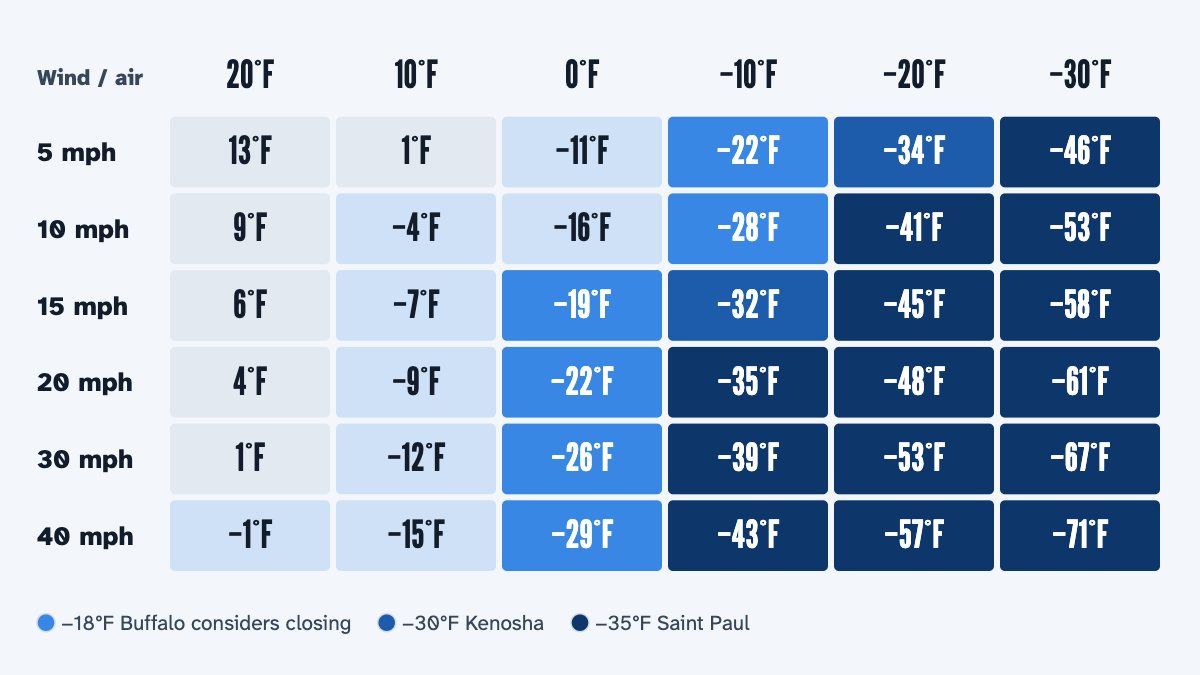
Kansas City’s normal winter low is 23.7°F, so its cold point is −21°F. St. Louis, with milder nights at 26.4°F, sits at −19°F, and Independence and Lee’s Summit are the coldest at −22°F. For scale, the Weather Service’s wind chill chart puts 0°F with a 15 mph wind at −19°F, when “exposed skin can freeze in 30 minutes.”
Alerts count too. The National Weather Service issues an Extreme Cold Warning when dangerously cold air or wind chills are expected or happening. That name replaced the Wind Chill Warning on or about October 1, 2024. A warning raises the calculator’s chance more than a watch or a Cold Weather Advisory does.
Try a bus-stop morning yourself:
Wind chill at the bus stop
−19°F
0°F with a 15 mph wind feels like −19°F. Buffalo, New York, will consider closing at −18°F.
The formula is the National Weather Service's, from its wind chill chart. Its own example: 0°F with a 15 mph wind feels like −19°F, and exposed skin can freeze in 30 minutes.
Who decides, and when do families hear?
Your district decides, not the state and not this calculator. Missouri’s rules cover what comes after: how lost hours are made up, when AMI can replace them, and when the Commissioner can excuse a shortfall.
On a closing day, a district with an AMI plan must tell families whether the plan is in use that day, under RSMo 171.033. So a closing can mean no school at all, or school at home. Your district’s website, app, or local TV and radio will say which.
The calculator is for the night before. It reads the National Weather Service forecast for the part of your ZIP code where most people live and shows its reasons, so you can see whether a chance rests on overnight snow, ice, cold or an alert. Forecasts can change overnight, so check again in the morning.
Snow days in Missouri
- Snow
- About 3 inches in big cities
- 3.5 in Columbia
- A tenth of an inch of ice
- Cold
- Our cold point −19°F to −22°F
- Extreme Cold Warning
- School year
- 1,044 hours
- 36 make-up hours built in
- Making it up
- First 36 hours
- Half of the rest
- 60 hours at most
- AMI
- Approved plan
- Up to 36 hours
- Paper or online
- Who decides
- Your district
- Commissioner waivers
Questions people ask
How many snow days do Missouri schools get?
Missouri counts hours, not days. Every calendar holds 36 make-up hours for bad weather, and past that the formula above caps required make-up at 60 hours. Districts in a charter-form county or a city of more than 30,000 people also need at least 169 school days under RSMo 171.031; for a four-day week, the number in the law is 142.
What is an AMI day in Missouri?
It is a day when school buildings are closed but learning goes on at home, on paper or online, under a plan DESE approved before the school year. AMI covers up to 36 hours a year, and those hours do not need to be made up.
Does extreme cold count like a snow day in Missouri?
Yes, when lost hours are counted. The state’s definition of inclement weather includes extreme cold, so hours lost to a dangerous wind chill fall under the same make-up rule as a snowstorm.
Will my Missouri school close tomorrow?
Only your district can say. Type your ZIP code at the top of this page for the calculator’s chance of a snow day, a late start or school as usual, then watch your district’s own channels for the decision.
Sources: RSMo 171.033 and RSMo 171.031 (Missouri Revisor of Statutes); DESE memo OQS-26-007 on AMI plans (May 20, 2026).
Facts checked October 29, 2026.
More guides
-
-
-
-

-
-