Georgia Snow Day Calculator: Ice, Rare Snow and Make-Up Days
Snow is rare in Georgia, so half an inch of snow or a thin glaze of ice can close schools, by our rule of thumb. Boards may skip up to 4 make-up days after an emergency.

- Under 5%
- 5 to 24%
- 25 to 49%
- 50 to 74%
- 75% or more
The next school day in Georgia
Worked out from the National Weather Service forecast, 3:07 PM EDT, Thursday.
- Atlanta<1% snow dayFriday: no snow
- Columbus<1% snow dayFriday: no snow
- Augusta<1% snow dayFriday: no snow
- Macon<1% snow dayFriday: no snow
- Savannah<1% snow dayFriday: no snow
- Athens<1% snow dayFriday: no snow
Snow is rare in Georgia. Atlanta’s normal is 1.1 inches a year, Macon’s 0.2 and Savannah’s 0, by NOAA’s 1991–2020 normals. Because the calculator ties its closing point to how much snow a place normally gets, all six Georgia cities on our map sit at or just above its floor: by our rule of thumb, about half an inch of overnight snow is enough for schools to close about half the time.
Ice matters as much as snow. The calculator treats about 0.08 inch of ice as enough to close schools where snow is rare, and the National Weather Service’s Peachtree City office, which serves Atlanta, issues a Winter Storm Warning for 2 inches of snow, half an inch of sleet or a quarter inch of freezing rain.
When schools do close, the State Board of Education’s rule 160-5-1-.02 lets a local board skip up to four make-up days lost to an emergency, without asking the state.
How much snow closes school in Georgia?
About half an inch, by our rule of thumb, in every city on our Georgia map. That is the floor of the calculator’s rule, or just above it: Atlanta, with 1.1 inches a year, is the only one with enough snow to lift it, and only a little.
Georgia's six largest cities: normal snowfall a year (NOAA 1991–2020) and the snowfall and wind chill at which, by our rule of thumb, schools there usually close.
| City | Normal snowfall | Usually closes at | Cold point (wind chill) |
|---|---|---|---|
| Atlanta | 1.1 in. a year | 0.5 in. of snow | −9°F |
| Columbus | 0.4 in. a year | 0.5 in. of snow | −7°F |
| Augusta | 0.8 in. a year | 0.5 in. of snow | −7°F |
| Macon | 0.2 in. a year | 0.5 in. of snow | −7°F |
| Savannah | 0 in. a year | 0.5 in. of snow | −3°F |
| Athens | 0.7 in. a year | 0.5 in. of snow | −10°F |
Our rule of thumb: the usual closing point is 0.5 × (normal snowfall a year)0.7, the cold point the normal December–February low minus 45°F. How the calculator works.
Atlanta (1.1 inches a year), Augusta (0.8), Athens (0.7), Columbus (0.4), Macon (0.2) and Savannah (0) all land at about half an inch. The differences show up in the cold column instead, from −10°F in Athens to −3°F in Savannah.
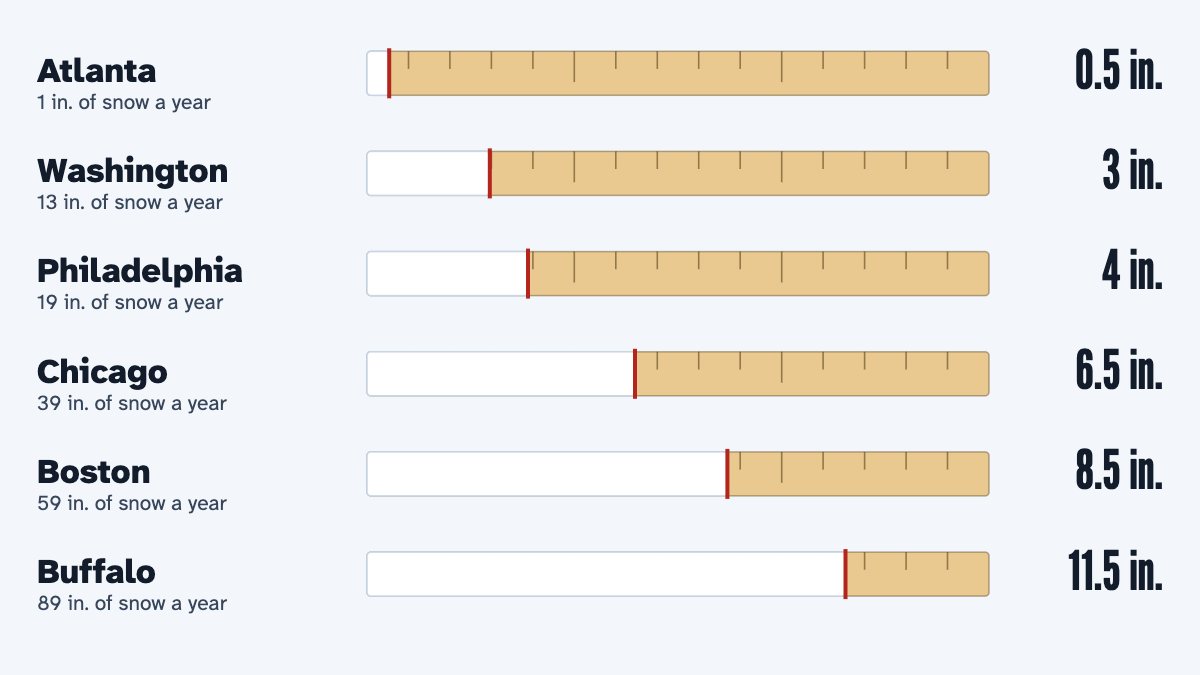
The yardsticks above show how the same rule treats snowier cities: the more snow a place normally gets, the more it takes to close its schools. The calculator also counts snow fully when it falls overnight (9 PM to 6 AM) or while buses run (6 to 10 AM), and less when it falls while it is above freezing. More on how the calculator works.
The Weather Service’s own bar is low here too. Its Peachtree City office issues a Winter Storm Warning for 2 or more inches of snow when it is 80% confident, up to 36 hours ahead; a watch comes 36 to 48 hours ahead, and a Winter Weather Advisory 12 to 24 hours ahead for “inconveniences” below warning level. The calculator adds to its chance for warnings, and less for watches and advisories.
Where does Georgia get the most snow?
On higher ground, and even there it is only a few inches. NOAA keeps snowfall normals for 95 Georgia weather stations. The snowiest, Sautee, about 1,590 feet up, averages 3.9 inches a year, followed by a station near Dallas, Georgia (3.8), Dahlonega (3.3), Blairsville (3.1) and Ellijay (2.9). The Atlanta airport station averages 2.2.
Normal snowfall a year and normal December to February low at each of the 95 weather stations in Georgia with a snowfall normal in NOAA's U.S. Climate Normals for 1991–2020, with each station's location, elevation and how complete its record is.
The 10 snowiest and 5 least snowy of 95 stations in Georgia
| Station | Normal snowfall | Dec–Feb low | Elevation |
|---|---|---|---|
| Sautee 3W | 3.9 in. | 30°F | 1,591 ft |
| Dallas 7 Ne | 3.8 in. | 33°F | 1,028 ft |
| Dahlonega 4WSW | 3.3 in. | — | 1,460 ft |
| Blairsville Experiment Station | 3.1 in. | 27°F | 1,949 ft |
| Ellijay | 2.9 in. | — | 1,359 ft |
| Jasper 1 Nnw | 2.5 in. | 33°F | 1,465 ft |
| Clayton 1 Ssw | 2.4 in. | 31°F | 1,965 ft |
| Atlanta Hartsfield International Airport | 2.2 in. | 38°F | 1,010 ft |
| Danielsville | 2.1 in. | 34°F | 780 ft |
| Chickamauga 2 Sw | 2.1 in. | 35°F | 799 ft |
| … | |||
| Warner Robins | 0 in. | 38°F | 420 ft |
| Waycross 4 Ne | 0 in. | 39°F | 145 ft |
| Woodbine | 0 in. | 40°F | 16 ft |
| Savannah International Airport | 0 in. | 42°F | 46 ft |
| Brunswick Malcolm Mckinnon Airport | 0 in. | 46°F | 16 ft |
Download “Normal snowfall at Georgia weather stations, 1991–2020” (CSV, opens in Excel)
Built from: U.S. Climate Normals, 1991–2020 (National Centers for Environmental Information).
Half the stations average 0.3 inches or less, and several, including Savannah’s airport, Brunswick, Waycross, Woodbine and Warner Robins, average none at all. In those places any snow is out of the ordinary.
Do snow days have to be made up in Georgia?
Not all of them. Georgia’s State Board rule, 160-5-1-.02, has each local board schedule at least 180 school days “or its equivalent,” with a minimum daily average of instructional time: 4.5 hours in grades K–3, 5 hours in grades 4–5 and 5.5 hours in grades 6–12. A district that runs fewer loses a prorated share of state money.
The same rule lets a local board choose not to make up as many as four days lost to an emergency, disaster, act of God, civil disturbance, or fuel or supply shortage, without asking the State Board. The rule cites Georgia law, O.C.G.A. 20-2-168, for that power.
Only days when students are present for at least half the required instructional time count as school days, so a day cut short before that point does not count. Each local board approves its school day and year at a regular board meeting, and the calendar goes to the state Department of Education each May 31.
The rule’s history ends with its 2010 version, and we found no later change. We could not read the state’s own copy of the statute or Department of Education guidance, so we cannot say more about days beyond those four.
Can Georgia schools switch to remote learning instead?
Some districts do, but we could not find the state rule. Atlanta Public Schools lists a virtual or remote day among its five possible weather calls, on its inclement weather plan. The State Board rule we read has no provision for remote or digital learning days in bad weather, and we could not reach Department of Education guidance, so we cannot say how such a day counts toward the 180.
How cold does it have to be to close school in Georgia?
There is no state number, but cold is on district lists. Atlanta Public Schools names extreme cold among its reasons to close, and Fulton County Schools weighs temperature, wind chill and whether diesel buses can start in extreme cold. Gwinnett County Public Schools checks its buses too, noting that “extreme cold can cause operational problems for diesel buses.” None of the three pages gives a number.
The Weather Service’s Peachtree City office sets its own cold levels for the Atlanta metro: an Extreme Cold Warning at 0°F or lower, and a Cold Weather Advisory from 1°F to 10°F. By our rule of thumb, the calculator’s cold point is a wind chill near −9°F in Atlanta, −10°F in Athens, −7°F in Augusta, Columbus and Macon, and −3°F in Savannah: each city’s normal December–February low minus 45°F.
Who decides, and when do Georgia families hear?
Each district decides, and the metro Atlanta districts we checked aim to tell families between 5 and 6 a.m.
Atlanta Public Schools aims to decide by 5:00 a.m., weighing road safety, temperature, precipitation and whether buses and staff can travel safely. Its choices are a normal day, a delayed start, a virtual or remote day, a closing, or an early dismissal, and if no announcement is made by then, schools run on a normal schedule.
At Fulton County Schools, an Emergency Response Team meets several times a day and staff test bus routes, because “even if it looks clear on one street,” other parts of the county may not be. The superintendent decides no later than 5:30 a.m.
At Gwinnett County Public Schools, the superintendent decides with input from public safety, emergency management, the county and the state transportation agency. Staff head out as early as 3:30 or 4 a.m. to drive the roads, full-day cancellations usually come by 6 a.m., and the district says an early-morning cancellation is more likely than letting school out early.
Check your district’s website, app or local TV and radio for the final word. The calculator is independent: not a school district, the state or the National Weather Service. It reads the Weather Service forecast from 6 AM the day before to 3 PM on the school day, so its chance can change as a storm gets closer.
The page at a glance:
Snow days in Georgia
- What closes schools
- half an inch of snow
- a thin glaze of ice
- extreme cold
- Weather Service
- warning at 2 inches
- a quarter inch of freezing rain
- cold warning at 0°F
- School year
- 180 days or equal
- skip up to 4 make-up days
- Mornings
- Atlanta by 5:00 a.m.
- Fulton by 5:30 a.m.
- Gwinnett usually by 6 a.m.
- Remote days
- Atlanta lists them
- state rule not found
Questions people ask
How much snow does it take to close school in Atlanta?
About half an inch overnight, by our rule of thumb, the lowest closing point the calculator uses. Ice can do it with less, and only the district decides.
Do Georgia schools make up snow days?
A local board may skip making up as many as four days lost to an emergency without State Board approval, under Rule 160-5-1-.02. What happens after the fourth day is not covered by what we could read.
What time do Atlanta schools announce closings?
Atlanta Public Schools aims to decide by 5:00 a.m., Fulton County by 5:30 a.m., and Gwinnett usually announces full-day cancellations by 6 a.m. At Atlanta Public Schools, no announcement means a normal day.
Can Georgia schools have virtual days for bad weather?
Atlanta Public Schools lists them as an option. We could not find the state rule that says how such a day counts, so check your district’s policy.
Sources: Georgia State Board of Education Rule 160-5-1-.02; National Weather Service Peachtree City, winter weather safety; Atlanta Public Schools, inclement weather plan.
Facts checked October 29, 2026.
More guides
-
-
-
-

-
-