Indiana Snow Day Calculator: Chances, Make-Up Days and Virtual Days
By our rule of thumb, 2.5 inches closes Evansville schools and 8.5 South Bend’s. Indiana requires 180 days; a virtual day counts if half of it is live, and self-paced ones stop at three.

- Under 5%
- 5 to 24%
- 25 to 49%
- 50 to 74%
- 75% or more
The next school day in Indiana
Worked out from the National Weather Service forecast, 3:07 PM EDT, Thursday.
- Indianapolis<1% snow dayFriday: no snow
- Fort Wayne<1% snow dayFriday: no snow
- Evansville<1% snow dayFriday: no snow
- Fishers<1% snow dayFriday: no snow
- South Bend<1% snow dayFriday: no snow
- Carmel<1% snow dayFriday: no snow
Indiana spans two winters. South Bend, near Lake Michigan, averages about 59 inches of snow a year; Evansville, on the Ohio River, about 11. By our rule of thumb, schools close about half the time at 8.5 inches overnight in South Bend, 6 in Fort Wayne, 4.5 in Indianapolis, Fishers and Carmel, and just 2.5 in Evansville.
Ice counts as well as snow. The calculator treats about a tenth of an inch of freezing rain as enough to close schools almost anywhere, a little less where snow is rare and a little more where it is common. Our cold points, the morning wind chills at which schools start closing for cold by our rule, run from −17°F in Evansville to −26°F in South Bend.
Missed days are not free. The Indiana Department of Education requires 180 instructional days and grants no automatic snow days, but a school can hold a virtual day instead, and virtual days that are at least half live teaching have no cap in the department’s guidance.
How much snow closes school in Indiana?
By our rule of thumb, about 2.5 inches overnight in Evansville, 4.5 in Indianapolis, Fishers and Carmel, 6 in Fort Wayne and 8.5 in South Bend. Each is the snowfall at which schools there close about half the time, worked out from the city’s normal yearly snowfall.
Indiana's six largest cities: normal snowfall a year (NOAA 1991–2020) and the snowfall and wind chill at which, by our rule of thumb, schools there usually close.
| City | Normal snowfall | Usually closes at | Cold point (wind chill) |
|---|---|---|---|
| Indianapolis | 24.5 in. a year | 4.5 in. of snow | −22°F |
| Fort Wayne | 33.2 in. a year | 6 in. of snow | −24°F |
| Evansville | 10.8 in. a year | 2.5 in. of snow | −17°F |
| Fishers | 21.4 in. a year | 4.5 in. of snow | −23°F |
| South Bend | 58.9 in. a year | 8.5 in. of snow | −26°F |
| Carmel | 21.8 in. a year | 4.5 in. of snow | −23°F |
Our rule of thumb: the usual closing point is 0.5 × (normal snowfall a year)0.7, the cold point the normal December–February low minus 45°F. How the calculator works.
South Bend gets more than five times Evansville’s snow, and its closing point is more than three times higher. Indianapolis and its northern suburbs share nearly the same numbers, so the calculator gives them nearly the same odds for the same storm. If your district rarely closes, or closes at the first flake, tell the calculator and it moves the point.
Timing changes the math. The calculator reads the National Weather Service forecast for the part of your ZIP code where most people live, hour by hour. Snow that falls overnight or while buses run counts in full, snow the afternoon and evening before counts 80%, and snow after school has started counts less. Snow falling with the air above freezing counts less, since it melts on the roads. A Weather Service warning raises the chance more than a watch or an advisory does.
Where does Indiana get the most snow?
In the north, near Lake Michigan. NOAA has snowfall normals for 122 Indiana stations, with a middle value of about 20 inches a year, and the snowiest are LaPorte (65.2 inches), South Bend’s airport (64.5), New Carlisle (62.1) and Plymouth (54.9). The station at the Weather Service’s own northern Indiana office averages 47.3.
Normal snowfall a year and normal December to February low at each of the 122 weather stations in Indiana with a snowfall normal in NOAA's U.S. Climate Normals for 1991–2020, with each station's location, elevation and how complete its record is.
The 10 snowiest and 5 least snowy of 122 stations in Indiana
| Station | Normal snowfall | Dec–Feb low | Elevation |
|---|---|---|---|
| Laporte | 65.2 in. | 20°F | 809 ft |
| South Bend Michiana Regional Airport | 64.5 in. | 20°F | 773 ft |
| New Carlisle | 62.1 in. | — | 760 ft |
| Plymouth | 54.9 in. | 19°F | 815 ft |
| South Bend 4.6 Se | 49.9 in. | — | 884 ft |
| Northern Indiana Weather Office | 47.3 in. | 20°F | 951 ft |
| Goshen 3SW | 45.2 in. | 21°F | 875 ft |
| Kingsbury 1N | 41.7 in. | — | 755 ft |
| Indiana Dunes Nl | 40.3 in. | 21°F | 680 ft |
| Valparaiso Wtr Wks | 40 in. | 21°F | 800 ft |
| … | |||
| Mount Vernon | 8.4 in. | 25°F | 357 ft |
| Saint Meinrad | 8.3 in. | 28°F | 510 ft |
| Seymour 2 N | 8 in. | 24°F | 570 ft |
| Jt Myers Locks & Dam | 7.5 in. | 27°F | 340 ft |
| Newburgh L&d | 6.6 in. | 26°F | 380 ft |
Download “Normal snowfall at Indiana weather stations, 1991–2020” (CSV, opens in Excel)
Built from: U.S. Climate Normals, 1991–2020 (National Centers for Environmental Information).
The least snowy stations are in the far south, most of them near the Ohio River: the Newburgh locks and dam average 6.6 inches and the J.T. Myers locks and dam 7.5, with Seymour, Saint Meinrad and Mount Vernon all near 8. A school in LaPorte and one in Newburgh face very different winters, and the calculator reads each place’s own normals.
Do snow days have to be made up in Indiana?
Yes, unless the school has days to spare. The Department of Education’s guidance says “Each school year must consist of at least 180 days of instruction,” with at least 5 hours of instruction a day in grades 1 to 6 and 6 hours in grades 7 to 12. For missed days, the department reduces the next August’s tuition support payment.
There are no automatic forgiven days. The department recommends building at least five make-up days into the calendar, and a school that schedules more than 180 days may not need to make up a closing at all. Short days help: a day with a 2-hour delay or 2-hour early dismissal for safety still counts toward the 180.
Waivers are narrow. The department’s guidance allows one only for self-paced virtual days past the three-day cap, when extraordinary circumstances made both in-person and live online teaching impossible, and the request is due within 10 days of the event. A request to count a day with no instruction at all will not be considered. These rules come from the department’s guidance; the current text of the Indiana Code itself was not available to us.
Can Indiana schools switch to virtual learning instead?
Yes, and the rules favor live lessons. Since 2022–23, a virtual day counts toward the 180 if at least half of it is live instruction directed by a teacher. Self-paced days are capped: the department’s guidance allows no more than three days a year that are mostly self-paced, while live virtual days have no cap in it.
A virtual day still needs real teaching time: at least 2.5 hours of in-person or live instruction in grades 1 to 6, and 3 hours in grades 7 to 12. Past three self-paced days, a school needs a waiver, granted only if extraordinary circumstances made both in-person and live online teaching impossible. A school can also ask the State Board of Education for a separate flexibility waiver. The department’s guidance does not apply to virtual charter schools, virtual schools or nonpublic schools.
For families, that means a closing in Indiana may turn into a virtual day rather than a day off. Ask your school which it plans to use, and whether its virtual days will be live or self-paced.
How cold does it have to be to close school in Indiana?
The state rules we read set no number, and we found no Indiana district’s written cold rule to quote, so it is your district’s call. By our rule of thumb, schools start closing for cold at a morning wind chill of about −17°F in Evansville, −22°F in Indianapolis, −23°F in Fishers and Carmel, −24°F in Fort Wayne and −26°F in South Bend: 45 degrees below each city’s normal December-to-February low.
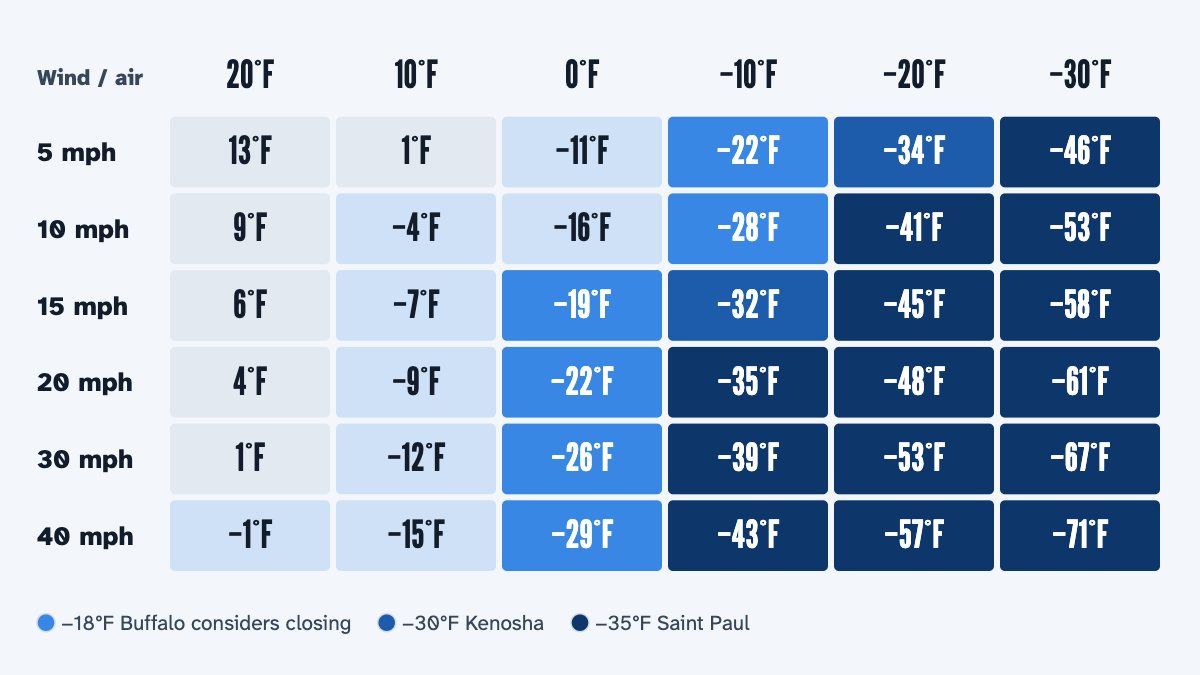
The calculator reads the Weather Service’s forecast wind chill for 5 to 9 AM, bus-stop time, and raises its chance when an Extreme Cold Warning is in force. On the Weather Service’s wind chill chart, a 0°F morning with a 15 mph wind feels like −19°F, cold enough for exposed skin to freeze in 30 minutes.
Who decides, and when do Indiana families hear?
Your school corporation’s superintendent and board decide; the state’s Department of Education only handles waivers and the tuition-support cut afterwards. Clocks differ from district to district, and we have not found one from an Indiana district that we can cite, so we won’t guess at a time.
Watch your district’s website, app and local TV and radio, and look at the calculator the night before and again early in the morning, after the forecast has been updated. A late start is worth knowing about here: a 2-hour delay still counts as a school day in Indiana, so a district does not lose a day by choosing one.
Is it a snow day in Indiana tomorrow?
That is your district’s call; the calculator gives the odds from tomorrow’s forecast for your ZIP code, and the map below sums up the rules behind them.
Snow days in Indiana
- Snow that closes schools
- Evansville 2.5 in
- Indianapolis 4.5 in
- Fort Wayne 6 in
- South Bend 8.5 in
- The school year
- 180 days
- 5 or 6 hours a day
- no automatic forgiven days
- Virtual days
- Count if half is live
- self-paced: 3 a year
- live: no cap
- Short days
- 2-hour delay counts
- 2-hour early dismissal counts
- Cold
- No state number
- our points −17°F to −26°F
Questions people ask
Do Indiana schools have to make up snow days?
Yes, if a closing drops them below 180 days. The state recommends building at least five make-up days into the calendar, and a live virtual day can take the place of a closing.
How many eLearning days can Indiana schools have?
The department’s guidance caps mostly self-paced virtual days at three a year. Days that are at least half live, teacher-directed instruction count toward the 180 with no cap in the guidance.
Does a two-hour delay count as a school day in Indiana?
Yes. The department counts a day with a 2-hour delay or 2-hour early dismissal for safety toward the 180 instructional days.
How cold does it have to be to cancel school in Indiana?
There is no state number; your district decides. By our rule of thumb, schools start closing for cold at a morning wind chill near −22°F in Indianapolis and as mild as −17°F in Evansville.
Sources: Indiana Department of Education, instructional time guidance; Indiana Department of Education, virtual student instruction days memo (April 2022).
Facts checked October 29, 2026.
More guides
-
-
-
-

-
-