Maine Snow Day Calculator: Chances, Make-Up Days and Extended Days
By our rule of thumb, 9 to 10.5 inches of snow closes schools in Maine's big cities half the time. Lost days can be made up with one-hour extensions: five equal one day.

- Under 5%
- 5 to 24%
- 25 to 49%
- 50 to 74%
- 75% or more
The next school day in Maine
Worked out from the National Weather Service forecast, 3:07 PM EDT, Thursday.
- Portland<1% snow dayFriday: no snow
- Lewiston<1% snow dayFriday: no snow
- Bangor<1% snow dayFriday: no snow
- South Portland<1% snow dayFriday: no snow
- Auburn<1% snow dayFriday: no snow
- Sanford<1% snow dayFriday: no snow
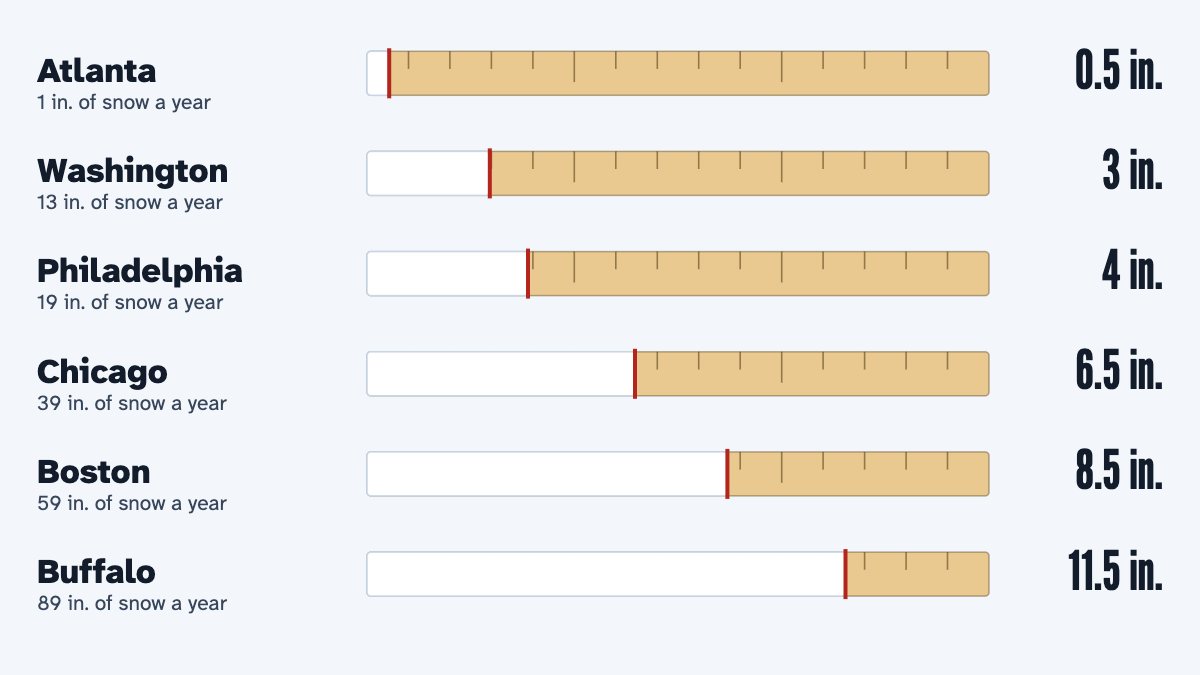
In Maine’s biggest cities, 9 to 10.5 inches of snow is where schools close about half the time, by our rule of thumb. Sanford sits at 9 inches, Portland, Bangor and South Portland at 10, and Lewiston and Auburn at 10.5.
Maine expects a lot of snow. The six cities on our map normally get 64.2 to 75.2 inches a winter, and the middle of the state’s 60 NOAA weather stations gets 84.8. Our cold points run from −27°F in South Portland to −33°F in Bangor.
Schools must be kept for 180 days, with at least 175 used for instruction. Maine also has its own way to win back a lost day: under a plan the Commissioner approves, schools can add an hour to the school day, and 5 of those hours count as 1 day.
How much snow closes school in Maine?
Between 9 and 10.5 inches in the six cities on our map, by our rule of thumb. That is the amount at which schools close about half the time.
Maine's six largest cities: normal snowfall a year (NOAA 1991–2020) and the snowfall and wind chill at which, by our rule of thumb, schools there usually close.
| City | Normal snowfall | Usually closes at | Cold point (wind chill) |
|---|---|---|---|
| Portland | 72.9 in. a year | 10 in. of snow | −28°F |
| Lewiston | 75.2 in. a year | 10.5 in. of snow | −32°F |
| Bangor | 74.5 in. a year | 10 in. of snow | −33°F |
| South Portland | 70.1 in. a year | 10 in. of snow | −27°F |
| Auburn | 75.2 in. a year | 10.5 in. of snow | −32°F |
| Sanford | 64.2 in. a year | 9 in. of snow | −31°F |
Our rule of thumb: the usual closing point is 0.5 × (normal snowfall a year)0.7, the cold point the normal December–February low minus 45°F. How the calculator works.
Sanford, with 64.2 inches a year, has the lowest point at 9 inches. Lewiston and Auburn (75.2 each) have the highest, 10.5, and Bangor’s 74.5 inches put it at 10.
Bangor and Lewiston show how fine the line can be. Their normals differ by less than an inch, 74.5 against 75.2, but the table rounds to the half inch and they fall on either side of a line: 10 and 10.5. The calculator itself works from your own ZIP code’s forecast, so treat the table as a guide.
When the snow falls changes its weight. The calculator counts snow in full overnight (9 PM to 6 AM) and during bus hours (6 to 10 AM), 80% in the afternoon and evening before, 45% during the school day and only 35% the morning before.
Wind and ice change it too. Gusts of 25 mph or more while an inch or more falls make the snow count more. And in snowy places, it takes more ice to close schools: by our rule of thumb, the ice point rises toward 0.18 inch, against about a tenth of an inch almost anywhere.
Do snow days have to be made up in Maine?
Yes, unless the Commissioner of Education reduces or waives them. 20-A M.R.S. § 4801 requires schools to be kept for at least 180 days a year, and “At least 175 days shall be used for instruction.” No more than 5 of the 180 may go to in-service, meetings, parent conferences or records days.
Here is the extension rule. With a plan the Commissioner approves, a school may add one hour to the school day on up to 25 days a year, and every 5 one-hour extensions count as 1 more school day. It may be used only to make up days missed to weather or emergency closures. So extensions can recover at most 5 days a year.
A worked example: a winter that costs a school 3 days needs 15 one-hour extensions to win them back, well within the 25 allowed. Other make-up methods can be used too, if they are in a plan the Commissioner approves.
The Commissioner may also reduce or waive the minimum number of days on a school board’s application, or allow an equivalent number of hours in place of days for a limited time, with the board’s written reasons. A unit that does not comply may not receive its state school subsidy until it provides for future compliance.
Seniors may be allowed to graduate up to 5 school days before the end of the year. The section sets no hours minimum, and its listed history ends with Public Law 2019, chapter 105.
Can Maine schools switch to remote learning instead?
The state rules we read do not provide for it. § 4801 lets a district put “other ways to make up school days missed due to weather or emergency closures” into a plan the Commissioner approves. But we did not find a Maine rule or Department of Education page that counts a remote day as a school day.
If your district runs a remote day during a storm, ask whether its approved make-up plan counts it toward the 175. Our guide to snow days, delays and e-learning days explains the terms.
Where does Maine get the most snow?
Rangeley, about 1,530 feet up, has the highest normal of Maine’s 60 NOAA weather stations: 123.3 inches a year. Eustis (118.5), the Caribou airport (118.2) and a second Rangeley station (117.6) follow.
Normal snowfall a year and normal December to February low at each of the 60 weather stations in Maine with a snowfall normal in NOAA's U.S. Climate Normals for 1991–2020, with each station's location, elevation and how complete its record is.
The 10 snowiest and 5 least snowy of 60 stations in Maine
| Station | Normal snowfall | Dec–Feb low | Elevation |
|---|---|---|---|
| Rangeley | 123.3 in. | 4°F | 1,530 ft |
| Eustis | 118.5 in. | 5°F | 1,260 ft |
| Caribou Municipal Airport | 118.2 in. | 6°F | 624 ft |
| Rangeley 2 Nw | 117.6 in. | 6°F | 1,780 ft |
| Topsfield 2 | 114.7 in. | 10°F | 620 ft |
| Andover 2 | 111.8 in. | 7°F | 822 ft |
| Long Falls Dam | 109.1 in. | 8°F | 1,160 ft |
| Brassua Dam | 107.7 in. | 5°F | 1,069 ft |
| Hartford | 107.7 in. | 12°F | 705 ft |
| Jackman | 106.9 in. | 3°F | 1,214 ft |
| … | |||
| Lewiston | 65.1 in. | 15°F | 180 ft |
| Eastport | 61.8 in. | 18°F | 85 ft |
| Eliot | 55.8 in. | — | 20 ft |
| Tenants Harbor | 53.1 in. | 20°F | 21 ft |
| Kennebunkport | 48.9 in. | 16°F | 20 ft |
Download “Normal snowfall at Maine weather stations, 1991–2020” (CSV, opens in Excel)
Built from: U.S. Climate Normals, 1991–2020 (National Centers for Environmental Information).
By our rule of thumb, a place with Rangeley’s snowfall would need about 14.5 inches to close, near the rule’s 15-inch ceiling. Caribou’s 118.2 inches would put a place at about 14.
Even the least snowy station, Kennebunkport, normally gets 48.9 inches, and the middle of the list is 84.8. The Lewiston station’s 65.1 inches sits among the least snowy, while our map gives the city 75.2, because the map’s city numbers weight several stations. Of the 60, 13 are what NOAA calls standard, with 24 or more years of records; 47 are provisional, with at least 10.
How cold does it have to be to close school in Maine?
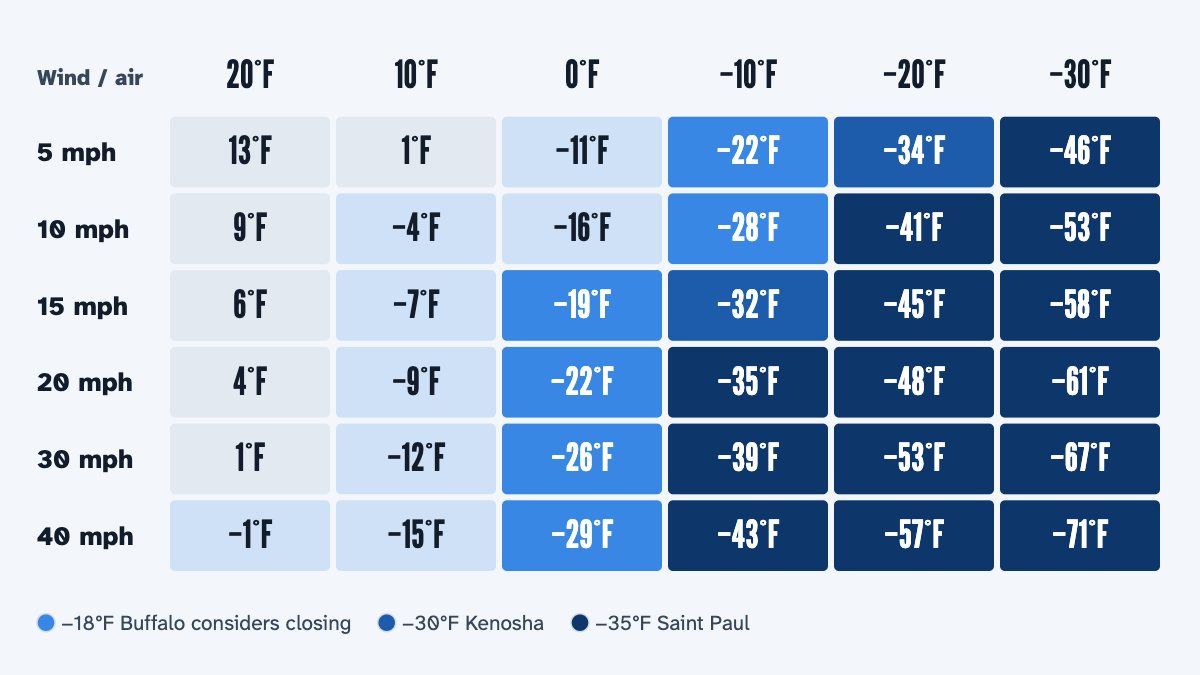
Maine’s school-year law sets no temperature, so the calculator uses our cold point: a wind chill of −27°F to −33°F in the map’s cities, by our rule of thumb. It is the normal December-to-February low minus 45°F. Districts that publish a cold number are in our guide to cold-weather closings.
Bangor’s normal winter low is 12.1°F, so its cold point is −33°F. Portland’s is 17.5°F, so its cold point is −28°F. The calculator checks the wind chill from 5 to 9 AM.
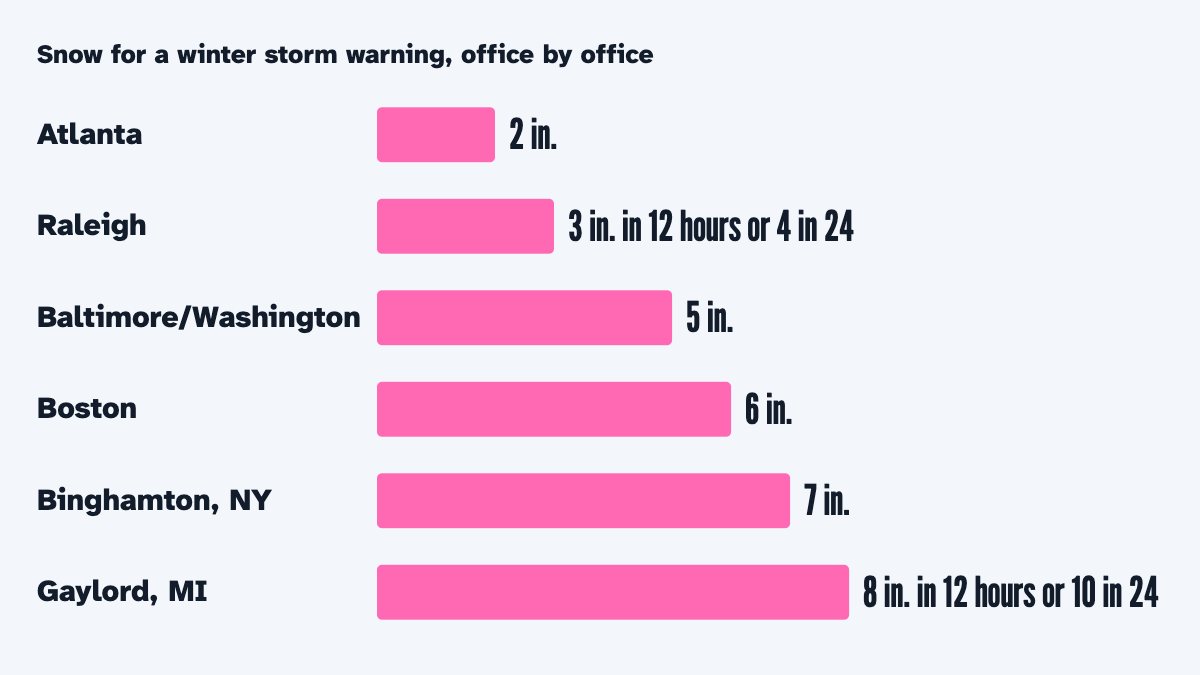
NOAA’s wind chill chart sorts frostbite risk into bands: none, over 2 hours, up to 30 minutes, up to 10 minutes and up to 5 minutes. An Extreme Cold Warning, the Weather Service’s name since on or about October 1, 2024 for what was the Wind Chill Warning, raises the calculator’s chance more than a watch or a Cold Weather Advisory.
Who decides, and when do families hear?
Your school administrative unit’s board and superintendent close schools. The Commissioner of Education grants waivers and approves make-up plans.
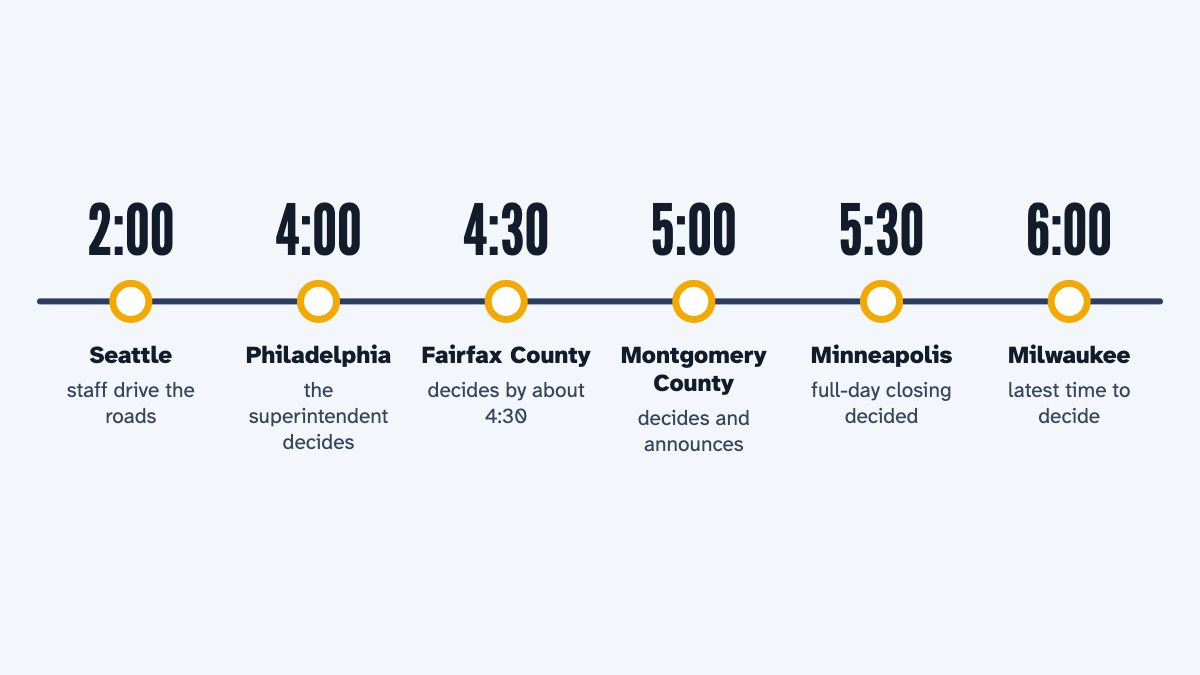
If your district uses one-hour extensions, the news after a storm may be a longer school day for a while rather than an extra day at the end of the year. For the closing itself, check your district’s website, app, or local TV and radio. Our guide to how schools decide snow days explains what goes into the call.
The calculator gives you a chance the night before and shows its reasons, from the National Weather Service forecast for the part of your ZIP code where most people live. If your district is known for holding out, set it to rarely closes. Forecasts change, so look again in the morning.
Snow days in Maine
- Snow
- 9 inches in Sanford
- 10 in Portland
- 10.5 in Lewiston and Auburn
- Cold
- Our cold point −27°F to −33°F
- Extreme Cold Warning
- School year
- 180 days
- 175 for instruction
- Make-up
- One-hour extensions
- 5 extensions make 1 day
- Up to 25 a year
- Waivers
- Commissioner can reduce days
- Hours in place of days
- Who decides
- Board and superintendent
- Commissioner approves plans
Questions people ask
How does Maine make up snow days?
By adding days, or, under a plan the Commissioner approves, by adding an hour to the school day on up to 25 days. Every 5 one-hour extensions count as 1 school day.
How many snow days do Maine schools get?
State law sets no number of free days. Schools need 180 days with 175 for instruction, and the Commissioner may reduce or waive days on a school board’s application.
Can Maine schools have remote snow days?
We did not find a Maine rule that counts a remote day as a school day. Ask your district whether its approved make-up plan includes one.
Can Maine seniors finish before the rest of the school?
Yes, they may be allowed to graduate up to 5 school days before the end of the year.
Sources: 20-A M.R.S. § 4801 (Maine Legislature); National Weather Service, cold alerts; NOAA JetStream, wind chill.
Facts checked October 29, 2026.
More guides
-
-
-
-

-
-