New Hampshire Snow Day Calculator: Chances, Make-Up Hours, Remote Days
By our rule of thumb, 8 to 9.5 inches of snow closes schools in New Hampshire's big cities half the time. Remote learning can count when weather makes buses unsafe.

- Under 5%
- 5 to 24%
- 25 to 49%
- 50 to 74%
- 75% or more
The next school day in New Hampshire
Worked out from the National Weather Service forecast, 3:07 PM EDT, Thursday.
- Manchester<1% snow dayFriday: no snow
- Nashua<1% snow dayFriday: no snow
- Concord<1% snow dayFriday: no snow
- Dover<1% snow dayFriday: no snow
- Rochester<1% snow dayFriday: no snow
- Keene<1% snow dayFriday: no snow
In New Hampshire’s big cities, 8 to 9.5 inches of snow is where schools close about half the time, by our rule of thumb. Rochester sits at 8 inches, Dover and Manchester at 8.5, Nashua at 9, and Concord and Keene at 9.5.
Snow is part of every winter here. The six cities on our map normally get 50.6 to 66.6 inches a year, and the Mount Washington station, about 6,270 feet up, records 281.8. The cold is serious too: our cold points for those cities run from −28°F to −31°F.
The school year is 180 days or the matching hours. Lost time is made up with added hours before any waiver, and remote learning counts when weather makes it unsafe to bus students.
How much snow closes school in New Hampshire?
Between 8 and 9.5 inches in the six cities on our map, by our rule of thumb. That is the amount at which schools close about half the time.
New Hampshire's six largest cities: normal snowfall a year (NOAA 1991–2020) and the snowfall and wind chill at which, by our rule of thumb, schools there usually close.
| City | Normal snowfall | Usually closes at | Cold point (wind chill) |
|---|---|---|---|
| Manchester | 57.5 in. a year | 8.5 in. of snow | −28°F |
| Nashua | 62 in. a year | 9 in. of snow | −29°F |
| Concord | 66.6 in. a year | 9.5 in. of snow | −30°F |
| Dover | 56.1 in. a year | 8.5 in. of snow | −28°F |
| Rochester | 50.6 in. a year | 8 in. of snow | −28°F |
| Keene | 65.2 in. a year | 9.5 in. of snow | −31°F |
Our rule of thumb: the usual closing point is 0.5 × (normal snowfall a year)0.7, the cold point the normal December–February low minus 45°F. How the calculator works.
Rochester, with 50.6 inches a year, has the lowest point on the map, 8 inches. Concord (66.6) and Keene (65.2) have the highest, 9.5. Nashua (62) rounds to 9, and Manchester (57.5) and Dover (56.1) to 8.5.
When the snow falls matters as much as how much. The calculator counts snow in full overnight (9 PM to 6 AM) and during bus hours (6 to 10 AM), 80% in the afternoon and evening before, and 45% during the school day. So 9 inches that fall during the school day count as about 4, while the same 9 inches overnight count in full.
Wind adds to it: gusts of 25 mph or more while an inch or more falls make the snow count more. And if your district is used to big storms and holds out, tell the calculator it rarely closes.
Do snow days have to be made up in New Hampshire?
Yes, and with hours first. RSA 189:1 requires “at least 180 days in each year, or the equivalent number of hours,” and the state’s rules set those hours: at least 945 in grades 1 to 6, 990 in grades 7 to 12, and 450 in kindergarten.
Under Ed 306.15, schools must use additional hours to reschedule lost time before they ask for a waiver. Longer days only go so far: the rules count no more than 5.75 hours a day in elementary school and 6 in middle and high school.
Here is what that cap means in practice. Take a middle school whose days count 5.5 hours. A snow day costs it 5.5 hours, and stretching a day to the 6-hour cap wins back half an hour, so it takes 11 longer days to recover one snow day. A school already at the cap has to add days instead.
If time still runs short, a school board can ask the state board in writing for a reduction under RSA 189:2. After a hearing, the state board may cut the required time to the limits it thinks wise. Days lost to workshops, conventions or teachers’ institutes cannot be cut this way.
Kindergarten gets a break: under Ed 306.15, a morning or afternoon session cancelled for a delayed opening or early release does not have to be made up. The rules set no fixed number of free snow days. They carry an effective date of December 13, 2024; RSA 189:1 was last amended in 2011 and RSA 189:2 in 2007.
Can New Hampshire schools switch to remote learning instead?
Yes, when weather makes travel unsafe. Under Ed 306.18, remote learning can stand in for in-person instruction when inclement weather “makes it unsafe to safely transport students” to or from school. Ed 306.15 adds that such remote learning counts toward the required instructional time.
The rule allows remote learning online, by video or as a blend of the two. Each school board must adopt a policy to govern and run it.
The rules we read set no cap on weather remote days, require no state approval for each one, and say nothing about when teachers must be available. Those details live in your school board’s policy, so that is the document to ask for. Our guide to snow days, delays and e-learning days explains the terms.
Where does New Hampshire get the most snow?
Mount Washington has by far the highest normal of New Hampshire’s 38 NOAA weather stations: 281.8 inches a year. First Connecticut Lake (143.0) and Pinkham Notch (135.8) come next, then Bethlehem at 100.9.
Normal snowfall a year and normal December to February low at each of the 38 weather stations in New Hampshire with a snowfall normal in NOAA's U.S. Climate Normals for 1991–2020, with each station's location, elevation and how complete its record is.
The 10 snowiest and 5 least snowy of 38 stations in New Hampshire
| Station | Normal snowfall | Dec–Feb low | Elevation |
|---|---|---|---|
| Mount Washington | 281.8 in. | −1°F | 6,267 ft |
| First Connecticut Lake | 143 in. | 4°F | 1,650 ft |
| Pinkham Notch | 135.8 in. | 9°F | 2,025 ft |
| Bethlehem 2 | 100.9 in. | 6°F | 1,180 ft |
| York Pond | 95.5 in. | 7°F | 1,519 ft |
| Jefferson | 94.8 in. | 11°F | 1,235 ft |
| Mount Sunapee | 85.4 in. | 16°F | 1,275 ft |
| N Conway | 84 in. | 13°F | 522 ft |
| Tamworth 4 | 83 in. | 11°F | 541 ft |
| Berlin | 82 in. | 9°F | 920 ft |
| … | |||
| Milford | 57.4 in. | 16°F | 320 ft |
| Epping | 56.6 in. | 17°F | 160 ft |
| Nashua 2 Nnw | 52.9 in. | 17°F | 135 ft |
| Massabesic Lake | 52.8 in. | 16°F | 253 ft |
| Durham | 38.9 in. | 17°F | 75 ft |
Download “Normal snowfall at New Hampshire weather stations, 1991–2020” (CSV, opens in Excel)
Built from: U.S. Climate Normals, 1991–2020 (National Centers for Environmental Information).
Our rule tops out at 15 inches, which it reaches at about 129 inches of snow a year, so the top 3 stations all sit at that ceiling. A place with Bethlehem’s snowfall would need about 12.5 inches to close.
The least snowy station is Durham, at 38.9 inches, and the middle of the list is 72.0. Of the 38, 7 are what NOAA calls standard, with 24 or more years of records, and 31 are provisional, with at least 10. The normals cover 1991 to 2020.
How cold does it have to be to close school in New Hampshire?
New Hampshire’s school rules set no temperature, so the calculator uses our cold point: a wind chill of −28°F to −31°F in the map’s cities, by our rule of thumb. It is the normal December-to-February low minus 45°F. Districts that publish a cold number are in our guide to cold-weather closings.
Keene, with a normal winter low of 13.8°F, sits at −31°F. Manchester, at 17.1°F, sits at −28°F. The calculator checks the wind chill from 5 to 9 AM, around bus time.
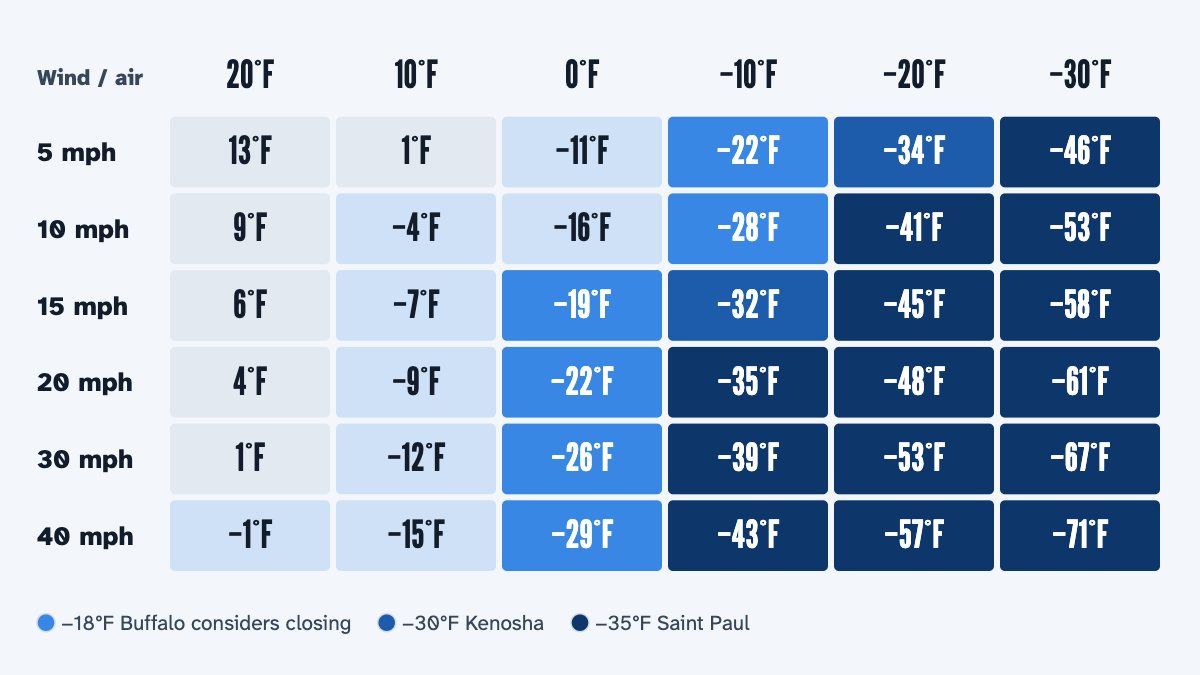
The Weather Service’s wind chill chart shades frostbite times of 30, 10 and 5 minutes; the colder the wind chill, the shorter the time. Its Extreme Cold Warning, the name that replaced the Wind Chill Warning on or about October 1, 2024, raises the calculator’s chance more than a watch or a Cold Weather Advisory.
Who decides, and when do families hear?
Your district makes the call on the day, under the remote-learning policy your school board adopted. The State Board of Education, after a hearing, can cut the required time, under RSA 189:2.
Because a remote day counts, a stormy morning can bring one of 3 messages: school is open, school is closed, or school is remote. Your district’s website, app, or local TV and radio will say which. Our guide to how schools decide snow days explains what goes into the call.
The calculator gives you a chance the night before. It reads the National Weather Service forecast for the part of your ZIP code where most people live and shows its reasons. Forecasts change, so look again in the morning.
Snow days in New Hampshire
- Snow
- 8 inches in Rochester
- 8.5 in Manchester
- 9.5 in Concord and Keene
- Cold
- Our cold point −28°F to −31°F
- Extreme Cold Warning
- School year
- 180 days or hours
- 945 or 990 hours
- Make-up
- Add hours first
- Day length capped
- State board can reduce
- Remote learning
- When buses are unsafe
- Board policy
- Counts toward hours
- Who decides
- Your district
- School board policy
Questions people ask
Can New Hampshire schools do remote learning instead of a snow day?
Yes. When inclement weather makes it unsafe to bus students, remote learning under the school board’s policy counts toward the required time.
How many snow days do New Hampshire schools get?
The state sets no number. Schools need 180 days or the matching hours, and lost time is rescheduled with added hours before a waiver can be asked for.
Can a longer school day make up a snow day?
Partly. Added hours are the first way to make up time, but the rules count at most 5.75 hours a day in elementary school and 6 in middle and high school.
Does kindergarten make up a missed half day?
Not when a morning or afternoon session is cancelled for a delayed opening or early release. The rules say it need not be made up.
Does a New Hampshire remote day need state approval?
Not in the rules we read. The school board adopts the policy, and the rules count weather remote learning toward instructional time without a state approval step or a cap on the number of days.
Sources: RSA 189:1 and RSA 189:2 (New Hampshire General Court); Ed 306.15 and Ed 306.18 (Department of Education rules).
Facts checked October 29, 2026.
More guides
-
-
-
-

-
-