Rhode Island Snow Day Calculator: Chances, Make-Up and Virtual Days
By our rule of thumb, about 6 to 7 inches of snow closes Rhode Island schools about half the time. Calendars carry 4 make-up days, and up to 5 virtual days need approval first.

- Under 5%
- 5 to 24%
- 25 to 49%
- 50 to 74%
- 75% or more
The next school day in Rhode Island
Worked out from the National Weather Service forecast, 3:07 PM EDT, Thursday.
- Providence<1% snow dayFriday: no snow
- Cranston<1% snow dayFriday: no snow
- Warwick<1% snow dayFriday: no snow
- Pawtucket<1% snow dayFriday: no snow
- East Providence<1% snow dayFriday: no snow
- Woonsocket<1% snow dayFriday: no snow
Rhode Island gets steady winter snow. Providence’s normal is 44.4 inches a year and Warwick’s 35, by NOAA’s 1991–2020 normals. By our rule of thumb, about 7 inches of overnight snow gives schools in Providence, Cranston, Pawtucket, East Providence or Woonsocket an even chance of closing, and about 6 in Warwick.
Days lost to snow are planned for. A state regulation has every district plan at least 184 school days, four more than the 180 the law requires, and the state education department’s 2025–26 calendar guidance calls the extra four make-up days. A district may also use up to five virtual days a year, but only with a plan the state has approved ahead of time.
How much snow closes school in Rhode Island?
About 6 to 7 inches, by our rule of thumb. That is the overnight snow at which schools close about half the time, worked out from each city’s normal snowfall.
Rhode Island's six largest cities: normal snowfall a year (NOAA 1991–2020) and the snowfall and wind chill at which, by our rule of thumb, schools there usually close.
| City | Normal snowfall | Usually closes at | Cold point (wind chill) |
|---|---|---|---|
| Providence | 44.4 in. a year | 7 in. of snow | −22°F |
| Cranston | 45.2 in. a year | 7 in. of snow | −22°F |
| Warwick | 35 in. a year | 6 in. of snow | −21°F |
| Pawtucket | 43.4 in. a year | 7 in. of snow | −22°F |
| East Providence | 41.4 in. a year | 7 in. of snow | −21°F |
| Woonsocket | 44.7 in. a year | 7 in. of snow | −24°F |
Our rule of thumb: the usual closing point is 0.5 × (normal snowfall a year)0.7, the cold point the normal December–February low minus 45°F. How the calculator works.
Five of the six cities sit close together, all near 7 inches: Cranston (45.2 inches a year), Woonsocket (44.7), Providence (44.4), Pawtucket (43.4) and East Providence (41.4). Warwick, with 35 inches a year, is the low one, near 6. Woonsocket also has the coldest normal winter low, 20.9°F, which puts its cold point at −24°F.
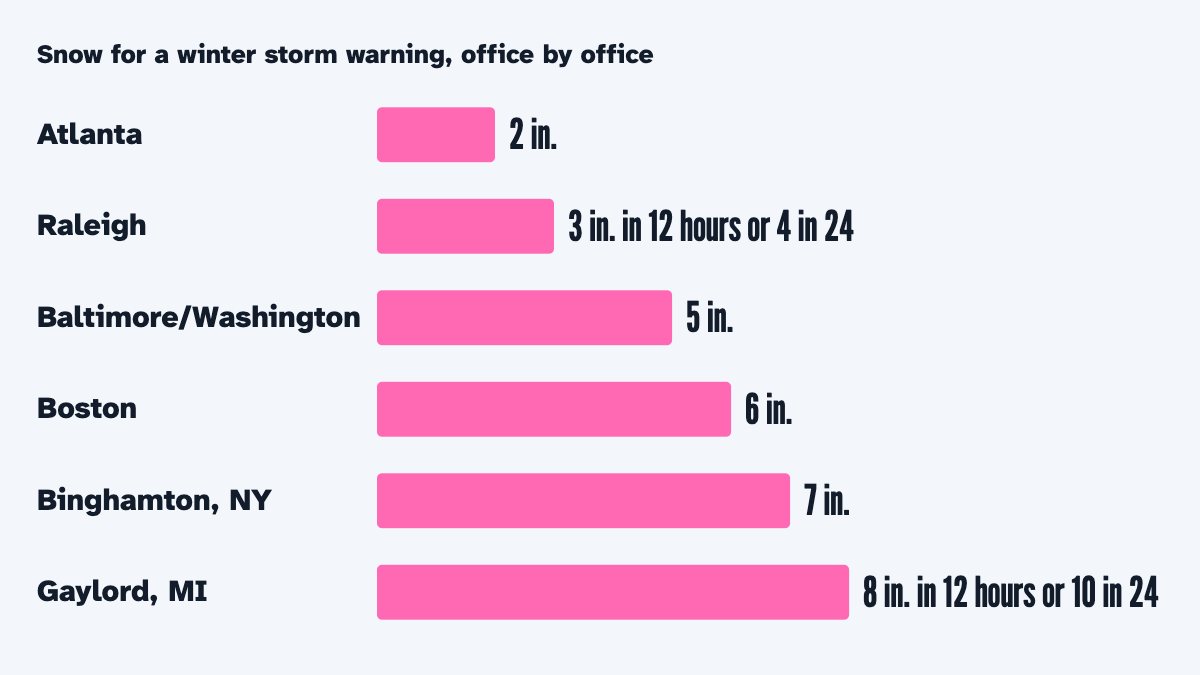
The National Weather Service office in Norton, Massachusetts, sets the warning levels for its area. It issues a Winter Storm Warning for 6 inches of snow averaged over a forecast zone, and a Winter Weather Advisory for 3 inches in 12 hours averaged over a zone in Connecticut, Massachusetts or Rhode Island, or for any freezing rain on roads. Its warnings cover weather expected within the next 12 to 36 hours.
The calculator adds more to its chance for a warning than for an advisory, and it counts snow fully when it falls overnight (9 PM to 6 AM) or while buses run (6 to 10 AM). More on how the calculator works.
Where does Rhode Island get the most snow?
At its highest station. NOAA keeps snowfall normals for only six Rhode Island weather stations, and North Foster, about 630 feet up, leads with 62.0 inches a year. Woonsocket follows at 41.5, then Tiverton (38.1), the Providence T. F. Green airport station (36.6) and Kingston (34.5). Newport, about 15 feet above sea level, gets the least: 26.0 inches.
Normal snowfall a year and normal December to February low at each of the 6 weather stations in Rhode Island with a snowfall normal in NOAA's U.S. Climate Normals for 1991–2020, with each station's location, elevation and how complete its record is.
Every station in Rhode Island, snowiest first
| Station | Normal snowfall | Dec–Feb low | Elevation |
|---|---|---|---|
| N Foster 1 E | 62 in. | 21°F | 630 ft |
| Woonsocket | 41.5 in. | 22°F | 110 ft |
| Tiverton | 38.1 in. | 26°F | 90 ft |
| Providence T F Green Airport | 36.6 in. | 24°F | 60 ft |
| Kingston | 34.5 in. | 23°F | 117 ft |
| Newport Rose | 26 in. | 27°F | 15 ft |
Download “Normal snowfall at Rhode Island weather stations, 1991–2020” (CSV, opens in Excel)
Built from: U.S. Climate Normals, 1991–2020 (National Centers for Environmental Information).
With only six stations, the snowiest and least snowy lists are the same places sorted two ways. Half the stations average 37.4 inches or more, and North Foster gets more than twice as much snow as Newport.
Do snow days have to be made up in Rhode Island?
Usually, yes. R.I. Gen. Laws 16-2-2 requires at least 180 days a year or the equivalent, not counting holidays, and a district that uses longer days must still provide 1,080 school hours; that hours option was added in 2024. At least 990 of the 1,080 hours must be actual instruction, the Rhode Island Department of Education (RIDE) says.
RIDE’s calendar guidance, written for 2025–26, is plain about weather: districts “are required to make up the day unless an alternative plan has been approved.” That is why calendars carry 184 days: the four extra days are set aside for weather or other closings.
There is one way around a make-up day. A district that schedules more than 180 days or 1,080 hours, or runs longer days, may skip it if it still provides at least 1,080 school hours, 990 of them instructional; some of those calendar setups need the Commissioner’s approval.
Short days have their own rule. A delayed opening or early dismissal counts toward the 180 only if school was open at least three hours. The state’s school-day regulation defines a school day as at least 5.5 hours (330 minutes) of actual school work, and lets the Commissioner shorten the year for an individual school by up to five days in total after short-term emergency closings.
Can Rhode Island schools switch to remote learning instead?
Yes, with a plan approved ahead of time. Under 16-2-2, RIDE takes district plans to teach through virtual education when schools close for bad weather or another emergency, and the plan must be approved by the Council on Elementary and Secondary Education for the day to count as a school day.
RIDE’s virtual instructional days page says approved virtual days are “limited to five per school year.” Plans are submitted every year, and without an approved plan and the notification step, a virtual day cannot count as one of the 180.
So a snowy morning in Rhode Island can bring a closing, a delay or, in a district with an approved plan, a day of school at home.
How cold does it have to be to close school in Rhode Island?
Far colder than a normal winter morning, by our rule of thumb: a wind chill near −21°F at bus time in Warwick and East Providence, −22°F in Providence, Cranston and Pawtucket, and −24°F in Woonsocket. That is each city’s normal December–February low minus 45°F. We have no Rhode Island district’s own cold number on file.
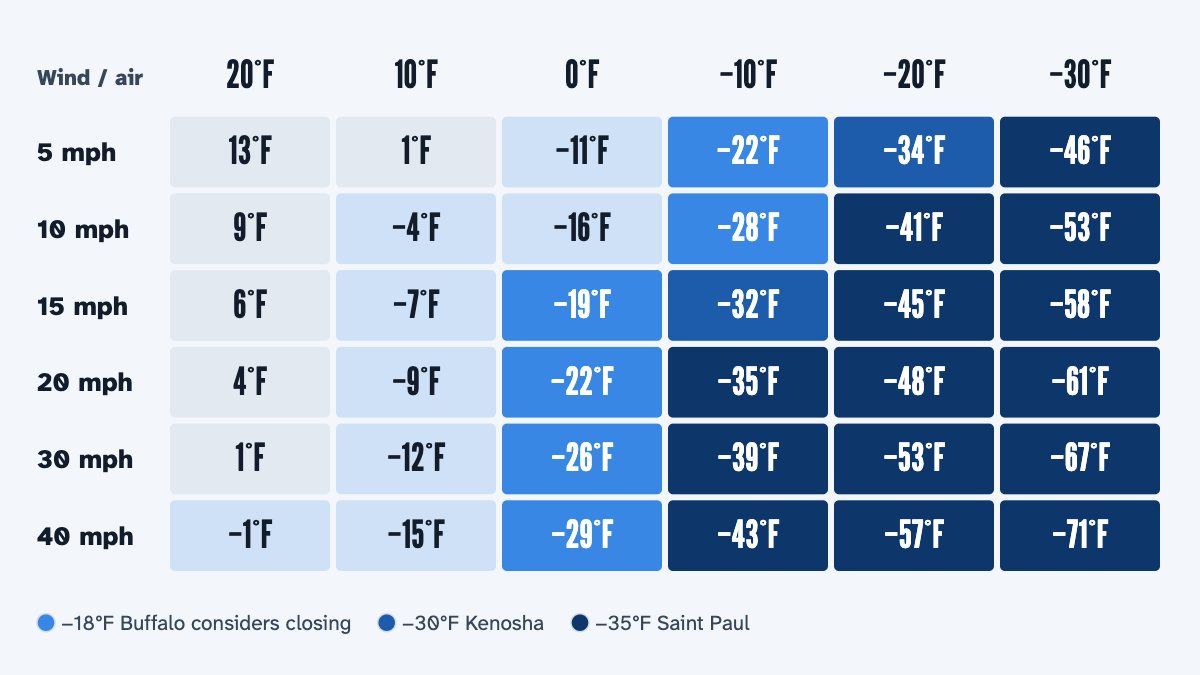
The calculator reads the wind chill from 5 to 9 AM and adds to its chance when the National Weather Service issues cold alerts, whose levels each local office sets. The top one is now the Extreme Cold Warning, which replaced the Wind Chill Warning on or about October 1, 2024; the Cold Weather Advisory is the step below. The Weather Service’s wind chill chart asks for extra caution with children.
Who decides, and when do Rhode Island families hear?
Your superintendent and district. The state’s school-day regulation lets the superintendent of schools shorten a school day for weather; if school stays open less than three hours, the superintendent must tell the Commissioner in writing within five days. Districts must also update their calendars in RIDE’s system within five days of an unplanned closing, the calendar guidance says.
We have not found a Rhode Island district’s announcement clock, so check your district’s website, app or local TV and radio for the final word. The calculator reads the Weather Service forecast from 6 AM the day before to 3 PM on the school day, so its chance can change overnight.
It is independent: not a school district, RIDE or the National Weather Service. It shows the reasons behind each chance so you can judge them.
The page at a glance:
Snow days in Rhode Island
- What closes schools
- 6 inches in Warwick
- 7 inches in Providence
- warnings at 6 inches
- School year
- 180 days or equal
- 1,080 hours
- 990 instructional
- Make-up days
- 184-day calendars
- 4 make-up days
- skip only if hours are met
- Short days
- 3 hours to count
- the superintendent reports shorter days
- Virtual days
- an approved plan first
- up to 5 a year
Questions people ask
How many snow days do Rhode Island schools get?
Calendars must hold at least 184 days under a state regulation, and RIDE’s 2025–26 calendar guidance calls the four days beyond the 180 make-up days. A district with an approved plan can also hold up to five virtual days a year, RIDE says. Beyond those, missed days are made up unless the district still meets its hours.
Do Rhode Island schools have virtual snow days?
Some do. A district needs a plan approved in advance and renewed every year, and RIDE limits approved virtual days to five per school year.
Does a two-hour delay count as a school day in Rhode Island?
It counts if school is open at least three hours that day, under RIDE’s guidance and the state’s school-day regulation. A shorter day must be reported to the Commissioner within five days.
Do Rhode Island schools have to make up snow days?
Usually. Districts must make up the day unless an alternative plan, such as an approved virtual day, applies, or the calendar still reaches 1,080 school hours with 990 instructional.
Sources: R.I. Gen. Laws 16-2-2; Rhode Island Department of Education, school calendar guidance (2025); Rhode Island Department of Education, virtual instructional days.
Facts checked October 29, 2026.
More guides
-
-
-
-

-
-