Wyoming Snow Day Calculator: Chances, Cold and the 175-Day Rule
Wyoming schools close for a big storm or bitter cold: about 6.5 to 10 inches of snow by our rule of thumb. A closed day must be made up if it leaves a school under 175 days.

- Under 5%
- 5 to 24%
- 25 to 49%
- 50 to 74%
- 75% or more
The next school day in Wyoming
Worked out from the National Weather Service forecast, 3:07 PM EDT, Thursday.
- Cheyenne<1% snow dayFriday: no snow
- Casper<1% snow dayFriday: no snow
- Gillette<1% snow dayFriday: no snow
- Laramie<1% snow dayFriday: no snow
- Rock Springs<1% snow dayFriday: no snow
- Sheridan<1% snow dayFriday: no snow
Snow is a normal part of a Wyoming winter: the middle of NOAA’s 109 Wyoming stations with a snowfall normal averages 49.7 inches a year. So it takes a lot to close schools. By our rule of thumb, a school in Casper closes about half the time once 10 inches falls overnight, one in Cheyenne at about 9 inches and one in Rock Springs at about 6.5. Type your ZIP code above to see the chance for your own school, from the National Weather Service forecast.
Cold is the other threat. Laramie, with a normal winter low of 11.1°F, has the lowest cold point on the state’s map by our rule: a wind chill near −34°F.
When schools do close, the day often comes back later. Wyoming requires at least 175 school days a year, and the state’s education department says a closure that drops a school below 175 days must be made up (Wyoming Department of Education, 2021).
How much snow closes school in Wyoming?
About 6.5 to 10 inches of overnight snow, by our rule of thumb. The calculator sets each city’s usual closing point from its normal snowfall, so the snowier the town, the more it takes to close its schools.
Wyoming's six largest cities: normal snowfall a year (NOAA 1991–2020) and the snowfall and wind chill at which, by our rule of thumb, schools there usually close.
| City | Normal snowfall | Usually closes at | Cold point (wind chill) |
|---|---|---|---|
| Cheyenne | 61 in. a year | 9 in. of snow | −28°F |
| Casper | 74.1 in. a year | 10 in. of snow | −30°F |
| Gillette | 54.8 in. a year | 8 in. of snow | −30°F |
| Laramie | 68 in. a year | 9.5 in. of snow | −34°F |
| Rock Springs | 39.3 in. a year | 6.5 in. of snow | −32°F |
| Sheridan | 64.4 in. a year | 9 in. of snow | −33°F |
Our rule of thumb: the usual closing point is 0.5 × (normal snowfall a year)0.7, the cold point the normal December–February low minus 45°F. How the calculator works.
Casper has the most snow of the 6 cities, 74.1 inches in a normal year, and the highest closing point, 10 inches. Laramie (68 inches a year) sits at 9.5, Sheridan (64.4) and Cheyenne (61) at 9, Gillette (54.8) at 8 and Rock Springs (39.3) at 6.5.
Wind matters too. The calculator counts snow more when gusts reach 25 mph or more while an inch or more falls. The Weather Service issues a Blizzard Warning when frequent gusts of 35 mph or more and falling or blowing snow cut visibility below a quarter mile for 3 hours or more (NWS winter alerts), and a warning out for your area raises the calculator’s chance.
Timing counts as well. Snow that falls overnight (9 p.m. to 6 a.m.) or while buses run (6 to 10 a.m.) counts fully, while snow from the afternoon before counts for less, since crews have hours to clear it. If your district rarely closes, or closes easily, tell the calculator and it moves the closing point.
Where does Wyoming get the most snow?
High in the mountains. Of NOAA’s 109 Wyoming stations with a snowfall normal for 1991–2020, the snowiest is Snake River, at about 6,880 feet, with 293.6 inches a year. Lake Yellowstone (199.4 inches), Old Faithful (197.0), Pahaska (180.5), Moran (174.9) and Moose (165.9) follow.
Normal snowfall a year and normal December to February low at each of the 109 weather stations in Wyoming with a snowfall normal in NOAA's U.S. Climate Normals for 1991–2020, with each station's location, elevation and how complete its record is.
The 10 snowiest and 5 least snowy of 109 stations in Wyoming
| Station | Normal snowfall | Dec–Feb low | Elevation |
|---|---|---|---|
| Snake Rvr | 293.6 in. | 2°F | 6,882 ft |
| Lake Yellowstone | 199.4 in. | 5°F | 7,892 ft |
| Old Faithful | 197 in. | 1°F | 7,351 ft |
| Pahaska | 180.5 in. | 8°F | 6,692 ft |
| Moran 5WNW | 174.9 in. | 3°F | 6,805 ft |
| Moose | 165.9 in. | 4°F | 6,444 ft |
| Bondurant | 141.1 in. | 3°F | 6,693 ft |
| Story | 138.3 in. | 14°F | 5,168 ft |
| Alta 1 Nnw | 113.4 in. | 12°F | 6,440 ft |
| Darwin Rch | 108.6 in. | −5°F | 8,190 ft |
| … | |||
| Boysen Dam | 16.1 in. | 8°F | 4,875 ft |
| Lovell | 13.3 in. | 10°F | 3,847 ft |
| Buffalo Bill Dam | 12.3 in. | 19°F | 5,160 ft |
| Deaver | 12.2 in. | 9°F | 4,105 ft |
| Powell Field Station | 11.2 in. | 8°F | 4,372 ft |
Download “Normal snowfall at Wyoming weather stations, 1991–2020” (CSV, opens in Excel)
Built from: U.S. Climate Normals, 1991–2020 (National Centers for Environmental Information).
The least snowy stations get far less: Powell averages 11.2 inches, Deaver 12.2, Buffalo Bill Dam 12.3 and Lovell 13.3. The calculator blends the NOAA stations nearest your ZIP code, so a school near a snowy station gets a much higher closing point than one near a dry one.
Do snow days have to be made up in Wyoming?
Yes, if the closure leaves a school with fewer than 175 school days. State law requires each district to run its schools for at least 175 days a year, a rule the legislature re-enacted in its 2026 session (2026 Enrolled Act No. 2). The Department of Education says that when a closure drops a school below 175 days, the days must be made up (memo 2021-114).
The money side is gentler. The funding law asks for 185 days of operation, and a shorter term caused by closures for weather does not cut a district’s money (Wyoming Statutes 21-13-307). The department reads the 185 days as including at least 175 days with students (memo 2021-114). The department has still said there is “no exemption from the 175-day requirement” (memo 2018-104).
We found no state number of free weather days. Any days a district schedules above 175 act as its cushion, and the department lists previously planned in-service days as one way to make up a lost day (memo 2018-104). Hours count too: the state’s rule sets at least 450 hours a year for kindergarten, 900 for elementary school, 950 for middle school and 1,000 for high school (Chapter 22 rules, 2022).
Every closure is reported. When a school closes for at least half a day because of weather, the district files the state’s temporary school closure form within 2 weeks, even if the year stays above 175 days (memo 2020-141). A district that wants a shorter week can ask the State Board for an alternative schedule of fewer than 175 days; an approval lasts 1 to 2 years (Chapter 22 rules).
Can Wyoming schools switch to remote learning instead?
Yes, if the district has a policy for it. Wyoming’s virtual education rules allow “temporary virtual education days,” and the department’s own examples include virtual school days during bad weather (memo 2022-080).
There are limits. A district may teach this way on fewer than half of its school days, and since 2022–23 a district that plans to use such days needs a school board policy the department has approved. Whether to use them at all is each district’s choice (memo 2022-080). We could not read the rule’s full text, so we cannot say whether it caps weather days more tightly than that.
Teaching away from the building can count as school time: the state’s definition of contact time includes on- or off-site instruction and logged work on an online learning platform (Chapter 22 rules).
How cold does it have to be to close school in Wyoming?
We found no statewide cold rule in Wyoming; each district decides. Our rule of thumb watches the wind chill from 5 to 9 a.m., around the time children wait for buses, and marks a cold point for each city: about −28°F in Cheyenne, −30°F in Casper and Gillette, −32°F in Rock Springs, −33°F in Sheridan and −34°F in Laramie.
Each cold point is the city’s normal December–February low minus 45 degrees, so Laramie, with the coldest normal low of the 6 (11.1°F), gets the lowest.
Wind chill at the bus stop
−19°F
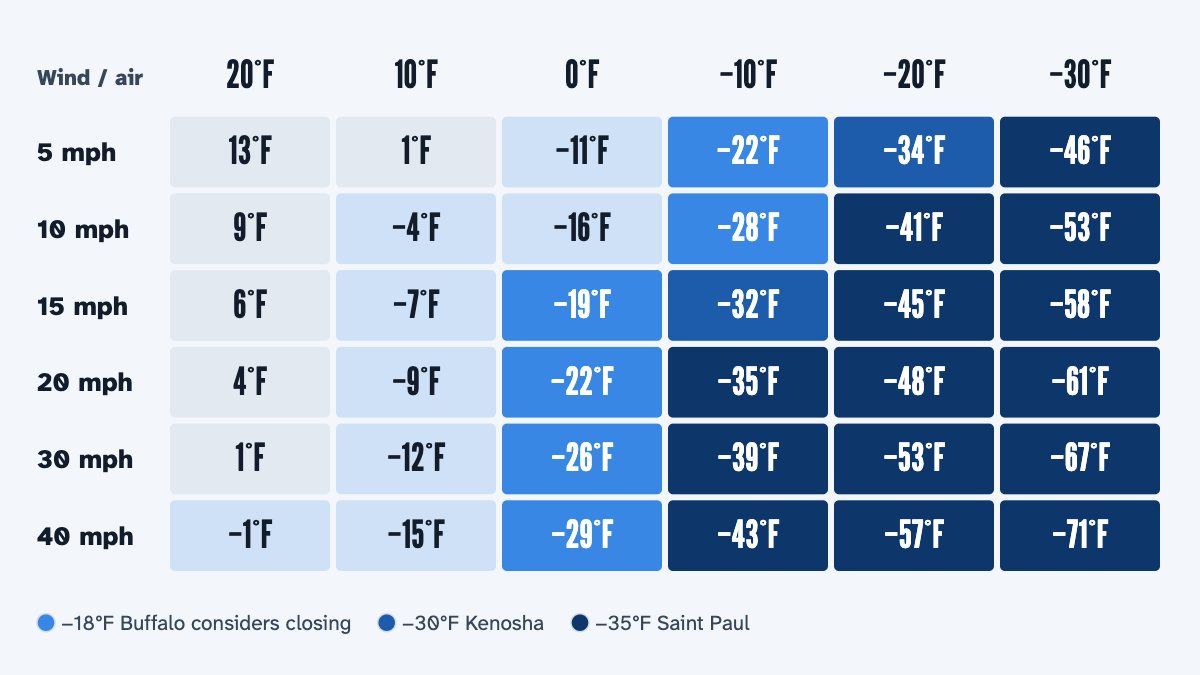
0°F with a 15 mph wind feels like −19°F. Buffalo, New York, will consider closing at −18°F.
The formula is the National Weather Service's, from its wind chill chart. Its own example: 0°F with a 15 mph wind feels like −19°F, and exposed skin can freeze in 30 minutes.
The National Weather Service’s wind chill chart shows how fast cold bites: 0°F with a 15 mph wind feels like −19°F, and exposed skin can freeze in 30 minutes (NWS wind chill chart). The chart’s colder bands mark frostbite in 10 and in 5 minutes (NWS wind chill brochure).
The alert to watch is the Extreme Cold Warning, which means extremely dangerous cold or wind chills are expected or occurring (NWS cold alerts). It replaced the Wind Chill Warning on October 1, 2024 (National Weather Service). Each local Weather Service office sets its own thresholds for these alerts (NWS wind chill chart).
Who decides, and when do families hear?
Your school district decides whether to close, and the state keeps count. The Department of Education tracks closures because “days of operation are tied to funding” (memo 2021-114).
We did not find a Wyoming district’s own closing clock in our research, so check your district’s website, app or local TV and radio. The calculator reads snow from 6 a.m. the day before to 3 p.m. on the school day, and the wind chill from 5 to 9 a.m., so look the evening before and again early in the morning, since forecasts change.
Snow days in Wyoming
- Closing snow
- Rock Springs about 6.5 inches
- Cheyenne about 9
- Casper about 10
- Cold
- Wind chill at bus time
- Cheyenne −28°F
- Laramie −34°F
- Make-up
- At least 175 days
- Below 175 means make-up
- Report within 2 weeks
- Virtual days
- Board policy needed
- Under half of school days
- Who decides
- Your district
- The state keeps count
Questions people ask
How many snow days does Wyoming allow?
We found no state number. Wyoming requires at least 175 school days, so a district can lose only as many days as its calendar holds above 175 before it must make them up (memo 2021-114). The department lists previously planned in-service days as one way to do that.
Do Wyoming schools lose money when they close for snow?
Not for the weather closure itself. The funding law says a shorter term caused by closures for weather does not cut a district’s money (Wyoming Statutes 21-13-307). The 175-day rule still applies, so days lost below that line must be made up.
Can a Wyoming snow day be a virtual day?
Yes, where the district has a board policy the state has approved. Temporary virtual education days can be used in bad weather, on fewer than half of the year’s school days (memo 2022-080).
Will school be closed tomorrow in Wyoming?
Type your school’s ZIP code at the top of this page. The calculator reads the National Weather Service forecast for that spot and shows the chance of a snow day, a late start or school as usual, with its reasons. Only your district decides, so watch its website, app or local news.
Sources: Wyoming Statutes, Title 21, Wyoming Department of Education memo 2021-114 (temporary school closures) and memo 2022-080 (temporary virtual education days).
Facts checked October 29, 2026.
More guides
-
-
-
-

-
-