Nebraska Snow Day Calculator: Chances, Snow Totals and School Hours
By our rule of thumb, about 5 to 5.5 inches of snow closes schools in Omaha and Lincoln about half the time. Nebraska counts school hours and sets no number of snow days.

- Under 5%
- 5 to 24%
- 25 to 49%
- 50 to 74%
- 75% or more
The next school day in Nebraska
Worked out from the National Weather Service forecast, 3:07 PM EDT, Thursday.
- Omaha<1% snow dayFriday: no snow
- Lincoln<1% snow dayFriday: no snow
- Bellevue<1% snow dayFriday: no snow
- Grand Island<1% snow dayFriday: no snow
- Kearney<1% snow dayFriday: no snow
- Fremont<1% snow dayFriday: no snow
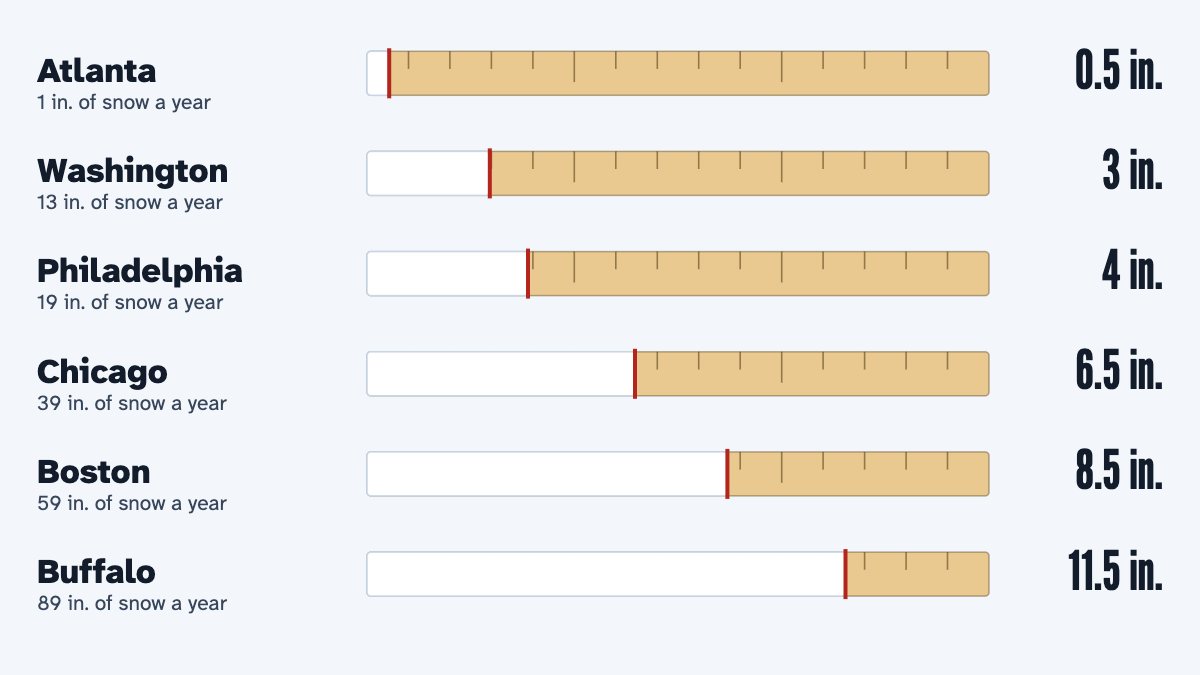
Nebraska winters bring both snow and cold. Omaha’s normal snowfall is 30 inches a year and Lincoln’s 27.2, by NOAA’s 1991–2020 normals, and normal December–February lows sit in the teens. By our rule of thumb, about 5 to 5.5 inches of overnight snow gives schools in either city an even chance of closing; Kearney, at 22.8 inches a year, sits near 4.5.
Wind matters here too. The calculator counts snow more when gusts reach 25 mph or more while an inch or more falls, and the National Weather Service’s Blizzard Warning is about wind and visibility, not depth.
The school year is counted in hours. Neb. Rev. Stat. 79-211 requires 1,032 instructional hours for elementary grades and 1,080 for high school, and the law sets no forgiven snow days. A district that falls short after storms can ask the State Board to excuse it, in a statement its school board’s secretary swears to (Neb. Rev. Stat. 79-213).
How much snow closes school in Nebraska?
About 4.5 to 5.5 inches in the state’s larger cities, by our rule of thumb. That is the overnight snow at which schools close about half the time, so it is a middle point, not a line.
Nebraska's six largest cities: normal snowfall a year (NOAA 1991–2020) and the snowfall and wind chill at which, by our rule of thumb, schools there usually close.
| City | Normal snowfall | Usually closes at | Cold point (wind chill) |
|---|---|---|---|
| Omaha | 30 in. a year | 5.5 in. of snow | −27°F |
| Lincoln | 27.2 in. a year | 5 in. of snow | −28°F |
| Bellevue | 27.5 in. a year | 5 in. of snow | −28°F |
| Grand Island | 27.2 in. a year | 5 in. of snow | −27°F |
| Kearney | 22.8 in. a year | 4.5 in. of snow | −29°F |
| Fremont | 29.8 in. a year | 5.5 in. of snow | −29°F |
Our rule of thumb: the usual closing point is 0.5 × (normal snowfall a year)0.7, the cold point the normal December–February low minus 45°F. How the calculator works.
The six cities sit close together. Omaha (30 inches a year) and Fremont (29.8) are near 5.5 inches; Lincoln, Bellevue and Grand Island (about 27 inches each) are near 5; Kearney (22.8) is near 4.5. Their cold points are close too, from −27°F to −29°F.
Timing can matter more than depth. The calculator counts snow fully overnight (9 PM to 6 AM) and while buses run (6 to 10 AM), at 80% in the afternoon and evening before, and at 45% during the school day. More on how the calculator works.
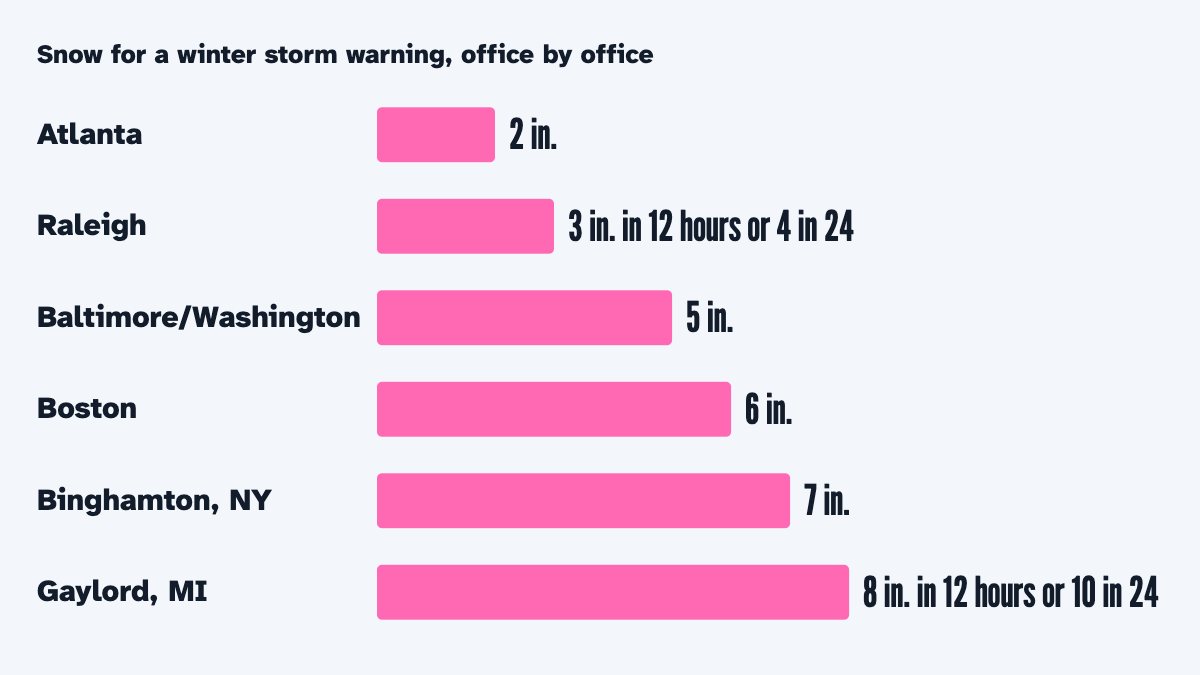
The Weather Service’s Blizzard Warning is for frequent gusts of 35 mph or more with falling or blowing snow that cut visibility below a quarter mile “for three hours or more.” Each Weather Service office sets its own snow amounts for warnings and advisories, and the calculator adds to its chance for warnings, less for watches and advisories.
Where does Nebraska get the most snow?
In the high country. NOAA keeps snowfall normals for 197 Nebraska weather stations, and most of the snowiest are high up: Harrison, about 4,850 feet up, averages 56.6 inches a year, the Plainsview ranch station 53.3, Bushnell 51.6 and Chadron 50.3. Royal, at about 1,850 feet, is the exception, with 48.7 inches.
Normal snowfall a year and normal December to February low at each of the 197 weather stations in Nebraska with a snowfall normal in NOAA's U.S. Climate Normals for 1991–2020, with each station's location, elevation and how complete its record is.
The 10 snowiest and 5 least snowy of 197 stations in Nebraska
| Station | Normal snowfall | Dec–Feb low | Elevation |
|---|---|---|---|
| Harrison | 56.6 in. | 12°F | 4,850 ft |
| Plainsview Rch | 53.3 in. | 17°F | 4,680 ft |
| Bushnell 15S | 51.6 in. | 12°F | 5,170 ft |
| Chadron 3SW | 50.3 in. | 13°F | 3,383 ft |
| Harrison 9NE | 50.3 in. | 16°F | 4,029 ft |
| Royal 2SE | 48.7 in. | — | 1,855 ft |
| Dalton | 48.1 in. | 20°F | 4,278 ft |
| Harrisburg 12WNW | 46.6 in. | 14°F | 4,550 ft |
| Gordon 6N | 45.8 in. | 14°F | 3,748 ft |
| Hemingford | 45.4 in. | 17°F | 4,270 ft |
| … | |||
| Medicine Creek Dam | 15.6 in. | 14°F | 2,409 ft |
| Barneston | 15.5 in. | — | 1,200 ft |
| Harlan County Lake | 15.3 in. | 17°F | 2,010 ft |
| Guide Rock | 15.2 in. | — | 1,635 ft |
| Paxton | 14 in. | — | 3,075 ft |
Download “Normal snowfall at Nebraska weather stations, 1991–2020” (CSV, opens in Excel)
Built from: U.S. Climate Normals, 1991–2020 (National Centers for Environmental Information).
Half the stations average 27.7 inches or more, close to what Lincoln gets. The least snowy, Paxton (14.0 inches), Guide Rock (15.2) and Harlan County Lake (15.3), still average more than a foot.
Do snow days have to be made up in Nebraska?
Only the hours matter, and there are no free days. A school year must reach 1,032 instructional hours for elementary grades and 1,080 for high school under 79-211, so a district whose calendar holds more than that can lose some hours to snow and still meet the bar. A district that drops below it must add time or ask to be excused.
The exception is in Neb. Rev. Stat. 79-213. At the State Board of Education’s discretion, a district whose school board closed schools because “severe storm conditions prevail” can keep its accreditation and state aid with fewer hours, as long as the board’s secretary swears to the facts and files the oath with the State Board.
The Nebraska Department of Education’s form for this is the Affidavit for Instructional Hour Exception for 2026–27, published in August 2026. The board states that it limited hours to keep students and staff safe, and attaches evidence of why days were cancelled and what it did to meet the hours. The form is filed after the school calendar ends; for 2026–27 the notarized affidavit is due by June 30, 2027, says the department’s reports and forms page.
Shortened days are tracked as well. The department’s 2025–26 data manual has a district mark a Weather Day on its calendar and record the day’s instructional time, such as half a day; the district decides whether a shortened day counts as a full day or part of one.
Can Nebraska schools switch to remote learning instead?
The state rules we read do not say. Nebraska’s school-hour laws, 79-211 and 79-213, say nothing about counting remote or e-learning days during a weather closing, and we found no Department of Education guidance on them.
If your district uses remote days, its own policy is the place to read how they count. Ask before you assume a snowy morning means a day of online work, or a day off.
How cold does it have to be to close school in Nebraska?
Far colder than a normal winter morning, by our rule of thumb: a wind chill near −27°F at bus time in Omaha and Grand Island, −28°F in Lincoln and Bellevue, and −29°F in Fremont and Kearney. That is each city’s normal December–February low minus 45°F. We have no Nebraska district’s own cold number on file.
Wind chill at the bus stop
−19°F
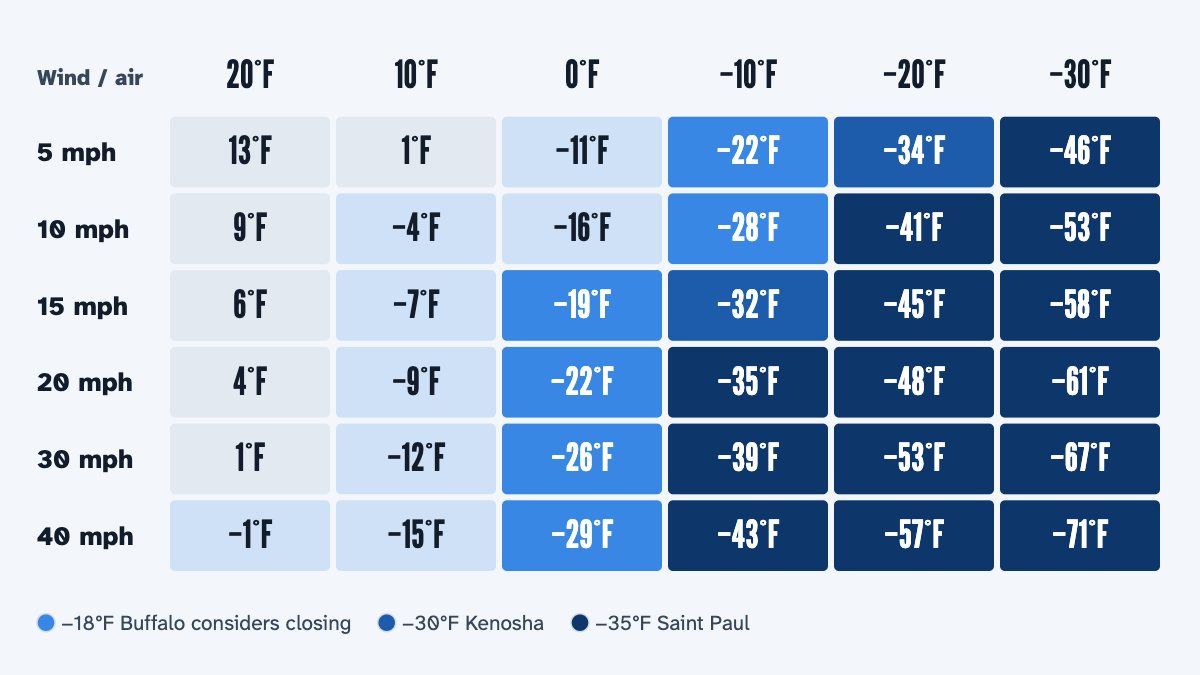
0°F with a 15 mph wind feels like −19°F. Buffalo, New York, will consider closing at −18°F.
The formula is the National Weather Service's, from its wind chill chart. Its own example: 0°F with a 15 mph wind feels like −19°F, and exposed skin can freeze in 30 minutes.
The slider uses the National Weather Service’s wind chill formula, and the Weather Service’s wind chill brochure marks three frostbite bands: 30, 10 and 5 minutes. NOAA adds that −40°F with a 5 mph wind and −20°F with a 45 mph wind both give a wind chill near −58°F, yet frostbite comes faster in the windy case, so “you cannot rely on the wind chill value alone,” its JetStream page says.
The calculator reads the wind chill from 5 to 9 AM and adds to its chance when the Weather Service issues an Extreme Cold Warning, the name that replaced the Wind Chill Warning on or about October 1, 2024, or a Cold Weather Advisory.
Who decides, and when do Nebraska families hear?
Your local school board and district. 79-213 speaks of the school board that “deems it advisable to close any or all schools,” and it is the board, not the state, that swears the affidavit afterward.
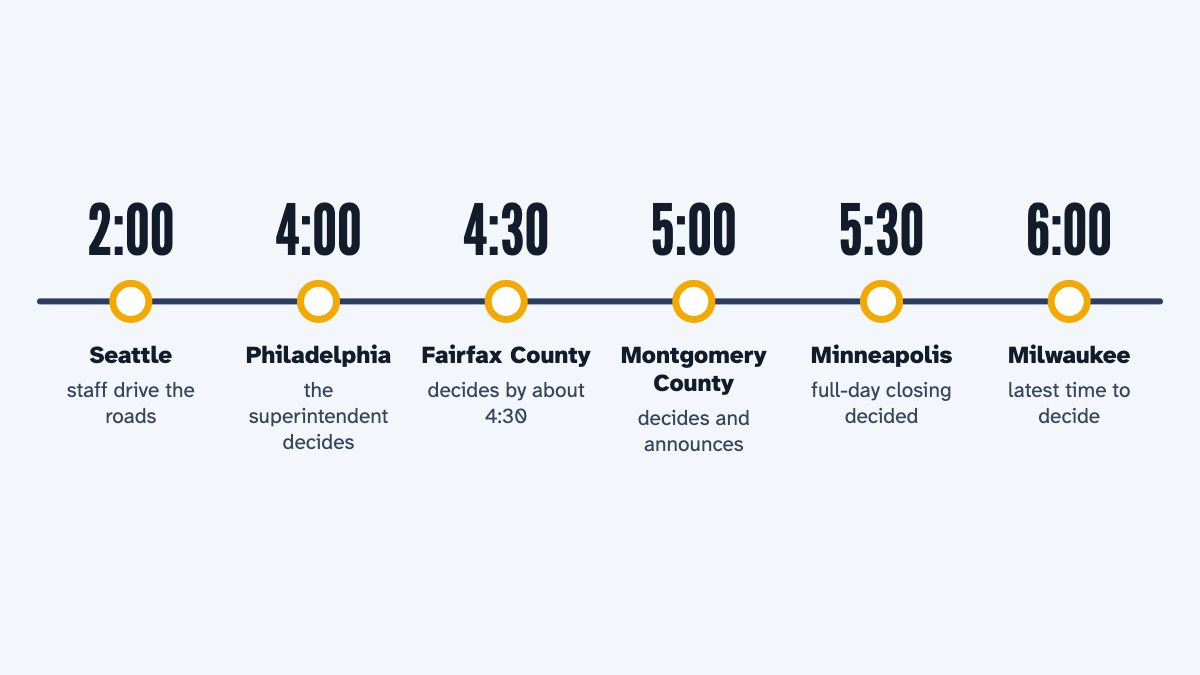
We have not found a Nebraska district’s announcement clock, so check your district’s website, app or local TV and radio for the final word. The calculator reads the National Weather Service forecast from 6 AM the day before to 3 PM on the school day, so its chance can change as the storm gets closer.
It is independent: not a school, a district, a state agency or the Weather Service. It shows the reasons behind each chance so you can judge them.
The page at a glance:
Snow days in Nebraska
- What closes schools
- 4.5 to 5.5 inches
- wind makes snow count more
- cold near −28°F
- Where it snows
- Harrison 57 inches
- Omaha 30 inches
- Paxton 14 inches
- School hours
- 1,032 hours elementary
- 1,080 hours high school
- no forgiven days
- Falling short
- a sworn affidavit
- the State Board decides
- due June 30, 2027
- Remote days
- not in the state rules we read
- check district policy
Questions people ask
How many snow days do Nebraska schools get?
The law does not give a number. Nebraska counts hours, so what matters is how far your district’s calendar runs above 1,032 hours for elementary grades or 1,080 for high school under 79-211. Your district can tell you.
Do Nebraska schools have to make up snow days?
If the year would fall short of the minimum hours, yes, unless the State Board excuses it. The school board files a sworn affidavit, due by June 30, 2027 for this school year, and the State Board decides at its discretion under 79-213.
How much snow does it take to cancel school in Omaha?
About 5.5 inches overnight, by our rule of thumb: the amount at which Omaha schools close about half the time. Wind, timing and ice can move that up or down, and only the district decides.
Does a half day count in Nebraska?
The district decides whether a shortened day counts as a full day or part of one, and records it with a Weather Day mark in the state’s data system, says the department’s 2025–26 data manual.
Sources: Neb. Rev. Stat. 79-211; Neb. Rev. Stat. 79-213; Nebraska Department of Education, Affidavit for Instructional Hour Exception 2026–27.
Facts checked October 29, 2026.
More guides
-
-
-
-

-
-