North Dakota Snow Day Calculator: Chances, Cold and Virtual Days
By our rule of thumb, 7 to 8 inches of snow closes North Dakota schools about half the time, and cold near −40°F can too. Only lost hours are made up, and virtual days can count.

- Under 5%
- 5 to 24%
- 25 to 49%
- 50 to 74%
- 75% or more
The next school day in North Dakota
Worked out from the National Weather Service forecast, 3:07 PM EDT, Thursday.
- Fargo<1% snow dayFriday: no snow
- Bismarck<1% snow dayFriday: no snow
- Grand Forks<1% snow dayFriday: no snow
- Minot<1% snow dayFriday: no snow
- West Fargo<1% snow dayFriday: no snow
- Williston<1% snow dayFriday: no snow
North Dakota schools face both deep snow and deep cold. Fargo’s normal snowfall is 50.5 inches a year and Bismarck’s 50, by NOAA’s 1991–2020 normals, and normal December–February lows sit in the single digits: 3.4°F in Fargo and 1.3°F in Grand Forks. By our rule of thumb, about 8 inches of overnight snow gives Fargo schools an even chance of closing, and 7.5 inches in Bismarck, Grand Forks or Minot.
Cold is the other trigger. The calculator’s cold point is a wind chill near −40°F at bus time in Minot, −42°F in Fargo and West Fargo, and −44°F in Grand Forks, and Fargo’s own schools list temperature and wind chill among their reasons to close.
North Dakota counts hours, not days. Under N.D.C.C. chapter 15.1-06, a school makes up only the hours it loses, and only if it would otherwise fall short of the yearly minimum, and a district may meet those hours with virtual instruction.
How much snow closes school in North Dakota?
About 7 to 8 inches in the state’s larger cities, by our rule of thumb. That is the overnight snow at which schools close about half the time, worked out from each city’s normal snowfall.
North Dakota's six largest cities: normal snowfall a year (NOAA 1991–2020) and the snowfall and wind chill at which, by our rule of thumb, schools there usually close.
| City | Normal snowfall | Usually closes at | Cold point (wind chill) |
|---|---|---|---|
| Fargo | 50.5 in. a year | 8 in. of snow | −42°F |
| Bismarck | 50 in. a year | 7.5 in. of snow | −39°F |
| Grand Forks | 48.4 in. a year | 7.5 in. of snow | −44°F |
| Minot | 48.4 in. a year | 7.5 in. of snow | −40°F |
| West Fargo | 50.3 in. a year | 8 in. of snow | −42°F |
| Williston | 44 in. a year | 7 in. of snow | −39°F |
Our rule of thumb: the usual closing point is 0.5 × (normal snowfall a year)0.7, the cold point the normal December–February low minus 45°F. How the calculator works.
The spread is small, since the big cities all get about 44 to 50 inches a year. Fargo and West Fargo (about 50 inches) sit near 8 inches; Bismarck, Grand Forks and Minot near 7.5; Williston (44) near 7. Look at the cold column: −44°F in Grand Forks, −42°F in Fargo and West Fargo, −40°F in Minot and −39°F in Bismarck and Williston.
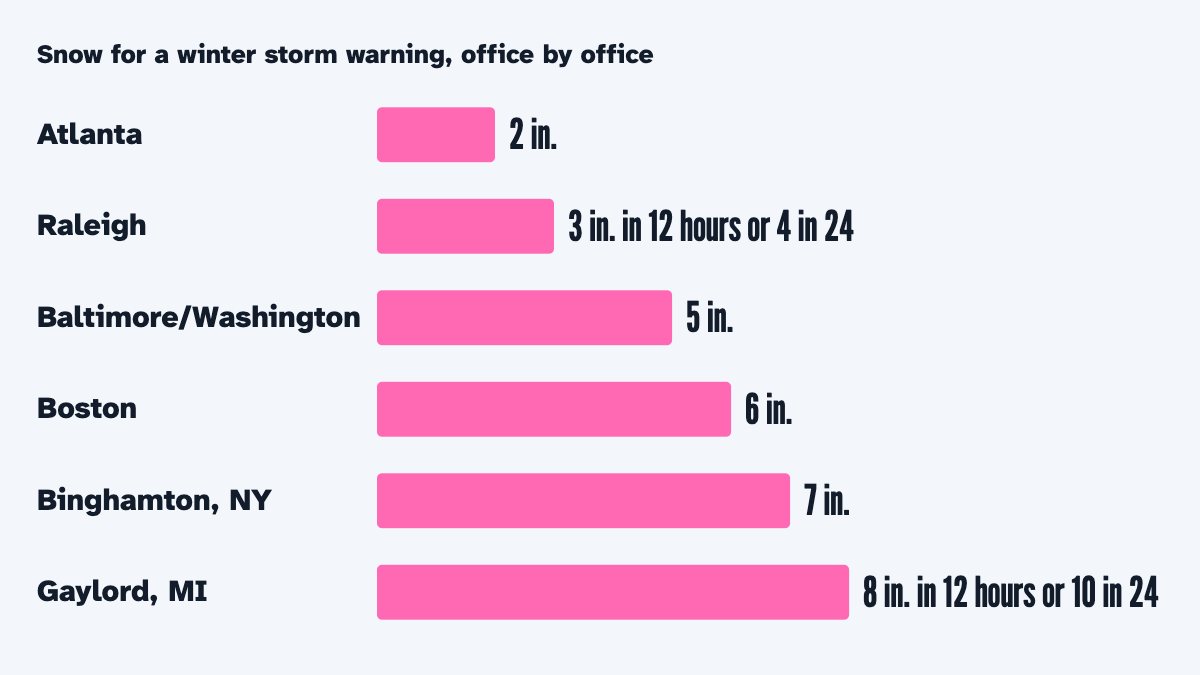
Wind is the wild card. The calculator counts snow more when gusts reach 25 mph or more while an inch or more falls, and the National Weather Service’s Blizzard Warning covers frequent gusts of 35 mph or more with falling or blowing snow that cut visibility below a quarter mile for three hours or more. The Weather Service also notes that the snow needed for a Winter Storm Warning in the Northern Plains is “typically much higher” than in the Southeast. More on how the calculator works.
Where does North Dakota get the most snow?
Fairly evenly across the state. NOAA’s 74 North Dakota weather stations run from 30.1 inches a year at Medora to 59.8 at a station near McHenry. Elgin (56.7), Berthold (55.3), Napoleon (53.2) and the Minot experiment station (51.8) come next, and the Fargo airport (51.4) and Bismarck (50.5) stations also make the top eight.
Normal snowfall a year and normal December to February low at each of the 74 weather stations in North Dakota with a snowfall normal in NOAA's U.S. Climate Normals for 1991–2020, with each station's location, elevation and how complete its record is.
The 10 snowiest and 5 least snowy of 74 stations in North Dakota
| Station | Normal snowfall | Dec–Feb low | Elevation |
|---|---|---|---|
| Mc Henry 3W | 59.8 in. | 2°F | 1,555 ft |
| Elgin | 56.7 in. | — | 2,400 ft |
| Berthold | 55.3 in. | — | 2,080 ft |
| Napoleon | 53.2 in. | 4°F | 1,980 ft |
| Minot Experiment Station | 51.8 in. | 4°F | 1,769 ft |
| Fargo Hector International Airport | 51.4 in. | 4°F | 900 ft |
| Pretty Rock | 51.2 in. | 8°F | 2,480 ft |
| Bismarck | 50.5 in. | 6°F | 1,658 ft |
| Watford City | 50.4 in. | 8°F | 2,170 ft |
| Bottineau | 49.8 in. | −1°F | 1,619 ft |
| … | |||
| Fessenden | 33.5 in. | 4°F | 1,620 ft |
| Zap | 33.4 in. | — | 1,825 ft |
| Reeder | 33.3 in. | — | 2,835 ft |
| Richardton Abbey | 33.2 in. | 10°F | 2,470 ft |
| Medora | 30.1 in. | 6°F | 2,268 ft |
Download “Normal snowfall at North Dakota weather stations, 1991–2020” (CSV, opens in Excel)
Built from: U.S. Climate Normals, 1991–2020 (National Centers for Environmental Information).
Half the stations average 42.9 inches or more. There is no low-snow corner: the least snowy stations, Medora, Richardton Abbey (33.2), Reeder (33.3) and Zap (33.4), still average 30 to 34 inches a year.
Do snow days have to be made up in North Dakota?
Only the hours lost, and only if needed. N.D.C.C. 15.1-06 requires at least 962.5 hours of instruction a year for elementary students and 1,050 for middle and high school students, and counts a full day as at least 5.5 hours for elementary students and 6 for high school students.
When a school cancels classes or dismisses early, it is responsible for making up only the hours and parts of hours it lost, and only if the cut would leave it short of the yearly minimum. The state-aid chapter, N.D.C.C. 15.1-27, says a closed school “shall reschedule those hours” so students get at least the minimum. If rescheduling would cause undue hardship, a school or district may ask the Governor to waive it, in whole or in part, for state-aid purposes.
Some districts plan for storms in the calendar. Grand Forks Public Schools builds two storm days into its calendar, its cancellation procedures say; check your own district’s calendar for its plan. A school on a four-day week still has to meet the hours, and needs a waiver from the state superintendent to run one, under 15.1-06.
Can North Dakota schools switch to remote learning instead?
Yes. Both chapters say “a school district may satisfy the requirements of this section by providing virtual instruction.” Attendance on a virtual day is verified by monitoring each student’s progress on academic pacing guides, and the instruction must meet the full-day definition in 15.1-06.
Under N.D.C.C. 15.1-07, a school board may adopt a policy that lets students learn virtually. The statutes we read set no limit on the number of virtual days.
So in North Dakota a storm can mean a closed building but a school day at home. Whether it does is up to your district’s policy.
How cold does it have to be to close school in North Dakota?
By our rule of thumb, a wind chill near −44°F at bus time in Grand Forks, −42°F in Fargo and West Fargo, −40°F in Minot, and −39°F in Bismarck and Williston. That is each city’s normal December–February low minus 45°F. The state laws we read set no number, and Fargo Public Schools names “temperature or wind chill numbers” among its reasons but gives none.
Wind chill at the bus stop
−19°F
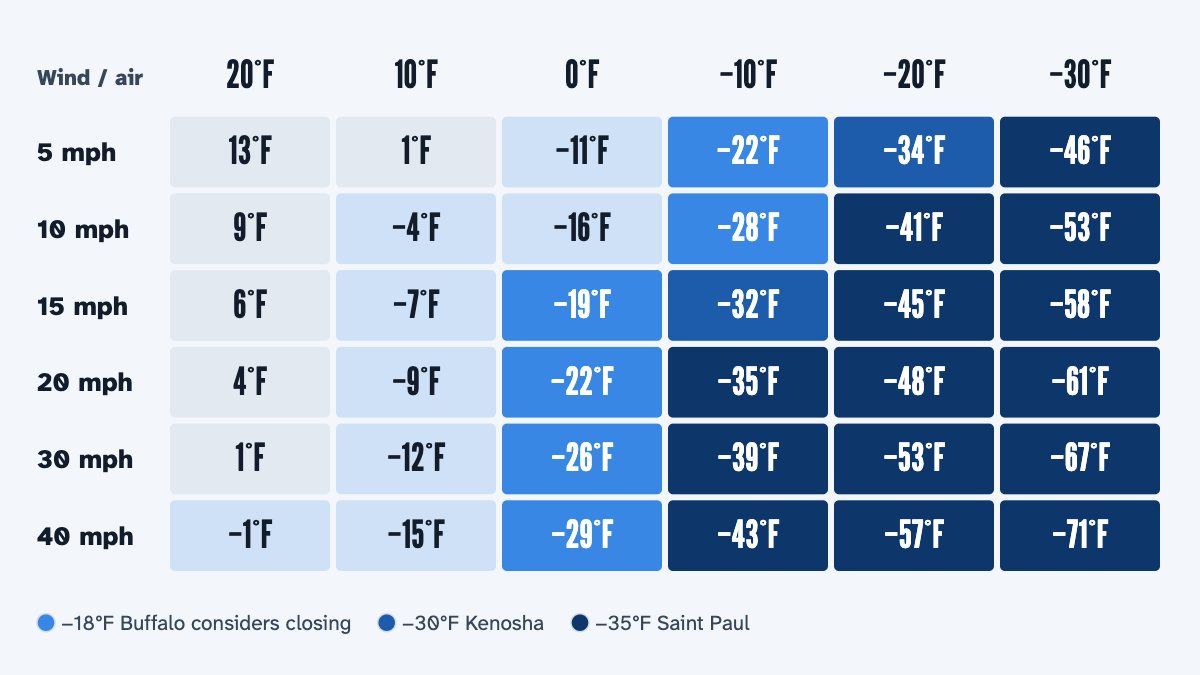
0°F with a 15 mph wind feels like −19°F. Buffalo, New York, will consider closing at −18°F.
The formula is the National Weather Service's, from its wind chill chart. Its own example: 0°F with a 15 mph wind feels like −19°F, and exposed skin can freeze in 30 minutes.
Recess is a lower bar than closing. Bismarck Public Schools’ weather policies say outdoor recess does not normally happen when the wind chill drops below −10°F. On the National Weather Service’s wind chill chart, the frostbite bands run from 30 minutes down to 10 and 5 minutes as the wind chill falls.
The calculator reads the wind chill from 5 to 9 AM and adds to its chance when the Weather Service issues an Extreme Cold Warning, which replaced the Wind Chill Warning on or about October 1, 2024, or a Cold Weather Advisory.
Who decides, and when do North Dakota families hear?
Your district decides, and the two big districts we checked make the call early in the morning. Fargo Public Schools says its first choice “will always be to remain open.” It weighs excessive snow, temperature or wind chill, wind speeds, road conditions and the safety of busing students, makes morning decisions by 6:00 a.m., and lets parents keep children home.
Grand Forks Public Schools has four options: hold school, open but delay buses, a two-hour delay, or cancel. It calls staff between 5:30 and 6:00 a.m. and families between 6:30 and 7:00 a.m., its procedures say.
Check your district’s website, app or local TV and radio for the final word. The calculator reads the Weather Service forecast from 6 AM the day before to 3 PM on the school day, so its chance can change overnight. It is independent: not a school district, a state agency or the Weather Service.
The page at a glance:
Snow days in North Dakota
- What closes schools
- 7 to 8 inches
- blizzard wind
- wind chill near −40°F
- School hours
- 962.5 hours elementary
- 1,050 hours middle and high
- Make-up
- only lost hours
- the Governor can waive hardship
- Grand Forks has 2 storm days
- Virtual days
- count toward the hours
- progress tracked
- no cap in the law we read
- Mornings
- Fargo by 6:00 a.m.
- Grand Forks families 6:30 to 7:00 a.m.
Questions people ask
Do North Dakota schools make up snow days?
Only the hours they lose, and only if the loss would leave them below the yearly minimum of 962.5 hours for elementary students or 1,050 for middle and high school students, under N.D.C.C. 15.1-06.
Can North Dakota schools use virtual days instead of snow days?
Yes. State law lets a district meet its hours with virtual instruction, with attendance checked against students’ progress on pacing guides. Your district’s own policy says when it uses them.
What time does Fargo announce school closings?
For morning decisions, by 6:00 a.m., says Fargo Public Schools. Parents may also choose to keep children home.
How cold does it have to be for no school in North Dakota?
The state laws we read set no number, and Fargo’s page gives none. By our rule of thumb, the cold point is a wind chill of −39°F to −44°F in the state’s big cities. Bismarck normally skips outdoor recess below a −10°F wind chill, a much lower bar than closing.
Sources: N.D.C.C. chapter 15.1-06; N.D.C.C. chapter 15.1-27; Fargo Public Schools, school cancellation process.
Facts checked October 29, 2026.
More guides
-
-
-
-

-
-