Montana Snow Day Calculator: Chances, Cold and Make-Up Hours
Montana schools close for a big storm or deep cold: about 6.5 to 11 inches of snow by our rule of thumb. State law gives each district 1 emergency day a year with nothing to make up.

- Under 5%
- 5 to 24%
- 25 to 49%
- 50 to 74%
- 75% or more
The next school day in Montana
Worked out from the National Weather Service forecast, 3:07 PM EDT, Thursday.
- Billings<1% snow dayFriday: no snow
- Missoula<1% snow dayFriday: no snow
- Great Falls<1% snow dayFriday: no snow
- Bozeman<1% snow dayFriday: no snow
- Butte<1% snow dayFriday: no snow
- Helena<1% snow dayFriday: no snow
It takes a real storm to close schools in Montana. Snow is normal here: even the least snowy of NOAA’s 139 Montana stations averages close to 10 inches a year. So by our rule of thumb a school in Billings closes about half the time once 8 inches falls overnight, and one in Bozeman not until about 11 inches. Type your ZIP code above and the calculator reads the National Weather Service forecast for your own town.
Cold can close schools too. Butte gets about three-quarters of the snow Billings does (37.7 inches a year against 50.5) but has colder winter nights, so its cold point by our rule is a wind chill near −36°F, the lowest on the state’s map.
When school does close, Montana counts the year in hours, not days. State law lets a school board close for 1 day a year in an unforeseen emergency with nothing to make up; after that, at least 75% of the lost time has to be made up to keep full state aid (Montana Code 20-9-806).
How much snow closes school in Montana?
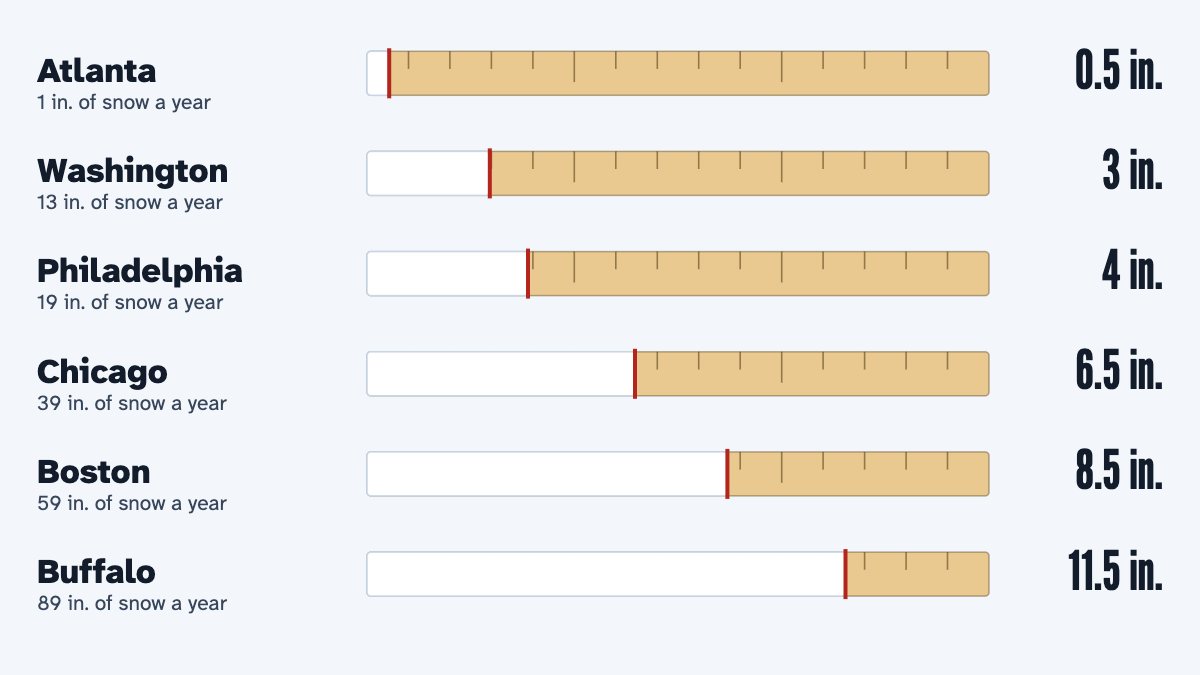
About 6.5 to 11 inches of overnight snow, by our rule of thumb, depending on the town. The calculator sets each place’s usual closing point from its normal snowfall: the more snow a town expects in a year, the more it takes to close its schools.
Montana's six largest cities: normal snowfall a year (NOAA 1991–2020) and the snowfall and wind chill at which, by our rule of thumb, schools there usually close.
| City | Normal snowfall | Usually closes at | Cold point (wind chill) |
|---|---|---|---|
| Billings | 50.5 in. a year | 8 in. of snow | −28°F |
| Missoula | 44.6 in. a year | 7 in. of snow | −26°F |
| Great Falls | 65.1 in. a year | 9.5 in. of snow | −29°F |
| Bozeman | 80.2 in. a year | 11 in. of snow | −31°F |
| Butte | 37.7 in. a year | 6.5 in. of snow | −36°F |
| Helena | 37 in. a year | 6.5 in. of snow | −31°F |
Our rule of thumb: the usual closing point is 0.5 × (normal snowfall a year)0.7, the cold point the normal December–February low minus 45°F. How the calculator works.
Bozeman has the most snow of the 6 cities, 80.2 inches in a normal year, so its closing point is the highest at 11 inches. Great Falls (65.1 inches a year) follows at 9.5, Billings (50.5) at 8 and Missoula (44.6) at 7. Butte (37.7) and Helena (37) need only about 6.5.
When the snow falls matters as much as how much. The calculator counts snow fully when it falls overnight (9 p.m. to 6 a.m.) or while buses run (6 to 10 a.m.), but only 80% of what falls the afternoon and evening before, since crews have time to clear it. Snow falling above freezing counts less, and gusts of 25 mph or more while an inch or more falls make it count more. If your district rarely closes, or closes easily, tell the calculator and it moves the closing point.
Where does Montana get the most snow?
In the mountains. NOAA has 139 weather stations in Montana with a snowfall normal for 1991–2020, and the snowiest, Cooke City 2 W at about 7,480 feet, averages 213.1 inches a year. Mystic Lake (192.7 inches), Hebgen Dam (177.2), Millegan (149.3) and Red Lodge (141.9) come next.
Normal snowfall a year and normal December to February low at each of the 139 weather stations in Montana with a snowfall normal in NOAA's U.S. Climate Normals for 1991–2020, with each station's location, elevation and how complete its record is.
The 10 snowiest and 5 least snowy of 139 stations in Montana
| Station | Normal snowfall | Dec–Feb low | Elevation |
|---|---|---|---|
| Cooke City 2 W | 213.1 in. | 7°F | 7,483 ft |
| Mystic Lake | 192.7 in. | 18°F | 6,544 ft |
| Hebgen Dam | 177.2 in. | 5°F | 6,489 ft |
| Millegan 14 Se | 149.3 in. | 11°F | 4,970 ft |
| Red Lodge | 141.9 in. | 14°F | 5,646 ft |
| Lindbergh Lake | 136.5 in. | 16°F | 4,320 ft |
| Seeley Lake Rs | 118.9 in. | 13°F | 4,100 ft |
| W Glacier | 115.2 in. | 20°F | 3,148 ft |
| Lewistown 11 Sse | 112.1 in. | 13°F | 4,965 ft |
| Mcleod | 100.2 in. | — | 4,809 ft |
| … | |||
| Dillon U Of Montana Western | 11.2 in. | 15°F | 5,129 ft |
| Hoyt 2 Wsw | 10.8 in. | — | 2,127 ft |
| Dodson 1 Wnw | 10.1 in. | — | 2,294 ft |
| Glen 4 N | 10.1 in. | 9°F | 5,054 ft |
| Whitewater | 9.9 in. | — | 2,328 ft |
Download “Normal snowfall at Montana weather stations, 1991–2020” (CSV, opens in Excel)
Built from: U.S. Climate Normals, 1991–2020 (National Centers for Environmental Information).
The station in the middle of the list gets 42.5 inches a year. Even the least snowy, Whitewater (9.9 inches) and Dodson (10.1), still average close to 10 inches. The calculator blends the NOAA stations nearest your ZIP code, so a school near a snowy station gets a higher closing point than one near a dry one.
Do snow days have to be made up in Montana?
Only after the first one. A school board may close for 1 school day each year because of an unforeseen emergency, with no make-up and no cut in state money (Montana Code 20-9-806). The law’s list of such emergencies includes storms, floods and fires (Montana Code 20-9-802).
Beyond that day, the board has to declare an emergency and pass a resolution saying it made a reasonable effort. At least 75% of the lost instruction time has to be made up to keep full state aid, so up to 25% of it can be let go (Montana Code 20-9-806). The law names the ways: teach past the last scheduled day, use scheduled vacation days, hold Saturday school or lengthen the school day (Montana Code 20-9-802).
Those hours matter because Montana has no statewide number of school days. Each district’s trustees set the number of days (Montana Code 20-1-302), and the state checks hours: 1,080 a year for grades 4 to 12, and 720 for grades 1 to 3 and full-time kindergarten (Montana Code 20-1-301, last amended in 2025). A district that falls short loses part of its state aid, called BASE aid.
Montana revised these closure laws in 2021 with a bill called SB 75, the state’s Office of Public Instruction says.
Can Montana schools switch to remote learning instead?
A district may teach remotely, but the rules we read do not set up a remote snow day. State law says a district “may provide remote instruction,” following the Board of Public Education’s standards (Montana Code 20-7-118).
The law’s definition of school hours even counts time spent logging on and off for remote instruction (Montana Code 20-1-101). But we found no rule or state guidance that turns a storm day into a remote day, or limits how many a district may use. Your district’s own plan is the place to look.
How cold does it have to be to close school in Montana?
We found no state rule that sets a number; each district makes its own call. Our rule of thumb watches the wind chill from 5 to 9 a.m., around the time children wait for buses, and marks a cold point for each city: about −26°F in Missoula, −28°F in Billings, −29°F in Great Falls, −31°F in Bozeman and Helena, and −36°F in Butte.
Each cold point is the city’s normal December–February low minus 45 degrees. Butte’s is the lowest because its winter nights are the coldest of the 6, with a normal low of 8.7°F.
Wind chill at the bus stop
−19°F
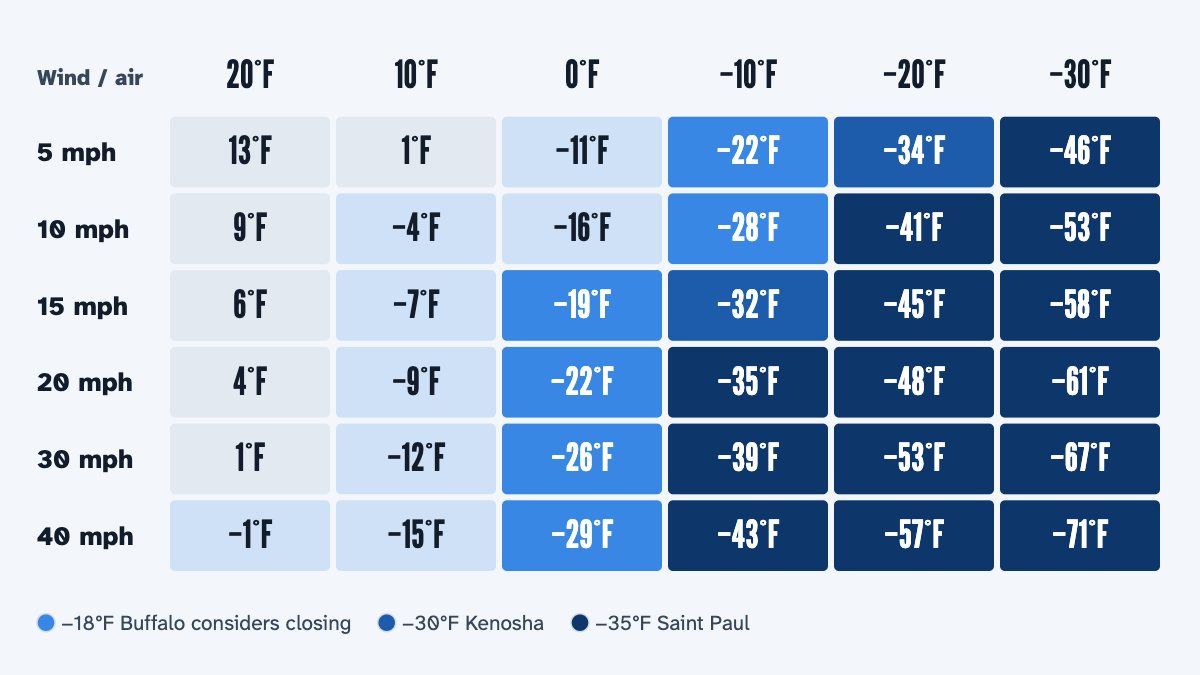
0°F with a 15 mph wind feels like −19°F. Buffalo, New York, will consider closing at −18°F.
The formula is the National Weather Service's, from its wind chill chart. Its own example: 0°F with a 15 mph wind feels like −19°F, and exposed skin can freeze in 30 minutes.
The National Weather Service works out wind chill with a published formula, and its chart shows how fast cold bites: 0°F with a 15 mph wind feels like −19°F, and exposed skin can freeze in 30 minutes (NWS wind chill chart). The Weather Service asks people to be even more careful with children.
The alert to watch is the Extreme Cold Warning, which means extremely dangerous cold or wind chills are expected or occurring (NWS cold alerts). It replaced the Wind Chill Warning on October 1, 2024 (National Weather Service), and the calculator raises the chance when one is out for your area.
Who decides, and when do families hear?
Your local school board and superintendent decide. The Office of Public Instruction says locally elected boards make the call because there is “not a state-wide mandate” (Office of Public Instruction, December 2022).
Once a closure is declared, the office asks trustees to tell the county superintendent of schools and the Office of Public Instruction right away (state closure guidance).
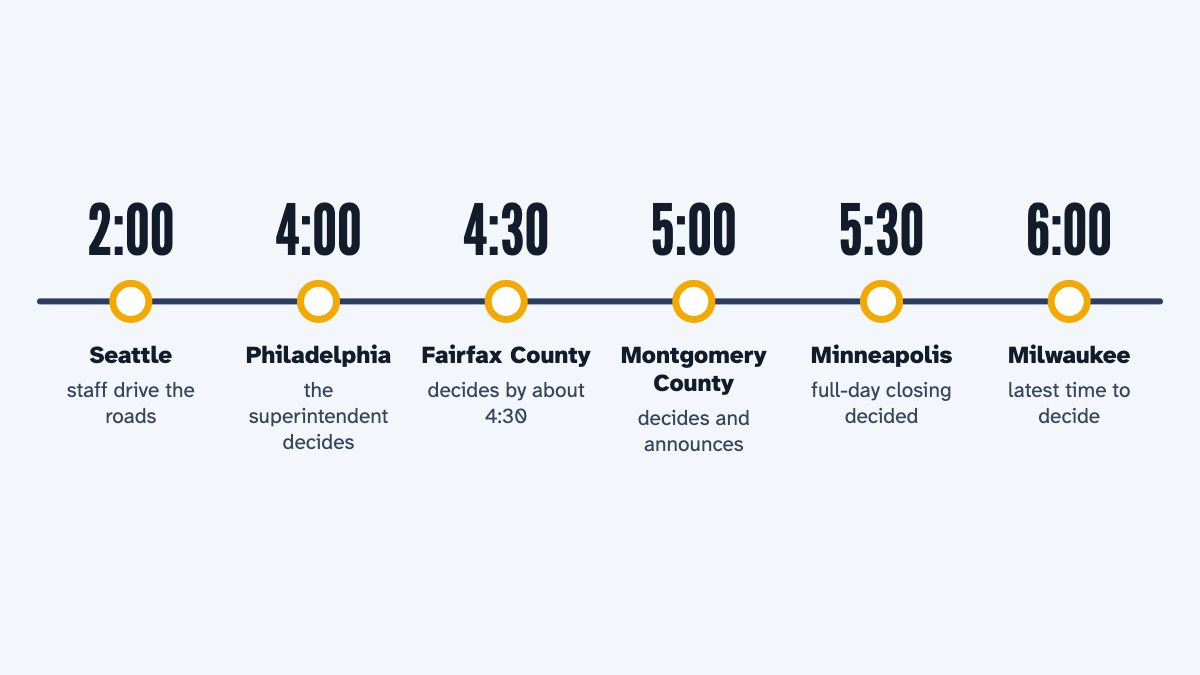
We did not find a Montana district’s own closing clock in our research, so check your district’s website, app or local TV and radio. The calculator reads the forecast for snow from 6 a.m. the day before through 3 p.m. on the school day, so look the evening before, then again early in the morning, since forecasts change overnight.
Snow days in Montana
- Closing snow
- Butte about 6.5 inches
- Billings about 8
- Bozeman about 11
- Cold
- Wind chill at bus time
- Billings −28°F
- Butte −36°F
- Make-up
- 1 free emergency day
- Then 75% of lost hours
- Longer days or Saturdays
- Remote days
- Districts may teach remotely
- No storm-day rule found
- Who decides
- Local school board
- Tells county and state
Questions people ask
How many snow days does Montana allow?
One with no strings attached. A school board may close for 1 school day a year for an unforeseen emergency, such as a storm, with no make-up and no loss of state money; after that, at least 75% of the lost hours must be made up to keep full state aid (Montana Code 20-9-806).
Does Montana count school days or hours?
Hours. The state requires 1,080 hours a year for grades 4 to 12 and 720 for grades 1 to 3 (Montana Code 20-1-301). Each district’s trustees decide how many days that takes.
Why does the calculator need less snow in Butte than in Bozeman?
By our rule of thumb, a town’s closing point follows its normal snowfall. Butte averages 37.7 inches a year and Bozeman 80.2, so the calculator expects Butte schools to close at about 6.5 inches and Bozeman’s at about 11. Only the district decides.
Will Montana schools be closed tomorrow?
Type your school’s ZIP code at the top of this page. The calculator reads the National Weather Service forecast for that spot and shows the chance of a snow day, a late start or school as usual, with its reasons. Your district makes the call, so watch its website, app or local news.
Sources: Montana Code 20-9-806 (emergency closures), Montana Code 20-1-301 (school hours) and Office of Public Instruction on school closures (2022).
Facts checked October 29, 2026.
More guides
-
-
-
-
-
-