South Dakota Snow Day Calculator: Chances, Cold and School Hours
By our rule of thumb, about 6 to 7.5 inches of snow closes South Dakota schools about half the time. Schools count hours, and once they have them, weather days need no make-up.

- Under 5%
- 5 to 24%
- 25 to 49%
- 50 to 74%
- 75% or more
The next school day in South Dakota
Worked out from the National Weather Service forecast, 3:07 PM EDT, Thursday.
- Sioux Falls<1% snow dayFriday: no snow
- Rapid City<1% snow dayFriday: no snow
- Aberdeen<1% snow dayFriday: no snow
- Brookings<1% snow dayFriday: no snow
- Watertown<1% snow dayFriday: no snow
- Yankton<1% snow dayFriday: no snow
South Dakota schools get both deep snow and deep cold. Sioux Falls’s normal snowfall is 45.5 inches a year and Rapid City’s 48.4, by NOAA’s 1991–2020 normals, and Aberdeen’s normal December–February low is 5.2°F. By our rule of thumb, it takes about 7 inches of overnight snow for Sioux Falls or Aberdeen schools to close about half the time, and about 7.5 inches in Rapid City.
Cold can do it on its own. The calculator’s cold point, by the same rule of thumb, is a wind chill near −34°F at bus time in Sioux Falls and −40°F in Aberdeen, the lowest of the six.
The school year is counted in hours, and the law is forgiving about weather. Under SDCL 13-26-2, a school does not have to make up time lost to weather once it has reached its minimum hours for the term.
How much snow closes school in South Dakota?
About 6 to 7.5 inches in the state’s larger cities, by our rule of thumb. That is the overnight snow at which schools close about half the time, worked out from each city’s normal snowfall.
South Dakota's six largest cities: normal snowfall a year (NOAA 1991–2020) and the snowfall and wind chill at which, by our rule of thumb, schools there usually close.
| City | Normal snowfall | Usually closes at | Cold point (wind chill) |
|---|---|---|---|
| Sioux Falls | 45.5 in. a year | 7 in. of snow | −34°F |
| Rapid City | 48.4 in. a year | 7.5 in. of snow | −31°F |
| Aberdeen | 42.1 in. a year | 7 in. of snow | −40°F |
| Brookings | 36.1 in. a year | 6 in. of snow | −38°F |
| Watertown | 37.4 in. a year | 6.5 in. of snow | −39°F |
| Yankton | 38.3 in. a year | 6.5 in. of snow | −32°F |
Our rule of thumb: the usual closing point is 0.5 × (normal snowfall a year)0.7, the cold point the normal December–February low minus 45°F. How the calculator works.
Rapid City (48.4 inches a year) has the highest closing point of the six, near 7.5 inches. Sioux Falls (45.5) and Aberdeen (42.1) sit near 7, Yankton (38.3) and Watertown (37.4) near 6.5, and Brookings (36.1) near 6. The cold column spreads wider, from −31°F in Rapid City to −40°F in Aberdeen.
Wind changes the math. The calculator counts snow more when gusts reach 25 mph or more while an inch or more falls, and it counts snow fully when it falls overnight (9 PM to 6 AM) or while buses run (6 to 10 AM). More on how the calculator works.
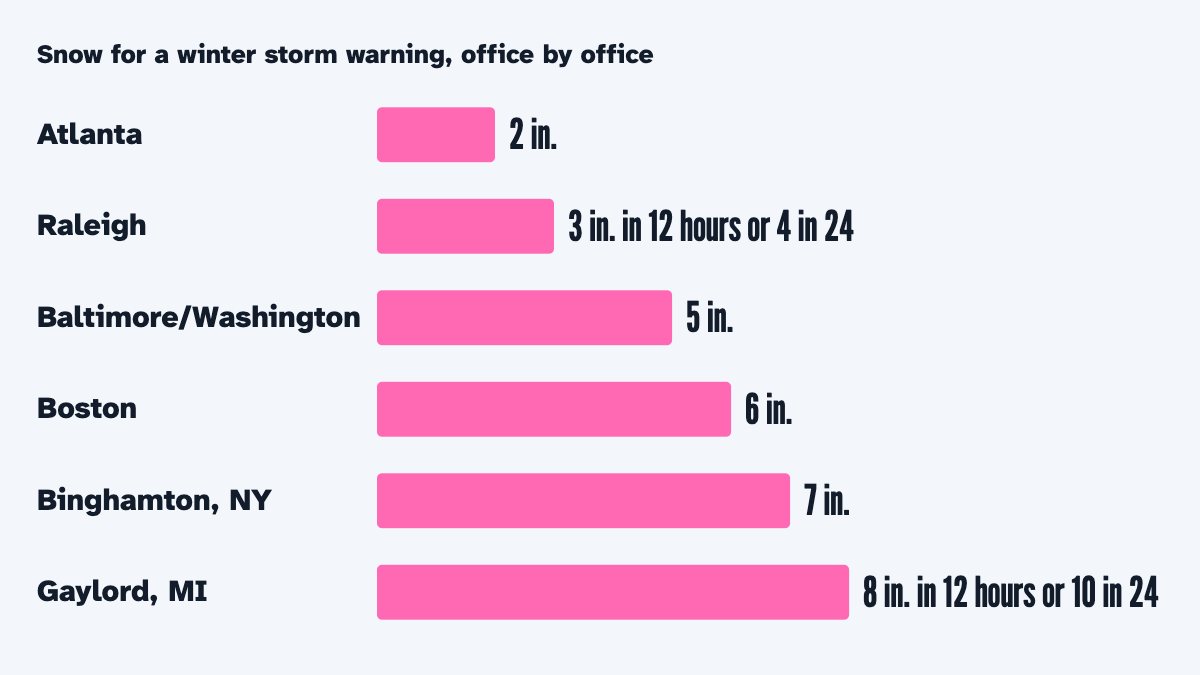
The National Weather Service sets its warning levels office by office, and its winter alerts page says the snow needed for a Winter Storm Warning in the Northern Plains is “typically much higher” than in the Southeast. Its Blizzard Warning is about wind and visibility, not depth: frequent gusts of 35 mph or more with falling or blowing snow that cut visibility below a quarter mile for three hours or more.
Where does South Dakota get the most snow?
On the highest ground. Lead, about 5,110 feet up, averages 183.9 inches a year, the most of NOAA’s 138 South Dakota weather stations. Bear Ridge (114.2 inches), Spearfish (70.5), Hill City (66.6), Pactola Dam (60.9) and the station at Mount Rushmore National Memorial (59.3) follow.
Two lower towns also make the top eight: Clear Lake (60.7 inches) and Summit (58.6), each under 2,000 feet up.
Normal snowfall a year and normal December to February low at each of the 138 weather stations in South Dakota with a snowfall normal in NOAA's U.S. Climate Normals for 1991–2020, with each station's location, elevation and how complete its record is.
The 10 snowiest and 5 least snowy of 138 stations in South Dakota
| Station | Normal snowfall | Dec–Feb low | Elevation |
|---|---|---|---|
| Lead | 183.9 in. | 18°F | 5,112 ft |
| Bear Ridge | 114.2 in. | 15°F | 3,900 ft |
| Spearfish | 70.5 in. | 17°F | 3,633 ft |
| Hill City | 66.6 in. | 10°F | 4,946 ft |
| Pactola Dam | 60.9 in. | 12°F | 4,720 ft |
| Clear Lake | 60.7 in. | 6°F | 1,812 ft |
| Mount Rushmore Nmem | 59.3 in. | 19°F | 5,311 ft |
| Summit 1 W | 58.6 in. | 6°F | 1,955 ft |
| Custer | 57.9 in. | 16°F | 5,480 ft |
| Hereford 12 Sw | 55.6 in. | 14°F | 2,810 ft |
| … | |||
| Conde | 28 in. | 5°F | 1,330 ft |
| Forestburg 4 Nne | 26.3 in. | 8°F | 1,277 ft |
| Doland | 23.3 in. | — | 1,351 ft |
| Raymond 3 Ne | 22 in. | — | 1,485 ft |
| Lake Sharpe Prj | 18.9 in. | 9°F | 1,461 ft |
Download “Normal snowfall at South Dakota weather stations, 1991–2020” (CSV, opens in Excel)
Built from: U.S. Climate Normals, 1991–2020 (National Centers for Environmental Information).
Half the stations average 41.0 inches or more. The least snowy, Lake Sharpe (18.9 inches), Raymond (22.0) and Doland (23.3), still average about 19 to 23 inches a year.
Do snow days have to be made up in South Dakota?
Not once the school has its hours. SDCL 13-26-1 sets the minimum: at least 437.5 hours for kindergarten, 875 for grades 1–5 and 962.5 for grades 6–12, with recess and lunch not counted in grades 1–12, nor passing time in grades 6–12. Each local school board sets the number of days in the term and the length of the day, and 13-26-2 adds that grades 1–12 run at least a nine-month term.
Then comes the key line. A school “is not required to make up time for school closing because of weather” once it has reached the minimum hours for the term, 13-26-2 says. So a district whose calendar holds more hours than the minimum can lose some to snow without adding any back. How many extra hours each district builds in is a local choice; your district’s calendar shows it.
Late starts and early dismissals count in full. If school opens late or lets out early because of weather, that day counts as the number of hours the district’s calendar planned for it.
In a declared emergency, the state’s Secretary of Education may waive the minimum hours, if the Governor or the President of the United States declares a state of emergency covering the school’s area. These sections were last amended in 2021 (13-26-1) and 2017 (13-26-2), and they apply to the 2026–27 school year.
Can South Dakota schools switch to remote learning instead?
The state laws we read do not say, except in a declared emergency. SDCL 13-26-1 and 13-26-2 do not mention remote or virtual days for weather. Only after the Governor or the President has declared an emergency must a district send the state a record of “the continuous instruction provided to the students,” and the Department of Education then decides whether it counts toward the hours.
We could not read the state’s administrative rules or Department of Education guidance on this, so check your district’s own policy before counting on a virtual day.
How cold does it have to be to close school in South Dakota?
Very cold, by our rule of thumb: a wind chill near −31°F at bus time in Rapid City, −32°F in Yankton, −34°F in Sioux Falls, −38°F in Brookings, −39°F in Watertown and −40°F in Aberdeen. That is each city’s normal December–February low minus 45°F. We have no South Dakota district’s own cold number on file.
Wind chill at the bus stop
−19°F
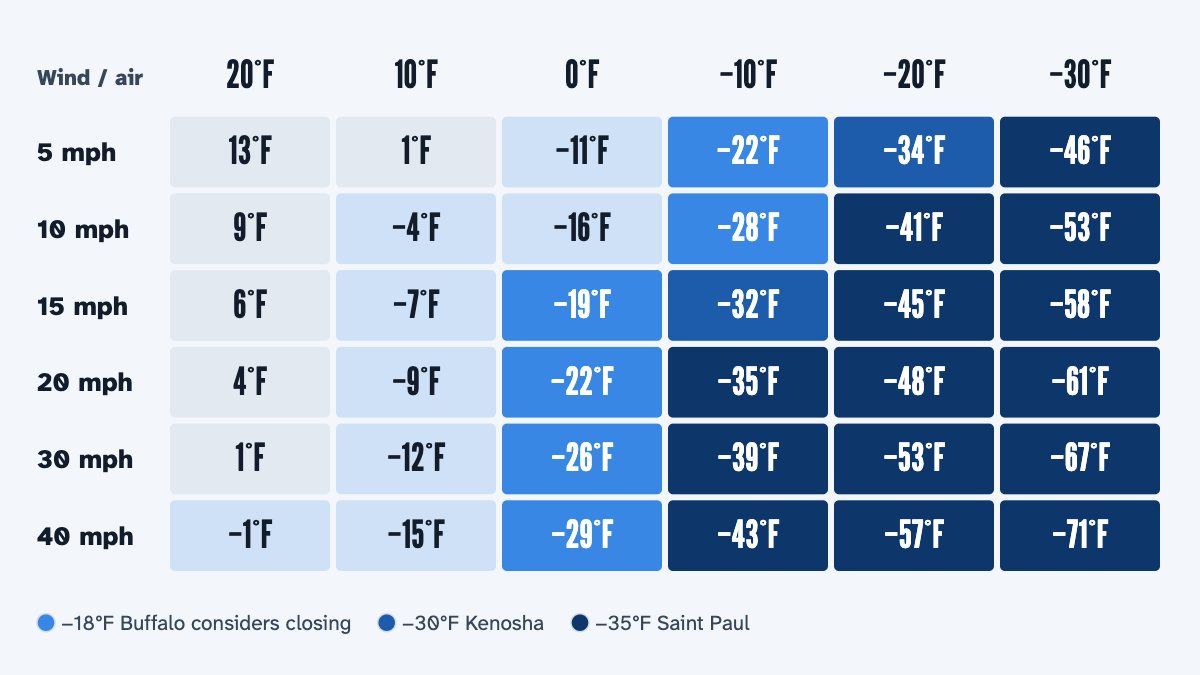
0°F with a 15 mph wind feels like −19°F. Buffalo, New York, will consider closing at −18°F.
The formula is the National Weather Service's, from its wind chill chart. Its own example: 0°F with a 15 mph wind feels like −19°F, and exposed skin can freeze in 30 minutes.
The slider uses the National Weather Service’s formula, which is defined only at 50°F or colder with wind above 3 mph. On the Weather Service’s wind chill chart, 0°F with a 15 mph wind already gives −19°F, and exposed skin can freeze in 30 minutes; colder bands on its frostbite chart bring that down to 10 and 5 minutes.
The calculator reads the wind chill from 5 to 9 AM and adds to its chance when the Weather Service issues an Extreme Cold Warning, the name that replaced the Wind Chill Warning on or about October 1, 2024, or a Cold Weather Advisory.
Who decides, and when do South Dakota families hear?
Your district decides. State law leaves the number of school days and the length of the day to each local school board, and the call on a stormy morning is the district’s.
We could not read a South Dakota district’s closing procedure, so we will not guess at times. Check your district’s website, app or local TV and radio for the final word. The calculator reads the National Weather Service forecast from 6 AM the day before to 3 PM on the school day, so its chance can change as a storm gets closer.
It is independent: not a school district, a state agency or the Weather Service. It shows the reasons behind each chance so you can judge them.
The page at a glance:
Snow days in South Dakota
- What closes schools
- 6 to 7.5 inches
- wind counts
- cold near −31°F to −40°F
- Where it snows
- Lead 184 inches
- Rapid City 48 inches
- Lake Sharpe 19 inches
- School hours
- 962.5 hours grades 6 to 12
- 875 hours grades 1 to 5
- boards set the days
- Make-up
- none once hours are met
- late starts count as planned
- Emergencies
- waiver after a declared emergency
- remote days not in the laws we read
Questions people ask
Do South Dakota schools have to make up snow days?
Not once they have reached the minimum hours for the term, under SDCL 13-26-2. A district that would fall below the minimum has to make up the difference, unless the state waives it after a declared emergency.
Does a late start count as a full day in South Dakota?
Yes. A day that starts late or ends early because of weather counts as the hours the district’s calendar planned for it, under the same law.
How cold does it have to be to cancel school in South Dakota?
The state sets no number, and we have no district’s on file. By our rule of thumb, the cold point runs from a −31°F wind chill in Rapid City to −40°F in Aberdeen; your district makes the call.
How much snow does it take to close school in Sioux Falls?
About 7 inches overnight, by our rule of thumb: the amount at which Sioux Falls schools close about half the time. Strong wind, timing and cold can tip a smaller storm into a closing.
Sources: SDCL 13-26-1; SDCL 13-26-2; National Weather Service, wind chill chart.
Facts checked October 29, 2026.
More guides
-
-
-
-

-
-