Oregon Snow Day Calculator: Chances and the New 16-Hour Rule
By our rule of thumb, 1 to 1.5 inches of snow closes schools in Portland, Salem and Eugene about half the time. Since October 16, 2026, up to 16 hours lost to bad weather can count.

- Under 5%
- 5 to 24%
- 25 to 49%
- 50 to 74%
- 75% or more
The next school day in Oregon
Worked out from the National Weather Service forecast, 3:07 PM EDT, Thursday.
- Portland<1% snow dayFriday: no snow
- Salem<1% snow dayFriday: no snow
- Eugene<1% snow dayFriday: no snow
- Gresham<1% snow dayFriday: no snow
- Hillsboro<1% snow dayFriday: no snow
- Bend<1% snow dayFriday: no snow
Most of Oregon’s big cities see little snow. Portland’s normal is 3.6 inches a year, Salem’s 5.3 and Eugene’s 2.2, by NOAA’s 1991–2020 normals. By our rule of thumb, about 1 inch of overnight snow gives Portland or Eugene schools an even chance of closing, and 1.5 inches in Salem, Gresham or Hillsboro. Bend, with 20.9 inches a year, needs about 4.
Ice counts on its own. The calculator treats about a tenth of an inch of ice as enough to close schools almost anywhere, and a little less where snow is rare.
On October 16, 2026, the rules changed. Oregon measures the school year in hours that districts schedule, and since then the State Board’s rule OAR 581-022-2320 lets a district, with its school board’s approval, count up to 16 hours for extraordinary circumstances, which the filing that made the change defines to include bad weather.
How much snow closes school in Oregon?
About 1 to 1.5 inches in Portland, Salem, Eugene, Gresham and Hillsboro, and about 4 inches in Bend, by our rule of thumb. That is the overnight snow at which schools close about half the time, worked out from each city’s normal snowfall.
Oregon's six largest cities: normal snowfall a year (NOAA 1991–2020) and the snowfall and wind chill at which, by our rule of thumb, schools there usually close.
| City | Normal snowfall | Usually closes at | Cold point (wind chill) |
|---|---|---|---|
| Portland | 3.6 in. a year | 1 in. of snow | −9°F |
| Salem | 5.3 in. a year | 1.5 in. of snow | −10°F |
| Eugene | 2.2 in. a year | 1 in. of snow | −10°F |
| Gresham | 4.1 in. a year | 1.5 in. of snow | −9°F |
| Hillsboro | 4 in. a year | 1.5 in. of snow | −11°F |
| Bend | 20.9 in. a year | 4 in. of snow | −21°F |
Our rule of thumb: the usual closing point is 0.5 × (normal snowfall a year)0.7, the cold point the normal December–February low minus 45°F. How the calculator works.
Eugene (2.2 inches a year) and Portland (3.6) are near 1 inch; Hillsboro (4), Gresham (4.1) and Salem (5.3) near 1.5; Bend (20.9) near 4. Bend’s normal winter low, 24.0°F, is also far colder than the others’, which puts its cold point at −21°F.
Wet snow counts less in the calculator: snow that falls while it is above freezing counts less, since it tends to leave roads wet rather than icy. Snow counts fully overnight (9 PM to 6 AM) and while buses run (6 to 10 AM), and only 45% during the school day. More on how the calculator works.
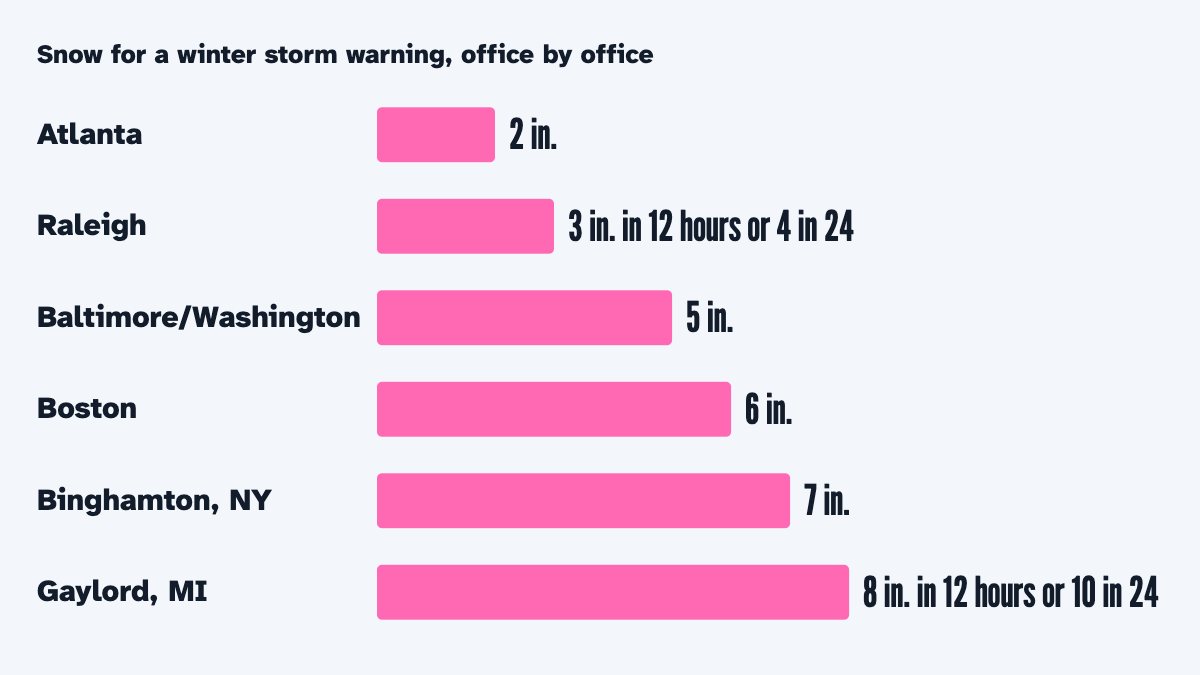
National Weather Service alerts add to the chance: most for a warning, less for a watch or an advisory. The Weather Service’s winter alerts page explains the difference: a watch is issued when conditions are favorable for a significant winter storm, an advisory when conditions should not be hazardous enough to meet warning criteria, and a warning for a significant event that makes travel difficult or impossible in places. Each office sets its own snow amounts, and an Ice Storm Warning usually comes at about a quarter inch of ice or more.
Where does Oregon get the most snow?
In the mountains. Crater Lake National Park’s headquarters, about 6,490 feet up, averages 463.1 inches a year, the most of NOAA’s 118 Oregon weather stations. Government Camp (232.5), Lemolo Lake (196.2) and Odell Lake (190.5) follow, then Howard Prairie Dam (117.6) and Meacham (113.2).
Normal snowfall a year and normal December to February low at each of the 118 weather stations in Oregon with a snowfall normal in NOAA's U.S. Climate Normals for 1991–2020, with each station's location, elevation and how complete its record is.
The 10 snowiest and 5 least snowy of 118 stations in Oregon
| Station | Normal snowfall | Dec–Feb low | Elevation |
|---|---|---|---|
| Crater Lake Nps Hq | 463.1 in. | 19°F | 6,485 ft |
| Government Camp | 232.5 in. | 26°F | 3,980 ft |
| Lemolo Lake 3 Nnw | 196.2 in. | 27°F | 4,077 ft |
| Odell Lake-east | 190.5 in. | 20°F | 4,800 ft |
| Howard Prairie Dam | 117.6 in. | 23°F | 4,567 ft |
| Meacham | 113.2 in. | 21°F | 3,723 ft |
| Marion Forks Fish Hatchery | 85.2 in. | 27°F | 2,475 ft |
| Rock Creek | 78.6 in. | — | 4,012 ft |
| Wickiup Dam | 73.9 in. | 21°F | 4,358 ft |
| Halfway | 62.3 in. | 21°F | 2,653 ft |
| … | |||
| Langlois #2 | 0 in. | 39°F | 90 ft |
| Port Orford 5 E | 0 in. | — | 150 ft |
| Roseburg Kqen | 0 in. | 37°F | 425 ft |
| Seaside | 0 in. | 39°F | 10 ft |
| Waterloo | 0 in. | — | 370 ft |
Download “Normal snowfall at Oregon weather stations, 1991–2020” (CSV, opens in Excel)
Built from: U.S. Climate Normals, 1991–2020 (National Centers for Environmental Information).
Half the stations average 5.3 inches or less, and 8 average none, among them Langlois, Port Orford, Roseburg, Seaside and Waterloo. A district near the mountains and one in Roseburg follow the same hour rules in very different winters.
Do snow days have to be made up in Oregon?
The rule does not say so in those words. OAR 581-022-2320 counts the hours districts schedule, not days: 900 for grades K–8, 990 for grades 9–11 and 966 for grade 12, for at least 92% of students district-wide and 80% at each school, across at least 265 calendar days in a row from the first instructional day to the last. It states no make-up requirement and no number of forgiven days, and we did not find Oregon Department of Education guidance on make-ups.
What changed on October 16, 2026: with local school board approval, a district may count up to 16 hours for extraordinary circumstances and calendar variances. The definition, in OAR 581-022-0102 from the same filing, includes “an act of nature (such as inclement weather, flooding, or earthquakes).” The permanent rule replaced a temporary one in effect since April 20, 2026.
Waivers are rare by design. The State Board may not waive the instructional time requirement except for a declared national or state disaster or a public health emergency, under OAR 581-002-0035, amended in the same filing. A separate rule in that filing, to preserve instructional time, says districts may not cut scheduled time further in 2026–27; it sunsets June 30, 2028, and it too allows up to 16 hours for extraordinary circumstances.
Can Oregon schools switch to remote learning instead?
Not by any weather rule we could find. Oregon’s instructional time rule counts online instruction supported by a licensed or registered teacher, but at most one hour per course per day, and not on days when no teacher is available. The rule text we read has no snow-day e-learning provision.
So a closed day in Oregon is not automatically a school day at home. If your district has its own plan, its policy says how it works.
How cold does it have to be to close school in Oregon?
By our rule of thumb, a wind chill near −9°F at bus time in Portland and Gresham, −10°F in Salem and Eugene, −11°F in Hillsboro and −21°F in Bend. That is each city’s normal December–February low minus 45°F. We have no Oregon district’s own cold number on file.
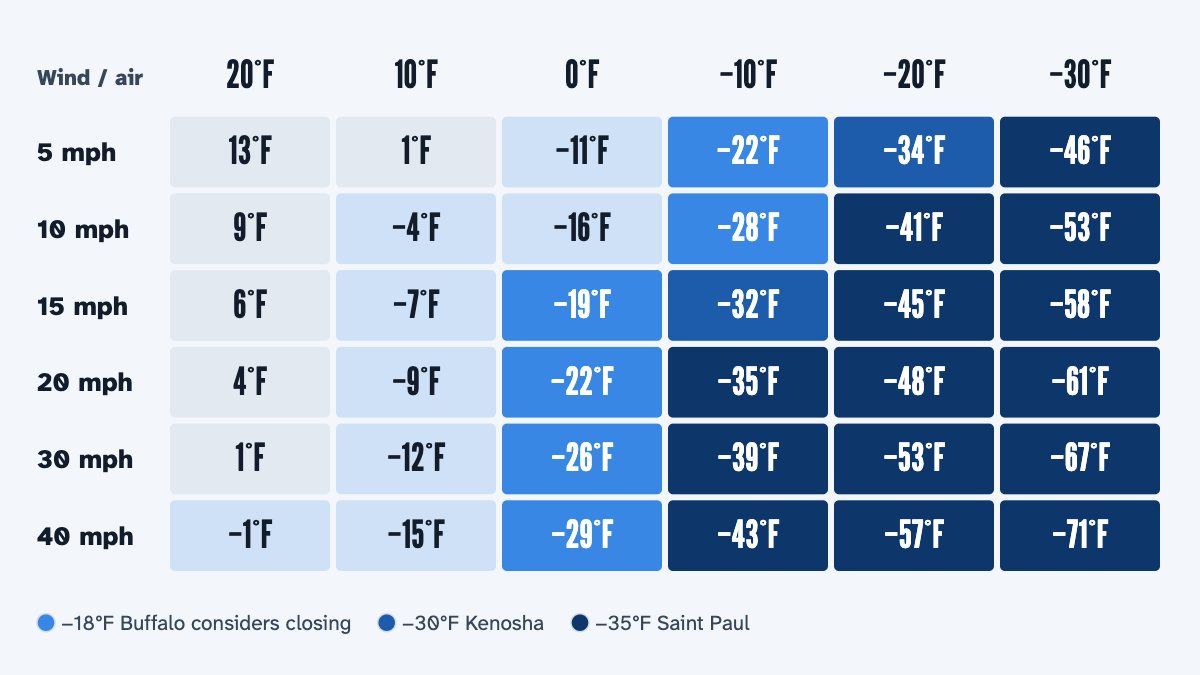
The calculator reads the wind chill from 5 to 9 AM and adds to its chance when the National Weather Service issues an Extreme Cold Warning, which replaced the Wind Chill Warning on or about October 1, 2024, or a Cold Weather Advisory. On the Weather Service’s wind chill chart, 0°F with a 15 mph wind gives −19°F, and exposed skin can freeze in 30 minutes. Wind chill, the chart notes, is defined only at 50°F or colder with wind above 3 mph.
Who decides, and when do Oregon families hear?
Your district decides on the morning itself, and its school board decides whether to count the 16 hours. A district that cuts scheduled time below its 2024–25 or 2025–26 level must give public notice and a written justification, under OAR 581-022-2320.
We have not found an Oregon district’s announcement clock, so check your district’s website, app or local TV and radio for the final word. The calculator reads the Weather Service forecast from 6 AM the day before to 3 PM on the school day, so its chance can change as a storm gets closer.
It is independent: not a school district, the state or the National Weather Service. It shows the reasons behind each chance so you can judge them.
The page at a glance:
Snow days in Oregon
- What closes schools
- 1 inch in Portland
- 1.5 inches in Salem
- 4 inches in Bend
- Where it snows
- Crater Lake 463 inches
- Government Camp 233 inches
- Roseburg none
- School hours
- 900 hours K to 8
- 990 hours grades 9 to 11
- 966 hours grade 12
- New in October 2026
- up to 16 hours for bad weather
- the school board approves
- Waivers and online time
- only after a declared disaster
- 1 hour per course a day
Questions people ask
Do Oregon schools make up snow days?
The state rule counts scheduled hours and states no make-up requirement. Since October 16, 2026, a district may count up to 16 hours lost to extraordinary circumstances such as bad weather, with its school board’s approval, under OAR 581-022-2320.
How much snow does it take to close school in Portland?
About 1 inch overnight, by our rule of thumb: the amount at which Portland schools close about half the time. Ice can do it with less, and only the district decides.
What changed in Oregon’s school-hour rules in October 2026?
A permanent rule took effect on October 16, 2026. It lets a district count up to 16 hours for extraordinary circumstances, including inclement weather, and keeps State Board waivers for declared disasters and public health emergencies only, according to the state’s rule filing.
Can Oregon schools do online learning on snow days?
The rule we read counts teacher-supported online instruction for at most one hour per course per day, and has no snow-day e-learning provision. Your district’s policy says what it does.
Sources: OAR 581-022-2320; Oregon Department of Education rule filing ODE 49-2026; National Weather Service, winter watches, warnings and advisories.
Facts checked October 29, 2026.
More guides
-
-
-
-

-
-