Washington Snow Day Calculator: Hills, Snow and Make-Up Days
By our rule of thumb, 1 to 2 inches of snow closes schools around Seattle about half the time, and about 7 inches in Spokane. Lost days are made up, through June 14 if need be.

- Under 5%
- 5 to 24%
- 25 to 49%
- 50 to 74%
- 75% or more
The next school day in Washington
Worked out from the National Weather Service forecast, 3:07 PM EDT, Thursday.
- Seattle<1% snow dayFriday: no snow
- Spokane<1% snow dayFriday: no snow
- Tacoma<1% snow dayFriday: no snow
- Vancouver<1% snow dayFriday: no snow
- Bellevue<1% snow dayFriday: no snow
- Kent<1% snow dayFriday: no snow
Washington has two snow-day climates. Seattle’s and Tacoma’s normal snowfall is 4.2 inches a year, while Spokane’s is 45.3, by NOAA’s 1991–2020 normals. By our rule of thumb, about 1.5 inches of overnight snow gives schools in Seattle, Tacoma or Bellevue an even chance of closing, while Spokane schools need about 7 inches.
Hills make small storms count. Seattle Public Schools warns that the downtown area may be clear while there is ice and snow in “outlying areas, side streets, and hills.”
The school year is strict. State law requires 180 school days and a set number of hours. A district that loses days to a storm must make a reasonable effort to make them up, including at least three days per closing, to keep its state funding, under chapter 392-129 WAC.
How much snow closes school in Washington?
About 1 to 2 inches in Seattle, Tacoma, Bellevue, Kent and Vancouver, and about 7 inches in Spokane, by our rule of thumb. That is the overnight snow at which schools close about half the time, worked out from each city’s normal snowfall.
Washington's six largest cities: normal snowfall a year (NOAA 1991–2020) and the snowfall and wind chill at which, by our rule of thumb, schools there usually close.
| City | Normal snowfall | Usually closes at | Cold point (wind chill) |
|---|---|---|---|
| Seattle | 4.2 in. a year | 1.5 in. of snow | −8°F |
| Spokane | 45.3 in. a year | 7 in. of snow | −20°F |
| Tacoma | 4.2 in. a year | 1.5 in. of snow | −8°F |
| Vancouver | 3.1 in. a year | 1 in. of snow | −11°F |
| Bellevue | 4.2 in. a year | 1.5 in. of snow | −8°F |
| Kent | 7.4 in. a year | 2 in. of snow | −8°F |
Our rule of thumb: the usual closing point is 0.5 × (normal snowfall a year)0.7, the cold point the normal December–February low minus 45°F. How the calculator works.
The five low-snow cities cluster: Vancouver (3.1 inches a year) is near 1 inch; Seattle, Tacoma and Bellevue (4.2 each) near 1.5; Kent (7.4) near 2. Spokane, at 45.3 inches a year, needs about 7 inches for the same chance, almost five times Seattle’s 1.5.
Two of the calculator’s rules matter here. Snow that falls while it is above freezing counts less, since it tends to leave roads wet. And you can tell the calculator your district closes easily or rarely closes, which moves the closing point; if your schools sit among steep hills like the ones Seattle’s page warns about, the first setting may fit better. More on how the calculator works.
How much snow would close school here?
Philadelphia, PA (about 19 in. of snow a year), with 4 in. overnight: snow day 52%, late start 43%, school as usual 5%. By our rule of thumb, schools there usually close at about 4 in.
Worked out with the calculator's own rules for a plain storm: the snow falls between 9 PM and 6 AM, it is 25°F with little wind, and no Weather Service warning is out. A real forecast also counts timing, ice, cold and alerts.
Try the tool above: pick a city, move the overnight-snow slider, and see how the chances of a snow day, a late start and school as usual shift.
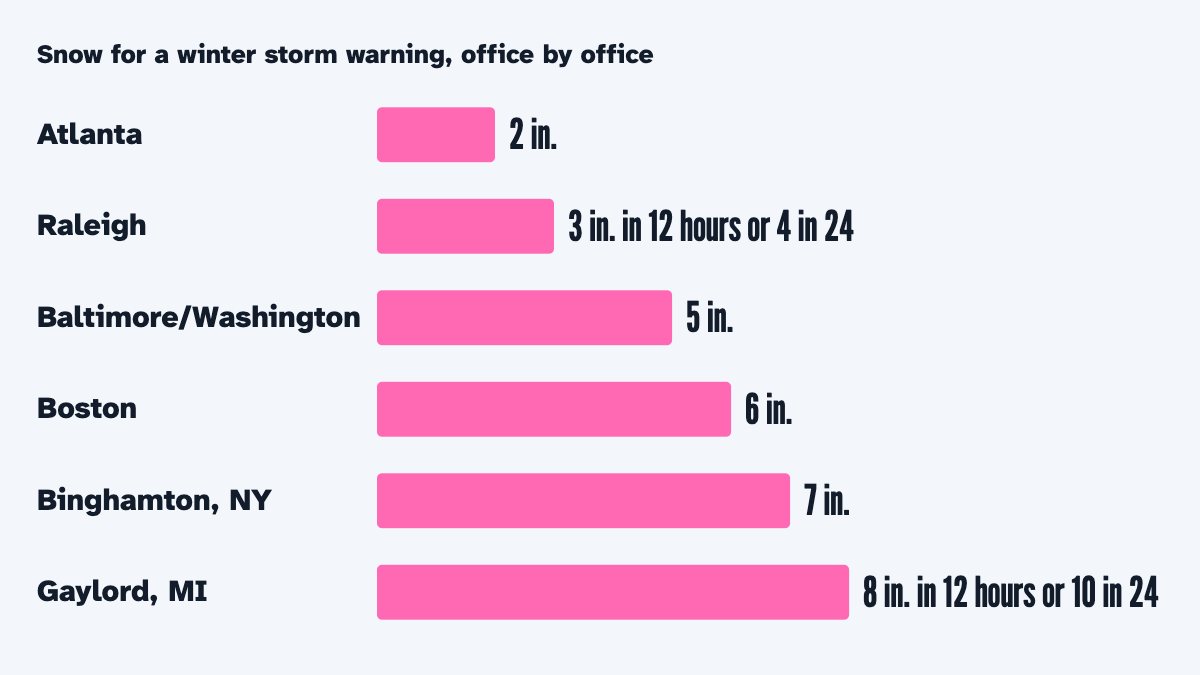
Weather Service alerts feed into the chance too. On the National Weather Service’s winter alerts page, a watch means conditions are favorable for a significant winter storm, an advisory means conditions should not reach warning level, and a warning means “Travel will become difficult or impossible in some situations.” Each local office sets its own snow amounts for these, and the calculator adds the most for a warning.
Where does Washington get the most snow?
In the mountains. NOAA keeps snowfall normals for 89 Washington weather stations, and Holden Village, about 3,220 feet up, leads with 273.7 inches a year. Longmire, in Mount Rainier National Park, averages 143.0; Stehekin 129.7; Mazama 123.1; Plain 117.3; and Leavenworth 80.2.
Normal snowfall a year and normal December to February low at each of the 89 weather stations in Washington with a snowfall normal in NOAA's U.S. Climate Normals for 1991–2020, with each station's location, elevation and how complete its record is.
The 10 snowiest and 5 least snowy of 89 stations in Washington
| Station | Normal snowfall | Dec–Feb low | Elevation |
|---|---|---|---|
| Holden Village | 273.7 in. | 17°F | 3,218 ft |
| Longmire Rainier Nps | 143 in. | 26°F | 2,762 ft |
| Stehekin 4 Nw | 129.7 in. | 26°F | 1,257 ft |
| Mazama | 123.1 in. | 17°F | 2,141 ft |
| Plain | 117.3 in. | 22°F | 1,936 ft |
| Leavenworth 3 S | 80.2 in. | 20°F | 1,128 ft |
| Ross Dam | 66.7 in. | 30°F | 1,236 ft |
| Glenwood #2 | 65.3 in. | 24°F | 1,902 ft |
| Winthrop 1 Wsw | 59.4 in. | 16°F | 1,749 ft |
| Tolt S Fk Reservoir | 55.2 in. | 33°F | 2,000 ft |
| … | |||
| Aberdeen | 0.5 in. | 37°F | 10 ft |
| Port Angeles | 0.4 in. | 37°F | 90 ft |
| Wauna 3 W | 0.3 in. | — | 17 ft |
| Grayland | 0 in. | 37°F | 10 ft |
| Long Beach Experiment Station | 0 in. | 36°F | 25 ft |
Download “Normal snowfall at Washington weather stations, 1991–2020” (CSV, opens in Excel)
Built from: U.S. Climate Normals, 1991–2020 (National Centers for Environmental Information).
Half the stations average 13.5 inches or less. The least snowy, Grayland and Long Beach, average none, and Aberdeen and Port Angeles less than an inch. That range is why the calculator reads the forecast for your own ZIP code rather than a statewide figure.
Do snow days have to be made up in Washington?
Yes. RCW 28A.150.220 requires both a minimum of 180 school days and instructional hours: at least 1,000 for grades 1–8 and 1,080 for grades 9–12. OSPI, the state superintendent’s office, lists 1,000 hours for kindergarten through grade 8 and bases funding on a district-wide average of at least 1,027 hours, on its waiver page.
When a storm or other unforeseen natural event makes schools unsafe, unreachable or unable to operate, RCW 28A.150.290 lets OSPI set terms under which the district keeps its state money. The rule, chapter 392-129 WAC, last changed in 2015, asks for a reasonable effort to make up the lost days: extend the school year to and through June 14, use scheduled vacation days and days set aside for foreseeable closures, and make up “at least three school days, per incident,” with their hours.
If the Governor has proclaimed a state of emergency for a storm that hit district-wide facilities, OSPI may accept the district’s average annual hours instead of the days. Without a reasonable effort, the state cuts the district’s money by the days lost divided by 180.
OSPI’s emergency closure waiver form adds that make-up days can run to and through June 14, that no law sets a last day of school, and that regularly scheduled late-start and early-release hours do not count as instructional hours. The district’s board must review and support the waiver request, and the superintendent signs it.
Can Washington schools switch to remote learning instead?
Not under the rules we read. Neither law (RCW 28A.150.220 and .290), nor chapter 392-129 WAC, nor OSPI’s waiver page and form says a remote day can replace a day lost to a closing. If your district offers remote days, its own policy is the place to look.
How cold does it have to be to close school in Washington?
By our rule of thumb, a wind chill near −8°F at bus time in Seattle, Bellevue, Tacoma and Kent, −11°F in Vancouver and −20°F in Spokane. That is each city’s normal December–February low minus 45°F. We have no Washington district’s own cold number on file.
The calculator reads the wind chill from 5 to 9 AM and adds to its chance when the National Weather Service issues an Extreme Cold Warning, the name that replaced the Wind Chill Warning on or about October 1, 2024, or a Cold Weather Advisory. The Weather Service’s wind chill chart notes that frostbite needs the actual air temperature to be below freezing, so a windy morning above freezing is not a frostbite risk, however cold it feels.
Who decides, and when do Washington families hear?
Each district decides. Seattle Public Schools publishes a clear overnight clock: at about 2 a.m., district staff drive set routes; at 3 a.m., the drivers report to supervisors, who recommend a normal day, a two-hour late start or a closure; and the target for a decision is 5 a.m.
On a late-start day, Seattle buses use snow-route stops on main roads that the city clears first. If weather turns during the day, the superintendent decides by 11 a.m. whether to send students home early.
Check your district’s website, app or local TV and radio for the final word. The calculator is independent: not a school district, OSPI or the National Weather Service. It reads the Weather Service forecast from 6 AM the day before to 3 PM on the school day, so its chance can change overnight, just as the road reports do.
The page at a glance:
Snow days in Washington
- What closes schools
- 1.5 inches in Seattle
- 7 inches in Spokane
- hills and ice
- School year
- 180 days
- 1,000 to 1,080 hours
- a 1,027-hour average
- Make-up
- to and through June 14
- 3 days per incident
- hours after an emergency
- Remote days
- not in the rules we read
- check district policy
- Seattle mornings
- roads checked at 2 a.m.
- decision by 5 a.m.
- early release by 11 a.m.
Questions people ask
Do Washington schools have to make up snow days?
Yes. A district that wants to keep its state funding after a closing must make a reasonable effort to make up the days, including at least three school days per incident, under chapter 392-129 WAC.
How much snow does it take to close school in Seattle?
About 1.5 inches overnight, by our rule of thumb. Hills, ice and timing matter as much as depth, and Seattle Public Schools checks the roads overnight before it decides.
What time does Seattle Public Schools announce snow closures?
Its target is 5 a.m., after staff drive set routes at about 2 a.m. and report at 3 a.m., says its transportation plan.
Can Washington schools go past June 14 to make up snow days?
Yes. Extending the year to and through June 14 is part of the reasonable effort the state expects, and OSPI’s waiver form says no law sets a last day of school.
Sources: RCW 28A.150.220; Chapter 392-129 WAC; Seattle Public Schools, inclement weather transportation plan.
Facts checked October 29, 2026.
More guides
-
-
-
-

-
-